NIST CSF 2.0 Govern and Protect Functions in Endpoint Programs
Govern establishes the policies that Protect must enforce on endpoints.
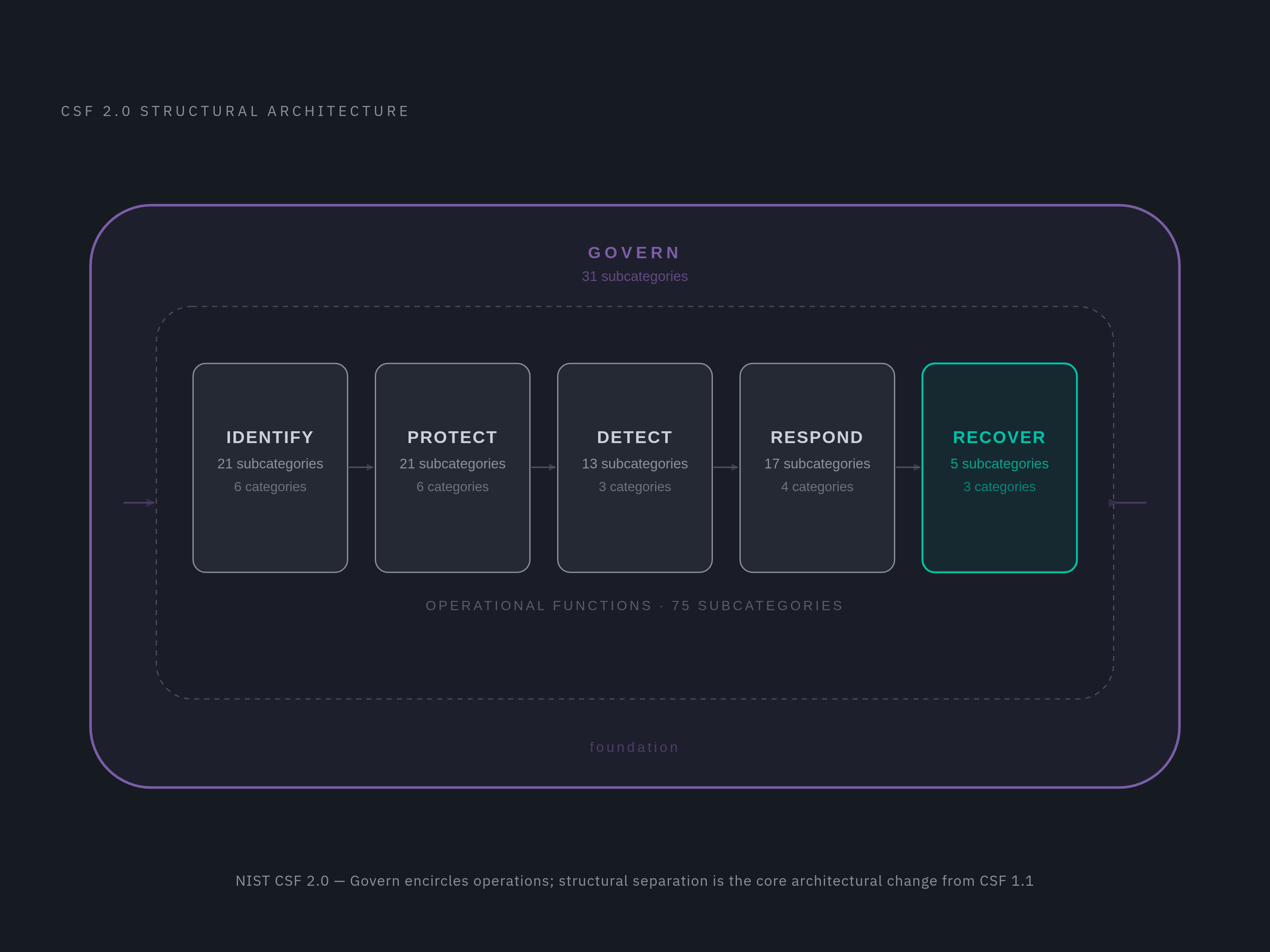
NIST's Cybersecurity Framework 2.0, published February 26, 2024, restructured the model into six functions: Govern, Identify, Protect, Detect, Respond, and Recover. The old version, CSF 1.1, ran five functions, 23 categories, and 108 subcategories. The new version has 22 categories and 106 subcategories, so the total count barely moved. What moved is the shape of the thing. Govern is entirely new, carrying 31 subcategories on its own, and in NIST's own diagrams it sits around the other five functions rather than beside them, because it's meant to be the foundation the rest of the framework stands on.
Endpoint programs touch all six functions in practice. Assets get counted under Identify, configurations get enforced under Protect, odd behavior gets flagged under Detect, incidents get contained under Respond, and clean states get restored under Recover. But Govern and Protect do the heavy lifting that everything else depends on. Govern writes the rules: who owns what, what risk the organization will tolerate, who signs off on exceptions. Protect carries those rules out: patching, access control, configuration enforcement, encryption. A Protect control with no Govern backing is just a habit some admin picked up. A Govern policy with no Protect execution is a PDF nobody follows.
CSF 1.1 scattered policy guidance across several categories, so a security team could point to fragments of governance without ever assembling a coherent picture. CSF 2.0 pulls all of that into one function, which makes the split between "we decided this" and "we did this" visible and checkable. That distinction matters more than it sounds like it should, because it's exactly what auditors and insurers now go looking for first.
One dependency worth flagging early, since it shapes everything that follows: Identify feeds Protect. The asset inventory and vulnerability data a team builds under Identify tell Protect where to spend its effort first. Govern still sets the destination; Identify tells Protect which road gets paved before the others.
What the Govern function actually requires at the organizational level
Govern breaks into six categories, and each one answers a different question about how an organization runs its risk decisions.
GV.OC, organizational context, asks what circumstances shape the risk decisions being made: mission, stakeholder expectations, legal obligations, dependencies on other systems or vendors. GV.RM, risk management strategy, sets how risk gets measured, ranked, communicated, accepted, avoided, reduced, or handed off to someone else through insurance or contract. That risk appetite is the thing every downstream Protect control is supposed to serve.
GV.RR assigns roles, responsibilities, and authorities, and it does something the old framework never forced: it puts names on cybersecurity outcomes outside the security team. Boards, business unit heads, legal, procurement, HR, all get explicit roles. GV.PO, policy, is the mechanism that turns a GV.RM decision into something an operations team can actually follow day to day. GV.OV, oversight, is brand new in 2.0. It requires regular review of how the whole risk management effort is performing, which is what keeps governance from turning into a document nobody revisits after the audit.
Then there's GV.SC, supply chain risk management, the single most detailed category in the entire framework at ten subcategories, over 9% of everything CSF 2.0 covers. GV.SC-01 requires a documented supply chain risk program that stakeholders have actually agreed to. GV.SC-02 requires that cybersecurity roles for suppliers, customers, and partners get spelled out and communicated, not assumed. For endpoint programs specifically, this matters because every agent, every management console, every piece of hardware running on a managed device came from a vendor, and GV.SC is the category that governs what gets let onto the network in the first place.
The design intent behind all six categories is the same: move cybersecurity out of IT's back office and into the enterprise risk conversation the board already has. That design intent reinforces the same idea from a different angle: risk registers should aggregate consistently, so a director gets a clean view of exposure across systems while the people doing the work still know what the enterprise actually needs from them.
There's a cost signal behind all this that's worth sitting with. According to Compass MSP, organizations with high security system complexity, often a symptom of governance that never got written down, faced average breach costs of $3.84 million, measurably above what simpler, better-governed architectures paid. Complexity isn't just annoying to manage. It's a line item.
How Govern's categories translate into endpoint-specific policy obligations
GV.RM decides how long a critical vulnerability can sit unpatched. A risk-tolerant organization might accept a 30-day window. A risk-averse one might demand 72 hours. Neither number is inherently right; what's wrong is having no documented decision at all and letting whichever admin is on shift make the call.
GV.PO is where acceptable use rules, device enrollment requirements, BYOD terms, removable media restrictions, and configuration baselines have to exist as written, approved policy, not as the unwritten convention that "everyone just knows" until someone new joins the team and doesn't.
GV.RR answers the accountability questions an auditor will ask on day one: who approves a change to the configuration baseline, who can grant an exception to the patch SLA, who owns the device inventory. If nobody can answer those questions in writing, the audit evidence gap is already there, no matter how good the tooling looks.
GV.OV is the review cycle that catches drift between what the policy says and what's actually happening on devices. Without it, a patch SLA written eighteen months ago might have quietly stopped matching reality months back, and nobody would know.
GV.SC applied to endpoints means every EDR vendor, MDM provider, and hardware OEM gets treated as a supply chain node, not a vendor relationship closed out after a one-time questionnaire. That distinction has teeth. Gartner projected that by 2025, 45% of organizations worldwide will have experienced a software supply chain attack, a threefold jump since 2021. Third-party exposure accounted for 35.5% of breaches in 2024. Those numbers point straight at the tools sitting on the endpoint itself: the agent, the console, the update mechanism.
This is the audit-readiness point worth underlining: an auditor checks Govern outcomes first. Policy documents, role assignments, risk appetite statements, oversight records, that's the evidence base. Deploying more endpoint controls doesn't close a gap that only a written policy can close.
What the Protect function covers and where endpoints concentrate the work
Protect has five categories, and it's the function where endpoint programs spend most of their daily operational effort.
PR.AA, identity management and access control, governs how access to systems and devices is managed and enforced. PR.AT, awareness and training, addresses the human side of endpoint risk. PR.DS, data security, covers how data is protected across its lifecycle on managed devices.
PR.PS, platform security, is the category most directly shaped by what Govern decided upstream: the patch SLA from GV.RM, the approved baseline from GV.PO, the change authority from GV.RR, all of it executes through PR.PS. PR.IR, technology infrastructure resilience, addresses the design choices that shrink the blast radius when one endpoint gets compromised anyway.
Most Protect outcomes get delivered physically at the endpoint. That's where the configuration actually lands, where the patch actually installs, where the login actually gets checked, where the disk actually gets encrypted. A program with strong Protect tooling but a thin Govern layer underneath it produces a specific, predictable failure pattern: controls quietly drift from whatever the policy originally intended, exceptions pile up with nobody having approved them, and there's no mechanism built in to notice.
The operational connection between Govern policies and Protect controls
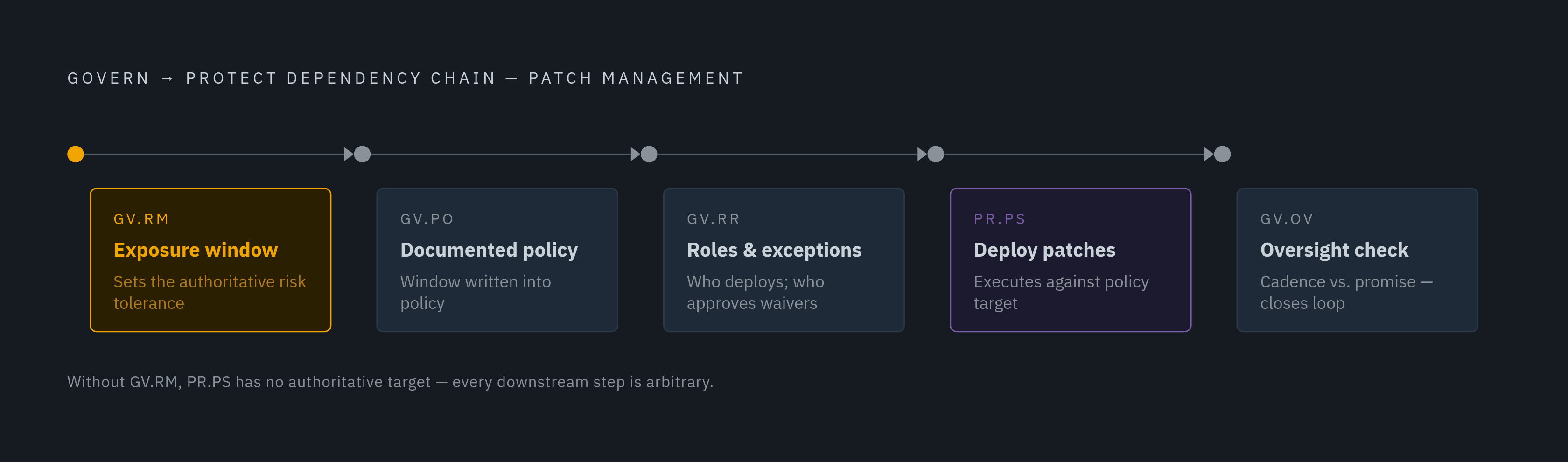
Patch management shows the Govern-to-Protect chain most clearly. GV.RM sets the acceptable exposure window. GV.PO writes that window down as policy. GV.RR names who deploys patches and who can grant an exception. PR.PS does the actual patching against that policy. GV.OV checks later whether the real patch cadence matched what was promised. Skip the first step and PR.PS has nothing authoritative to aim at; teams end up patching whenever it's operationally convenient, which is a nice way of saying whenever nothing more urgent is on fire.
Configuration baselines work the same way. GV.PO sets the approved baseline, say a specific CIS Benchmark level. PR.PS enforces it through MDM or a configuration management tool. GV.OV catches deployed configurations drifting away from that baseline over time. Without GV.PO's approval sitting behind it, there's no reference point at all, and drift can't be measured because there's nothing to measure it against.
Identity and access control follows the same logic. GV.RR decides who holds privileged access authority and under what conditions. GV.PO sets the least-privilege and acceptable use policy. PR.AA enforces those rules at the account and device level. Privilege creep, the slow accumulation of access rights beyond what a role actually needs, is as much a Govern failure as a Protect one; the ownership structure meant to stop it lives in GV, not in PR.
The feedback runs both directions. Protect's execution generates the evidence GV.OV needs to judge whether the governance is actually working: drift reports, exception logs, patch compliance rates all flow back into oversight. Platforms that manage devices, identity, and policy enforcement under one data model make that loop easier to close, since oversight can query the actual state of controls directly instead of stitching together reports from three or four disconnected tools. Zip is one such platform, deploying a company's full security program, device management, identity, and endpoint enforcement, as a single managed service.
Where endpoint programs typically break down across these two functions
The most common failure looks like this: EDR is installed, MDM has every device enrolled, the patching tool runs on schedule, and none of it has a documented SLA, an approved baseline, or a named owner for exceptions behind it. The controls exist and even work reasonably well day to day. They just can't be audited, because there's no paper trail connecting them to any decision anyone made.
The mirror-image failure shows up too: policy documents exist, acceptable use is written down, patch timelines are specified, configuration standards are on file, but no tool actually enforces any of it and no report measures compliance against it. That kind of policy is unfalsifiable. Nobody can confirm it's being followed and nobody can prove it isn't, because there's no evidence either way.
Fragmented tool stacks turn into a governance failure of their own. When patch management, identity, device inventory, and configuration enforcement each live in a separate tool owned by a separate team, GV.RR accountability gets fuzzy fast, and GV.OV oversight turns into manual reconciliation across reports that don't share a common format. That IBM figure from 2024, the $3.84 million average tied to high system complexity, is exactly this pattern showing up as a cost line.
Supply chain blind spots are a Govern-specific gap. Organizations that treat endpoint tooling vendors as interchangeable commodities, rather than as supply chain nodes under GV.SC, are carrying unassessed third-party risk on every device they manage. And since GV.OV is new to CSF 2.0, plenty of organizations simply don't have a review cadence yet. Without one, governance sits still while the risk it's supposed to track keeps moving.
Building an endpoint program that satisfies both functions together
Start with Govern, not with tools. Buying endpoint controls before the policy and accountability structure exists is the mistake that produces everything described above. Document organizational context and regulatory obligations under GV.OC first, since that determines which controls even apply and how strict they need to be. Set the risk appetite for endpoint exposure under GV.RM, covering patch windows, tolerance for configuration drift, and how access exceptions get handled. Name an owner for each endpoint control domain under GV.RR: patch, configuration, identity, supply chain, one person or role accountable for each.
From there, build the policy artifacts Protect will actually execute against: an approved configuration baseline with a documented approval authority, patch SLAs by severity tier with a named exception approver, a device enrollment and acceptable use policy, and vendor assessment requirements for anything running as an agent or console on a managed endpoint.
Then deploy Protect controls that generate evidence against those specific policies, not just controls that seem reasonable in isolation. PR.PS needs to produce compliance reporting measured against the GV.PO baseline, not a vague sense that "things are patched." PR.AA needs to enforce the exact least-privilege structure GV.RR defined, not a looser version of it. PR.DS needs encryption and data handling that matches the classification scheme the organization actually adopted.
Built in that order, an endpoint program stops being a pile of tools defended after the fact and becomes something closer to what CSF 2.0 was written to produce: a chain of decisions, each one traceable back to the one before it, with evidence at every link.