Vendor Sprawl Risk in SMB Security Stacks
Unmanaged apps and disconnected security tools leave SMBs exposed to costly breaches.
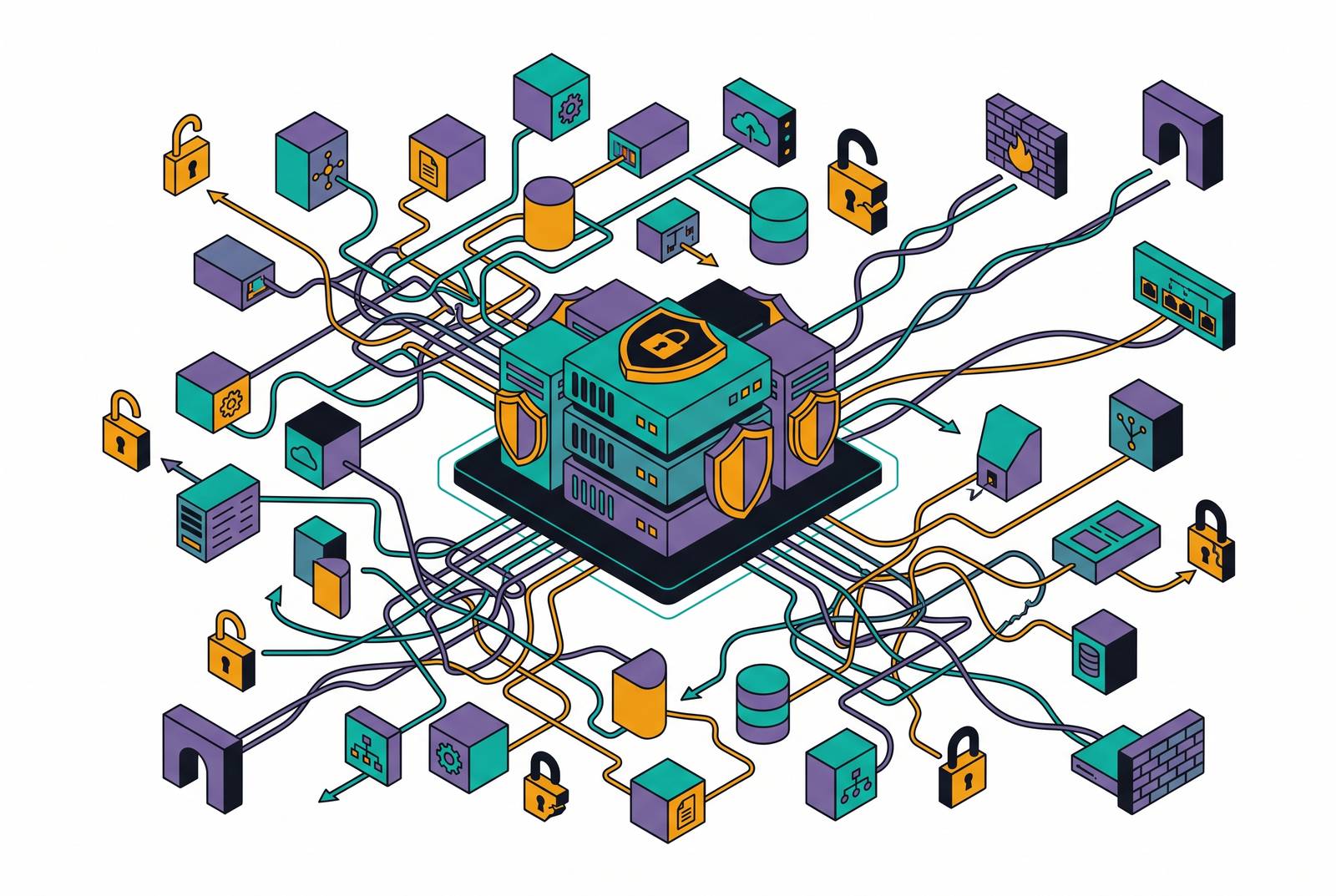
Most organizations now run more than a thousand cloud apps, and IT typically sees fewer than one in ten of them. Nudge Security has surfaced more than 70,000 unique SaaS apps across customer environments, many holding access to sensitive company data, almost none of them watched by anyone. Hybrid work made this worse: a free-tier signup takes thirty seconds, clears no procurement review, and sits in production before IT ever hears its name. That's the whole mechanism of shadow IT in one sentence, and it repeats daily across companies too small to have anyone whose job is to notice.
Three blind spots stack on top of each other here, and each does its own kind of damage. The visibility gap comes first: apps the security function doesn't even know exist. The control gap follows, where apps run with no MFA, no SSO, no log of who touched what. Then there's the response gap, and this one costs the most when it matters, because when an incident touches an app nobody catalogued, containment stalls and nobody can say with any confidence how far the exposure reaches.
Underneath all three, the identity problem compounds quietly. Unmanaged SaaS leaves orphaned accounts behind, former employees whose credentials still open the door months after they've left, because an app sitting outside the identity provider was never tracked on the way in. Nobody can revoke what was never logged. Compliance exposure follows the same shape: an app outside IdP governance can simply fail to meet GDPR, HIPAA, or SOC 2 requirements, and the business carries that liability without knowing it exists.
The IBM Cost of a Data Breach Report 2025 puts a number on where this is heading. Twenty percent of breaches involved shadow AI tools specifically, adding roughly $670,000 to the average cost of a breach. Shadow IT is migrating into categories most SMBs haven't started to govern, even as some companies finally get a handle on the older, more familiar version of it.
The specific ways disconnected tools degrade actual security
More tools were supposed to mean more coverage. That bet didn't pay off. Adding tools without integrating them creates an inventory problem wearing a security budget, and the industry has already run this experiment: 58% of organizations now run more than 25 security tools, and breach frequency and cost kept climbing anyway. The tooling grew faster than the outcomes did.
The failure sits in integration. Each product does its job fine in isolation, but tools that don't share data produce alerts that don't correlate, and the space between two disconnected systems is exactly where a threat moves without tripping anything. Sixty-five percent of organizations say they're running too many security tools; 53% say those tools can't be integrated with each other. That's the same problem counted from two directions.
Alert volume is where this stops being abstract. The average SOC receives something like 960 alerts a day, with false-positive rates running between 50% and 80%. That load is brutal even for a staffed operations center with analysts on rotation. For an SMB with no dedicated security person, the volume doesn't get triaged poorly; it gets ignored wholesale, structurally, because nobody's day was ever built around sorting through it. Picture the queue itself: alerts stack up unopened, not because someone chose to skip them, but because the job of opening them belongs to no one. Alert fatigue in that setting looks like an empty inbox nobody checked.
Governance rot sets in right alongside the alert problem. When no single person owns a vendor relationship, that tool becomes a forgotten line item that auto-renews every year without anyone checking whether it's still needed or still configured correctly. Patch cycles slip because tracking the vendor's update schedule was never anyone's job. Then an incident touches that tool, and the team realizes nobody actually knows what data it holds or what else it connects to. That coverage gap never shows up on a dashboard, because dashboards report what tools catch. What falls between them stays invisible, by definition.
Why SMBs are the primary target for the attacks that sprawl enables
Small businesses take a disproportionate share of the attacks aimed squarely at them, and the numbers converge from more than one source. TechAisle found that 43% of US SMBs faced at least one cyberattack in the past year; Hiscox put the figure for businesses under 250 employees at 40%. External actors are behind 91% of breaches at small organizations, and the motive is financial almost every time. The pattern points to deliberate targeting rather than opportunistic drift-by damage.
Ransomware makes that targeting explicit. Eighty-two percent of ransomware attacks in the period studied hit companies with under 1,000 employees. Ransomware was a factor in 44% of all data breaches in 2025, up from 32% the year before, an acceleration in a trend that was already moving one direction. Third-party compromise has doubled to account for 30% of all breaches, per the Verizon DBIR. The vendor relationship has become an attack vector in its own right, and treating vendors as a procurement question rather than a security one is the mistake underneath most of these numbers.
Sixty-one percent of SMBs, according to Vanson Bourne, worry that a serious attack could put them out of business entirely. That fear runs well ahead of the defenses most of these companies actually have, and the gap says something uncomfortable: instinct has outpaced infrastructure. Attackers don't need to out-engineer a sophisticated defense. They need one place where two tools in the stack don't talk to each other, and sprawl guarantees that place exists somewhere.
How third-party vendor risk turns each tool in the stack into a potential entry point
SecurityScorecard found that 35.5% of 2024 breaches originated from third-party compromise, up 6.5 points from the year before. The vectors involved are ordinary, and that's what should worry a small business more than any zero-day headline. File transfer software accounted for 14% of all third-party breaches in 2024, cloud products and services came in at 8.3%, payment card data breaches sat at 7.25%. These are tools SMBs use every day without a second thought, which is precisely the point: nobody treats the file-transfer app as an attack surface until it is one.
Seventy percent of cybersecurity professionals surveyed by ISC2 said their organizations worry about third-party supplier risk. That's concern coming from people who already have security roles and security budgets. Asking an SMB that doesn't even understand its own risk profile in isolation to layer third-party vendor assessment on top, with no dedicated function to run it, is closer to a wish than a plan.
Every vendor added to the stack is a relationship the business implicitly trusts with some slice of its data or infrastructure, and that trust almost never gets revisited once the contract is signed. Vendor count is a direct multiplier here. More vendors means more potential breach surfaces the business has no active way to watch, and the multiplier runs unchecked precisely because nobody owns the job of checking it.
The confidence gap — why most SMBs don't know how exposed they actually are
The Devolutions 2024–2025 State of IT Security in SMBs survey found 71% of respondents confident in their ability to handle a major security incident, but only 22% describe their organization's posture as advanced. That's the widest gap between confidence and readiness the survey has recorded, and it points to something closer to a perception problem than a knowledge gap. A long tool stack feels like protection. It looks like a mature program from across the room, and even up close, it's hard to notice what isn't covered when every category on paper has something assigned to it.
The underlying controls tell a plainer, less flattering story than the confidence numbers do. Fifty-two percent of SMBs still manage privileged access manually, through spreadsheets, shared vaults, or nothing formal at all, despite privileged access management being about as foundational a control as security has. Nearly 60% of SMBs never run security awareness training, one of the highest-return, lowest-cost risk reductions available to any organization regardless of size. Forty-three percent lack network-based firewalls even as cybersecurity spending has risen industry-wide, which means the money is going somewhere other than the controls that matter most.
The plain read on that gap: confidence like this gets inherited from the size of the stack, not earned through testing. For a company with no security team, nobody's job is to step back and ask whether the stack functions as a whole or just as a pile of individually reasonable purchases. That question never gets asked until the incident forces it.
What a breach actually costs an SMB when the stack fails
Breach costs for SMBs have climbed meaningfully year over year, and the financial damage from a single incident can be severe. Preventive spending runs a fraction of breach costs, which makes the math on prevention straightforward even for a company with no security budget line to point to. The cost of a single incident can reach well into the hundreds of thousands for an SMB with limited reserves, and it frequently passes straight through to customers instead of staying contained inside the business.
Downtime carries the real financial wound, and this is where most SMBs are watching the wrong number. Downtime and operational disruption routinely dwarf the ransom demand itself, which means the figure everyone fixates on is usually the smallest line item in the total loss. Fixating on the wrong number is its own kind of exposure.
Trust doesn't come back easily either. Consumer trust doesn't come back easily after a breach, and businesses that expose customer data often find the reputational damage outlasts the operational recovery. For small businesses operating with little or no cybersecurity budget, a breach is frequently the event that ends the company. The 61% of SMBs who already fear a serious attack could close them down have the math right.
What consolidation actually means in practice for a company running without a security team
Vendor consolidation has become a mainstream response across organizations of all sizes, driven by the mounting cost and complexity of managing sprawling tool stacks. Security improvement tends to lead the rationale, with operational relief and cost savings compounding on top, and that ordering shows consolidation functioning primarily as a security decision that happens to save money.
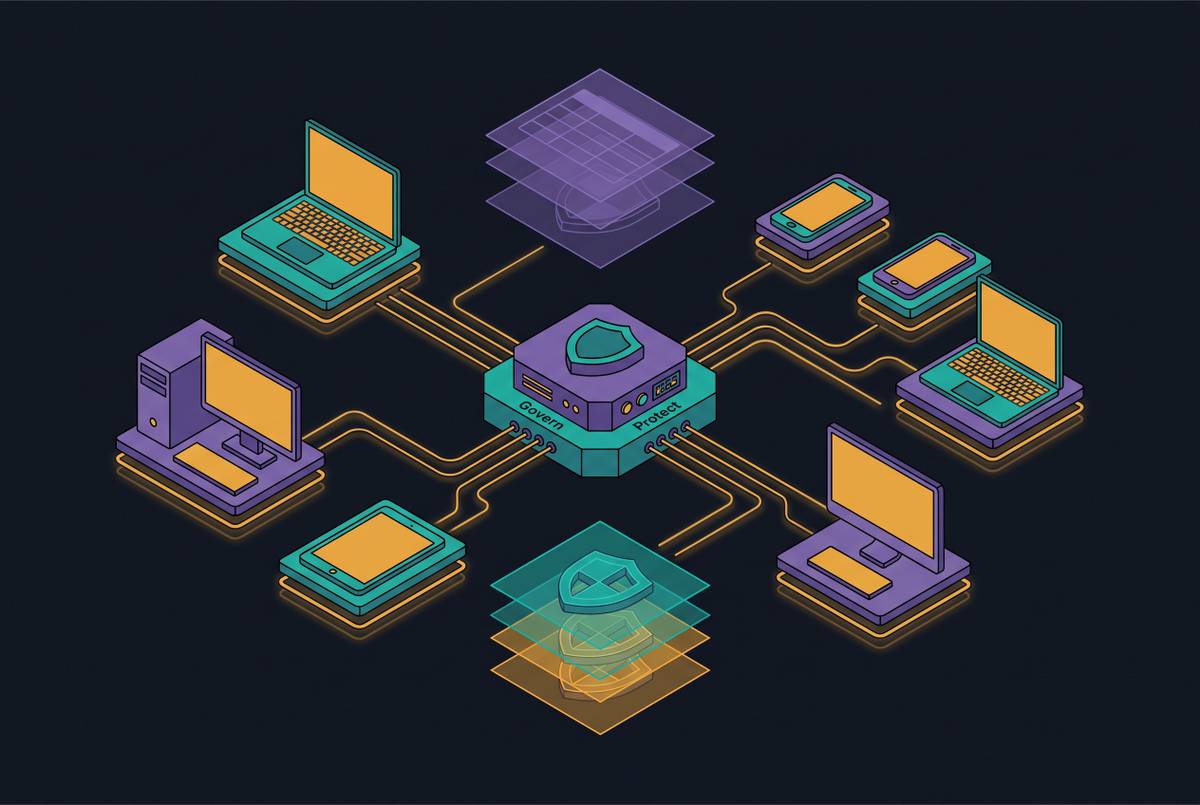
For a company without a security team, consolidation has a plain, practical meaning: fewer dashboards to check every morning, fewer vendor contracts to negotiate and renew, fewer integration points that can fail silently in the background. A consolidated posture brings device management, endpoint security, identity protection, and compliance into one data model, so alerts correlate instead of piling up in separate, disconnected queues. It means one vendor relationship to evaluate for third-party risk instead of dozens, and policy enforcement that holds steady across the environment instead of drifting tool by tool, configuration by configuration.
The first steps are unglamorous, and that's the point: boring, thorough effort carries more weight here than a clever fix. Audit every purchasing channel to find the actual vendor list, not the one procurement thinks exists; organizations typically discover 30 to 50% more vendors than expected once they look across all purchasing channels, not just the procurement system. Assign a named owner to every vendor relationship still in use, because tools without an owner are exactly the ones that auto-renew quietly and drift out of governance. Map which tools actually share data with each other and which sit isolated, since the isolated ones are where the gaps live.
After that, the discipline is subtraction. Prioritize cutting point solutions that duplicate coverage in the same category over buying anything new, no matter how good the pitch sounds in the room. Adding another tool to fix a gap left by the last unmanaged tool is how the sprawl started in the first place, and repeating that move under a new vendor name doesn't count as progress. A working stack earns its keep through alerts that mean something, produced by a system where coverage stays continuous and visible to someone who has never held a security title in their life.