Zero-Day Vulnerability Exposure Windows on Unpatched Endpoint Fleets
Behavioral detection bridges the gap between zero-day discovery and patch deployment.
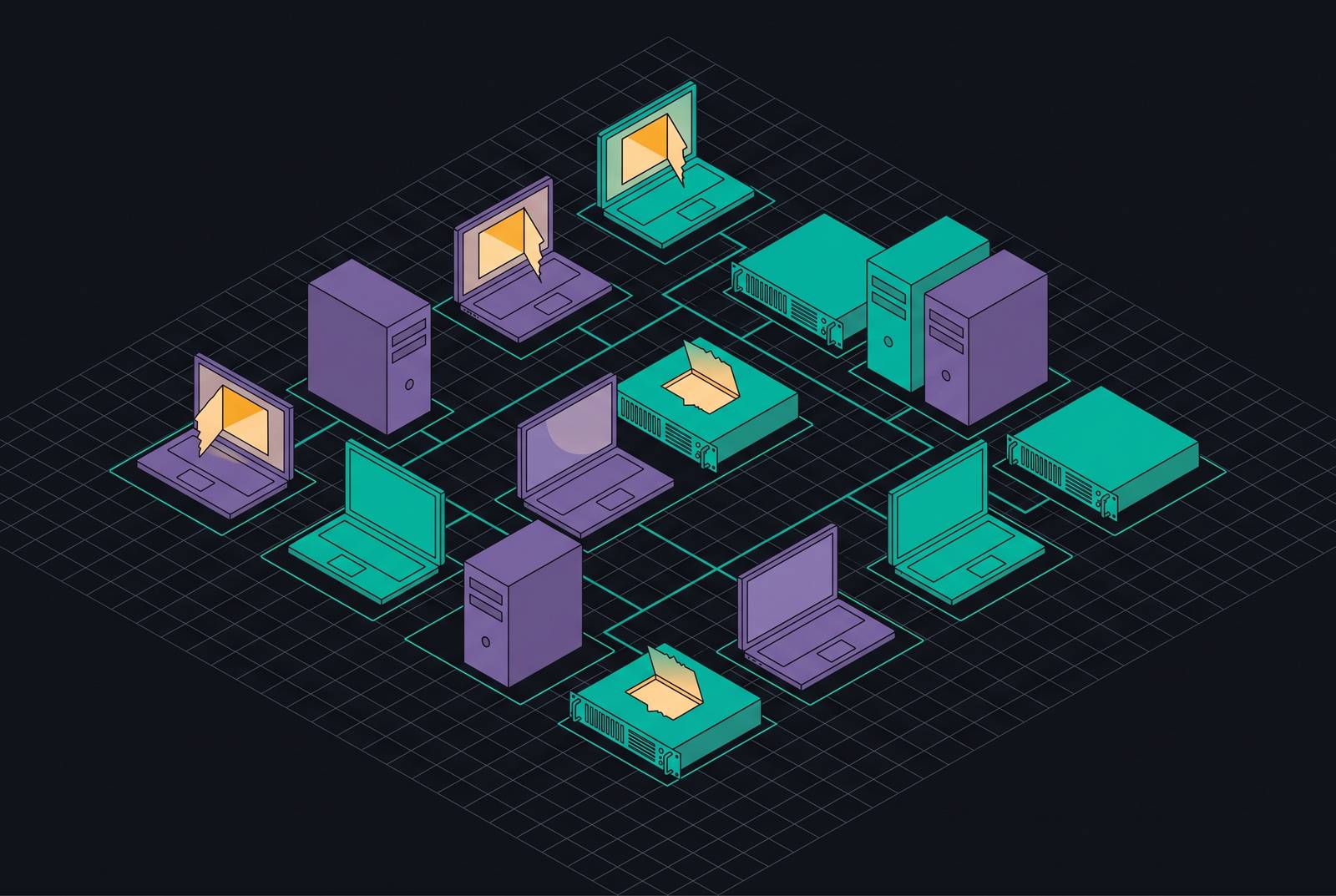
Zero-day vulnerability exposure windows on unpatched endpoint fleets are a timing problem. Attackers can act before there is a fix, while businesses may need weeks to get that fix onto every affected device. Businesses can cover both gaps with behavioral detection before patches arrive, then deploy the patches in priority order and check that they are in place.
How the exposure window actually forms — the gap between attacker speed and defender patching cadence
Attackers and defenders work on separate clocks. Mandiant's M-Trends 2026 estimates the mean time to exploit in negative days in 2025, meaning exploitation routinely begins before a patch exists. Verizon's 2026 DBIR found that median remediation time for vulnerabilities in CISA's catalog rose from the prior year, with only a quarter of those vulnerabilities fully remediated. One side can start before a fix is available, while the other must wait for that fix and then deploy it. That mismatch produces a repeating gap.
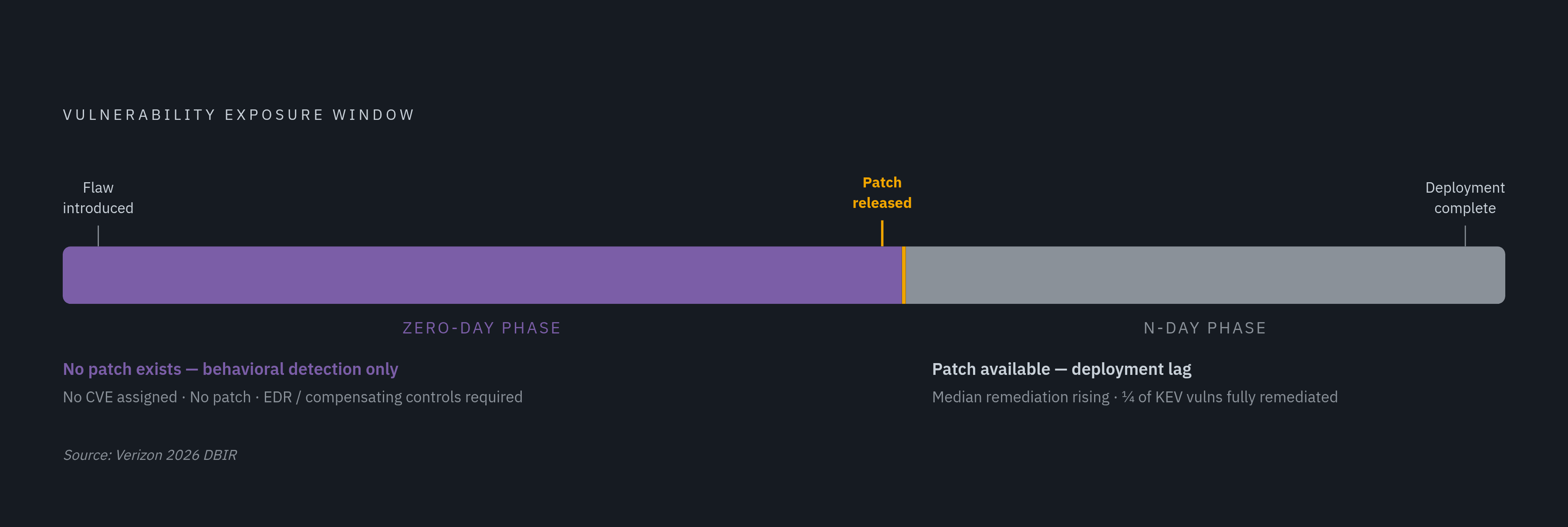
The exposure window starts when the flaw exists, before disclosure, before a CVE is assigned, and before a patch becomes available. Its first part is the zero-day phase, when only compensating controls can act, followed by the n-day phase, after a patch is released but before deployment is complete. This is where most successful post-disclosure exploitation occurs, because attackers know what to hit and defenders still have work to finish.
That distinction matters because faster patching addresses only one part of the problem. Even a business ready to install a fix at once has to wait until there is a patch.
Why unmanaged endpoint fleets make the n-day window structurally longer
Manual work consumes the time between a patch becoming available and a device becoming protected. Someone has to discover which devices are affected, test compatibility, schedule change windows, and confirm completion. On an unmanaged fleet, each of those steps can add days.
The process takes longer when different kinds of devices are outside the same management system. Edge devices, VPN gateways, and firewalls are major exploited surfaces, but they typically do not fall under the tools used to update workstations. A workstation rollout can therefore make progress while the network edge remains exposed. Verizon's 2025 DBIR found that edge device exploitation made up a much larger share of exploitation breaches than in past years. It also found that only roughly half of vulnerable edge devices were fully patched in the observed window.
The last devices are often the hardest to reach. They may be offline, unregistered, or employee-owned, which makes an apparently successful rollout less complete than it looks. Applying a patch to nearly all devices leaves the remainder fully exposed. That remaining tail is why deployment and completion are different milestones, and why unmanaged fleets can spend so long between them.
Where attackers actually enter — the endpoint categories most exploited inside these windows
Enterprise security and networking products show how a protection system can also become an entry point. GTIG's 2025 Zero-Days in Review recorded 21 exploited zero-days in VPN appliances, firewalls, remote access gateways, and other products in this category. It was the single largest enterprise sub-category exploited in 2025, though operating systems were still the largest category overall. Verizon's data shows an eightfold increase in exploitation reaching these devices. Their role at the network boundary makes their patching delays especially consequential.
Browser environments create another recurring opening. HP Threat Research confirmed eight actively exploited Chrome zero-days in 2025 that affected all browsers built on the same browser codebase, including Edge and Opera. It recorded a cumulative vulnerability window of at least 87 days, nearly a quarter of the year. Browsers are a familiar part of the fleet where repeated exposure makes detection important between updates.
The ToolShell SharePoint chain, CVE-2025-53770, was exploited shortly before disclosure by multiple APT groups and ransomware operators, enabling unauthenticated remote code execution and full control of compromised SharePoint servers. Confirmed victims included government agencies. A Qilin ransomware affiliate also exploited an authentication bypass in Check Point Remote Access VPN beginning May 7, 2026, a full month before public disclosure. Across the most exposed targets, the recurring pattern is internet-facing access, gaps in endpoint detection and response coverage, and slow patching.
Why small and midsize businesses are the primary population exposed by these windows
These attack surfaces become harder to defend when the same small team has to keep the business running and manage every security response. Many small and midsize businesses lack dedicated security staff to triage CISA's Known Exploited Vulnerabilities catalog, or KEV. They may also lack an automated deployment pipeline and a complete endpoint inventory. These gaps make the n-day phase longer before anyone decides what to do about a given patch. With little endpoint detection, these businesses also have less protection while they wait.
The 50-to-250-employee profile illustrates the mismatch. Cloud apps and remote access are widely used, but there may be no full-time security lead to oversee them. The business is big enough to draw ransomware operators but still has too few staff to close basic gaps. Flat networks with limited segmentation also give an intruder more room to move after entry.
Unpatched vulnerabilities were the most common technical entry point for ransomware in 2025, ahead of compromised credentials and phishing. That connects patching cadence directly to ransomware exposure.
What behavioral detection does that patching alone cannot, and why it matters inside the zero-day phase
When no patch exists, the available defense must address what an attacker does after entry. Detection that relies on a known exploit pattern may fail to spot an exploit that has not been seen before. But post-exploitation behavior is often well documented and stays much the same. Lateral movement, credential dumping, unusual process trees, and LSASS access map to known MITRE ATT&CK techniques regardless of the initial route in. The unknown flaw can lead to recognizable actions.
Managed endpoint detection and response, or EDR, uses behavioral analysis to act on those actions. It does not repair the vulnerability. Instead, it can interrupt the attack before ransomware deploys or data is exfiltrated. This makes it a compensating control for the period patching cannot cover.
Other controls limit what can happen after that first foothold. Least-privilege access cuts the permissions an attacker can abuse, while network segmentation limits how far they can move into other systems. Application allowlisting prevents unauthorized executables from running. That control would have blocked the fake ChatGPT Desktop delivery mechanism used in the CLFS exploit campaign. Together, these measures address the consequences of an exploitable flaw while the flaw itself remains unresolved.
How to shorten the n-day window — prioritization over completeness
Once there is a patch, the job shifts from limiting the harm from an unknown exploit to closing a known opening. Most organizations cannot patch the tens of thousands of CVEs disclosed each year, and treating them all as equally urgent wastes the little time and staff they have. Most CVEs are never weaponized. The useful target is the subset attackers are actively using and can reach in the business's environment.
CISA's KEV catalog provides a practical starting point because it lists vulnerabilities confirmed exploited in the wild. CISA's BOD 26-04, issued June 10, 2026, shortened remediation deadlines to as few as three days for the highest-risk tier of new catalog additions for Federal Civilian Executive Branch agencies. An internet-facing device with a moderately scored, actively exploited flaw can deserve attention before an internal server with a critical-scored flaw that has never been weaponized. Severity alone does not describe the chance of an attacker reaching a vulnerable system.
That ordering depends on knowing which assets exist. Shadow IT, unregistered devices, and forgotten cloud instances cannot enter a patch queue if they are absent from the inventory. Once affected assets are identified, deployment verification must be part of the same job as rollout. Confirmation that every affected device received and applied the fix is what turns a patching action into a closed n-day window.
What an integrated endpoint management platform does that a fragmented tool stack cannot
Good priorities do little if the business lacks a system that can enforce them. A patch tool may miss unmanaged devices, while an EDR tool may have no connection to identity. A compliance dashboard may show how things stand without changing them. Each tool can do its own job but leave the person using it to sort out the gaps between tools. For a business with no team devoted to security, that work adds to the wait.
An integrated platform combines device management, endpoint security, and identity protection in one place. The structural benefit is a shared view of assets tied to enforcement and verification. A complete asset inventory gives prioritization a foundation, while continuous patch and configuration enforcement reduces dependence on scheduled scan cycles. Verification across the fleet then establishes whether deployment actually finished. These functions belong together because a failure at any handoff can leave an affected device outside the process.
For a small team, the platform supplies an operating process in which prioritization, enforcement, and proof of completion no longer depend on an expert translating KEV entries into manual tickets across separate tools. That also makes deployment time a security property. A platform that takes two months to deploy extends the wait for those controls by two months, while one that deploys in two weeks can begin enforcing them sooner. Integration matters because it reduces the work between knowing about exposure and acting on it.
The practical floor — controls that narrow exposure windows when patching cannot move fast enough
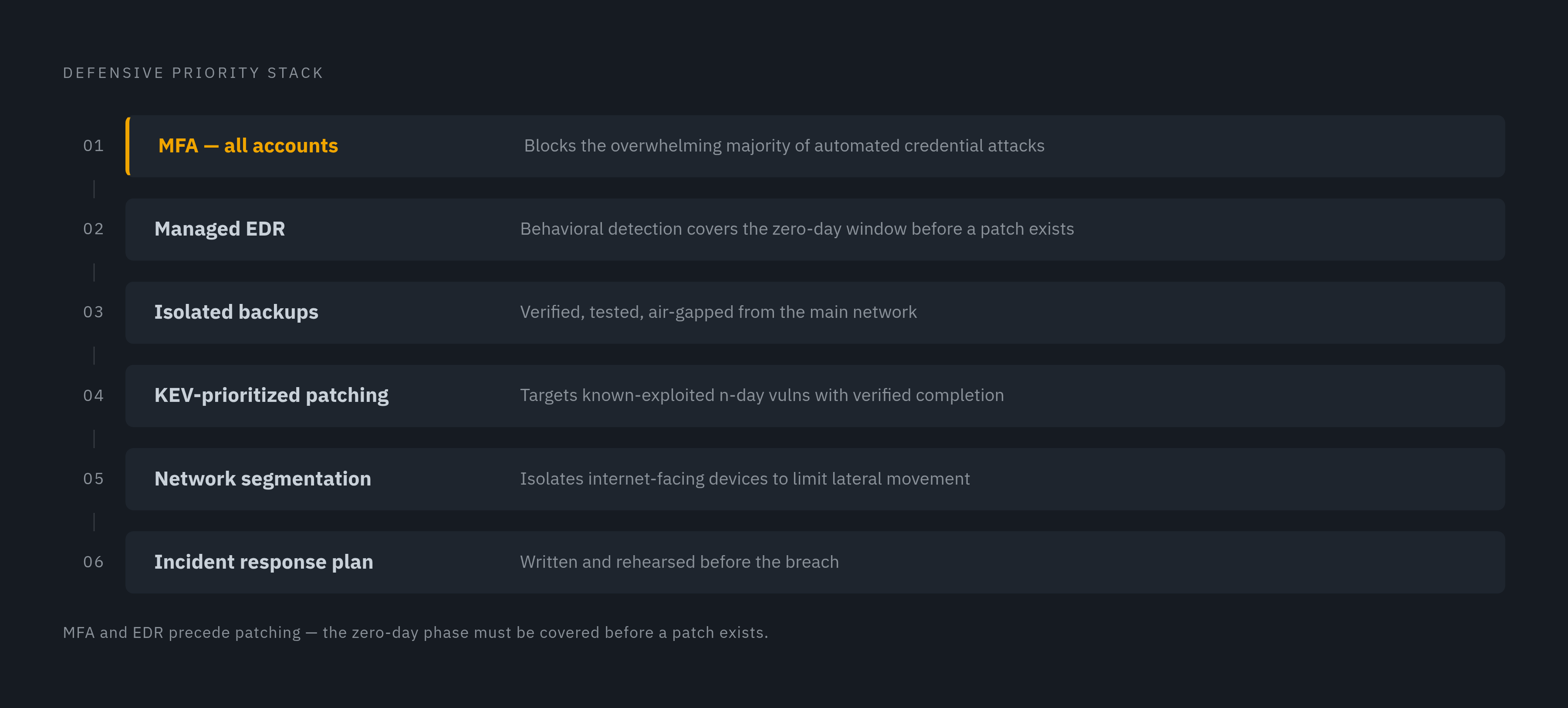
The practical priority order starts with MFA on all accounts. Credential abuse gives attackers another way in that a vulnerability patch will leave open. Microsoft's data shows that MFA blocks the overwhelming majority of automated account attacks. Managed EDR with behavioral detection comes next because it addresses the zero-day phase, when there is no fix to deploy.
Verified, tested backups follow to limit the leverage ransomware operators have after an intrusion. Backups connected to the main network are not protected backups. KEV-prioritized patching with verified completion then targets the n-day phase directly. Patch the flaws attackers are using in the order they are most likely to reach the environment, and confirm that the work finished.
Network segmentation for internet-facing devices is the next layer. It limits how far a compromised edge device, VPN gateway, or browser can reach into core infrastructure. A written incident response plan completes this practical floor by setting out what to do before an attack forces those choices. HP Threat Research describes post-exploitation chains in which attackers get to privilege escalation and lateral movement within hours of initial access. The plan should establish who is called first, what gets isolated, and when customers and regulators are notified.
This order covers entry, detection, recovery, patch completion, containment, and response while keeping each control's purpose clear. The exposure window will sometimes open despite efforts to prevent it. It can be made shorter after a patch arrives and less useful to an attacker before one does.