Patch Automation Policy Design for Endpoint Security Teams
Vulnerabilities weaponize in days, but most teams still patch like they have weeks.
Attackers now weaponize a disclosed vulnerability in about 5 days on average, down from roughly a month just a few years back, according to Tenable data. That collapse in exploitation time is the reason patch automation policy matters right now, and most teams are still building policy for a world where they had weeks to react, not days. A patching tool without a decision framework behind it just moves faster in the wrong direction. This piece breaks down what a real policy contains, how to rank risk, set deadlines, and build enforcement that holds even when no one's watching the queue.
Only 11% of organizations describe themselves as efficient at fixing vulnerabilities. The rest react, patch by patch, after something already went wrong. Verizon's Data Breach Investigations Report found that 22% of breaches involved exploiting a vulnerability that, in a lot of cases, had a fix sitting on the vendor's site for weeks or months. The MOVEit Transfer breach from 2023 is the clearest case study here: more than 2,700 organizations got hit, data on roughly 93 million people leaked, and a patch existed the whole time. Most of the affected organizations just hadn't deployed it yet.
Teams already know patching matters, so the gap here isn't awareness. What's missing is a documented process that tells the system what to fix first, how fast, and what happens if it doesn't get done. Call it patch decay: a machine that's fully secured today becomes a liability the moment tomorrow's vulnerability disclosure drops. Automation without a policy behind it is just faster chaos. A policy without automation behind it is just slower failure. Neither holds up alone.
What a patch automation policy is, and what it isn't
Having a patching tool is not the same thing as having a patch policy, and that distinction trips up more security teams than almost anything else in this space.
A patch automation policy is a written decision framework. It names which assets are in scope, how vulnerabilities get ranked, which patches roll out automatically versus which need a human to sign off, what testing a patch has to pass before it touches production, what happens when a device drifts out of compliance, and how exceptions get documented, approved, and eventually closed out.
Patch management is the tactical fix, the actual act of pushing an update. Vulnerability management is the bigger lifecycle: find the exposure, assess the risk, decide what to do about it, confirm it's fixed. Patching is one piece of that lifecycle, and the policy is the connective tissue that keeps the two working together instead of running in parallel and never talking to each other.
For a lean team, this plays out in a very practical way. Without a documented policy, every patch decision gets argued over from scratch, usually under time pressure, usually by whoever happens to be on call that day. With a policy in place, the tool executes on its own, and the human's job shrinks down to reviewing exceptions.
None of this works without an accurate asset inventory first, since a policy can't govern what it can't see. ConnectWise data shows 90% of cyberattacks start on an endpoint, which makes visibility into every device on the network something that has to be built in from day one, not bolted on later.
Building the risk-based prioritization layer, why CVSS alone will bury your team
CVSS scores feel objective, and that's exactly why they're dangerous to lean on alone. Only about 4% of vulnerabilities scoring above 7.0 ever get exploited in the wild. Chase the score-based queue and a team ends up pouring effort into the vulnerabilities least likely to ever cause harm, while the ones actually being used in attacks sit further down the list, waiting.
Volume makes this worse. Large enterprises commonly carry more than 100,000 open findings, with critical flaws sitting unpatched for an average of 252 days. That's a triage design failure. When everything gets scored the same way, nothing actually gets prioritized.
A working prioritization layer needs two signals, minimum. Asset criticality covers what the device does, who's on it, what data flows through it. Exploitability covers whether there's a known exploit circulating, and whether the asset sits exposed to the internet.
Combine those two and the output is a much smaller "act now" list: vulnerabilities that are both severe and actively being exploited, with everything else sorted into SLA tiers behind it. SLAs built around exposure (criticality plus exploitability) close more real-world risk than SLAs built around severity scores alone. Score-based prioritization is the wrong default, full stop. Any team still ranking its queue by CVSS number and nothing else is solving for the wrong variable, and no amount of tooling fixes that if the underlying logic stays broken.
Elia Zaitsev, former CTO at CrowdStrike, made this point at Fal.Con 2025 in Las Vegas on September 17, 2025: "Adversaries exploit known vulnerabilities within minutes, yet most organizations are slowed by silos between security and IT that delay fixes and leave dangerous gaps." That gap between minutes and silos deserves real attention, because prioritization isn't purely a technical challenge. A lot of it is organizational: security and IT working from different queues with different definitions of "urgent."
The policy document itself should spell out what moves a vulnerability up to immediate remediation: confirmed active exploitation, external exposure, or a contractual trigger like a client security requirement. Vague language here defeats the whole point of writing the policy down.
Setting remediation SLAs, the four-tier framework and its regulatory anchors
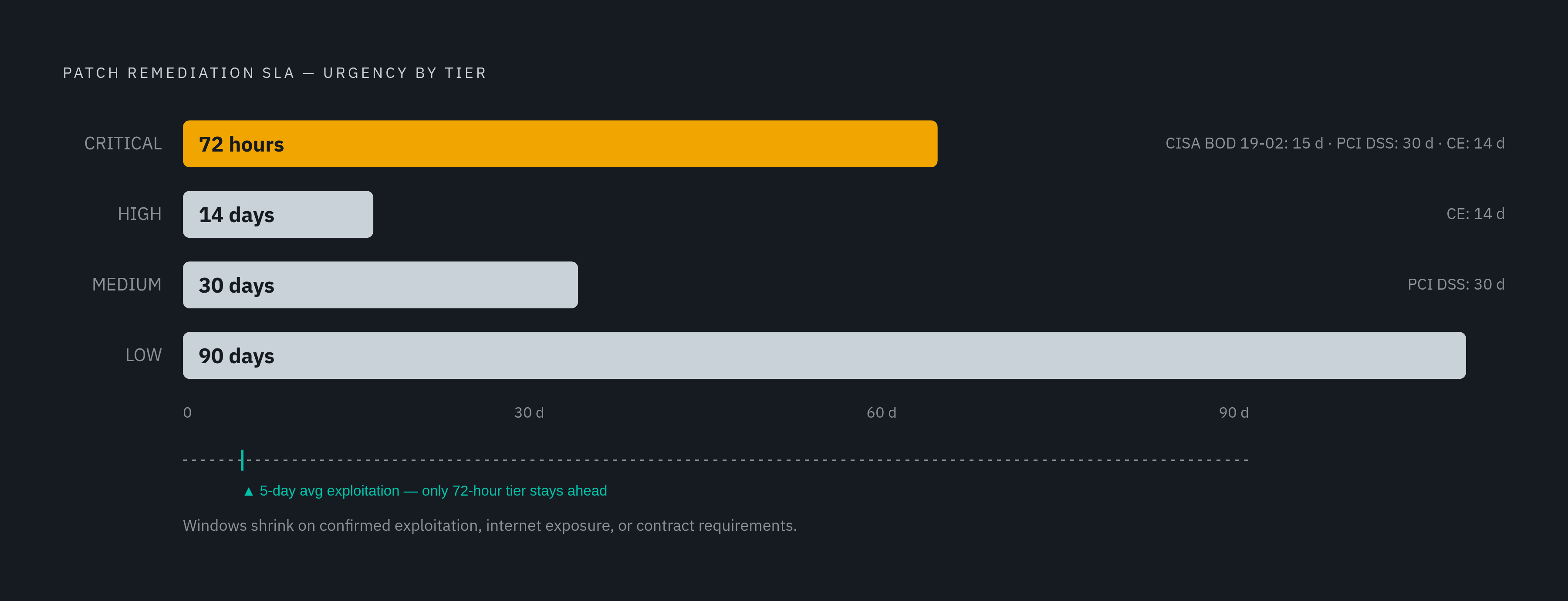
Widely adopted patch management templates settle on four tiers. Critical gets 72 hours from confirmed applicability. High gets 14 calendar days. Medium gets 30. Low gets 90.
Those windows shrink whenever exploitation gets confirmed, the system faces the internet directly, or a contract demands faster action. The policy should say so in plain language, not leave it to judgment calls made under pressure.
Regulatory frameworks set their own floors, and lining a policy up against them shows exactly where an organization stands. CISA's Binding Operational Directive 19-02 gives federal agencies 15 days for critical vulnerabilities and 30 for high, both measured from detection. PCI DSS Requirement 6.3.3 gives payment processors one month for critical vulnerabilities, counted from the patch's release date. The UK's Cyber Essentials standard requires action within 14 days for anything critical, high-risk, or scoring 7.0 or above on CVSS v3.
Those are floors, and treating them as targets is the mistake most teams make. A team operating under PCI DSS's one-month window needs to ask honestly whether 30 days is safe at all, given that exploitation now happens in about 5 days on average. Meeting the regulation doesn't mean staying ahead of the threat, and plenty of compliant organizations get breached anyway.
Even organizations with formal SLAs struggle to hit them. 60% miss their critical remediation target more than half the time, and industry-wide patch latency still averages 40 to 60 days. That gap, between what the policy says on paper and what happens on the ground, is where breaches happen. An SLA only works if the tier definitions match what the team's tooling and headcount can actually deliver.
Track four numbers to know if the SLA structure is holding: median time to install, SLA attainment rate, exception count and age, and rollback rate. Review the whole SLA matrix every quarter, or sooner if the environment shifts: new software gets added, a new compliance standard comes into play, or the team keeps missing the same deadline over and over.
Automation tiers determining what deploys automatically and what needs a human gate
Not every patch carries the same risk of breaking something, so the policy needs automation tiers sitting alongside the SLA tiers. "How fast" and "how automatically" are two separate questions, and collapsing them into one decision is where most rollout problems start.
No approval is needed for Tier 1, which runs fully automated: OS security patches on non-production endpoints, and patches for actively exploited CVEs on anything internet-facing. Tier 2 automates with a monitoring gate and a phased rollout, for high-severity patches hitting production or major application updates with a known history of compatibility issues. Tier 3 requires approval before anything deploys at all, covering line-of-business applications, kernel-level updates on servers, and anything on OT or IoT devices where a rollback is difficult or impossible.
Executing Tiers 1 and 2 through ring-based deployment is the standard approach. The pilot group is Ring 0, a small batch of non-critical devices or IT staff machines, meant to catch regressions early. Ring 1 expands to a larger sample across different business units. Ring 2 is the full fleet, and it only gets the patch once the earlier rings clear a monitoring check.
That monitoring check needs defined thresholds: stability metrics, a spike in help desk tickets, or a rollback rate from the pilot ring that crosses a line the policy sets in advance. Cross the threshold, and the rollout pauses automatically instead of grinding forward on inertia.
This is zero-trust logic applied to patching, plain and simple. A patch doesn't get treated as safe just because it comes from a vendor everyone already trusts. It gets verified in a small ring first, every time, even for systems the team has never had trouble with before. OpenText data puts a number on what this buys: automated patching with this kind of structure delivers 70% faster deployment and a 45% reduction in security incidents, according to OpenText.
Small details move the needle too. Clearer reboot countdowns, and defaulting updates to business hours instead of forcing a disruptive restart, can lift patch completion rates by 12 to 18 percent. The policy should spell out reboot window rules directly, because users quietly deferring updates is one of the sneakier ways compliance falls apart.
Enforcement rules, what happens when a device falls out of compliance
A policy without enforcement is just a suggestion. The mechanism that gives it teeth is compliance-gated access: devices that meet the patch policy get a trust token, and devices that don't get remediated or blocked from production resources.
In practice, that looks like an MDM platform such as Intune or Jamf flagging a device as non-compliant once its patch SLA gets breached. A conditional access policy, through something like Entra ID or an Okta device trust check, evaluates that compliance status alongside an EDR risk score at login. Fail the check, and the device gets quarantined from production access until the patch lands.
GDPR's Article 32 requires "appropriate technical measures" for data protection, and a documented, compliance-gated quarantine process is exactly the kind of control that satisfies an auditor asking what enforcement looks like in practice, not just on paper.
Consistency matters as much as the mechanism itself. A lightweight agent running on every managed endpoint, checking continuously rather than on a fixed schedule, means a device that was offline during last week's maintenance window still gets caught the moment it reconnects. Nothing slips through just because of bad timing.
Exceptions need their own governance, separate from the SLA itself. A valid exception requires a documented reason for missing the SLA, a compensating control that's actually in place, and a risk acceptance sign-off from whoever owns the asset. Exceptions also need expiration dates: emergency-tier exceptions escalate to the CISO after 7 days, critical after 30, high after 60, medium and low after 90. When an exception lapses without remediation, it escalates automatically to the next approval level. Left alone, "temporary" exceptions have a way of turning permanent without anyone deciding that on purpose.
Watch the exception count and how old those exceptions get. A rising number usually means one of two things: either too much is landing in the Critical queue, or there isn't enough capacity to clear it. Either way, that's a signal to act on.
Platform choices that support this policy structure for lean teams
The platform's job is to enforce the policy document, not just push updates on a timer, and that distinction should drive every tooling decision a lean team makes.
Windows-heavy environments have solid native options. Microsoft Intune Autopatch handles OS patching with ring-based rollout already built in, and environments with more complex on-prem requirements may call for additional tooling alongside Autopatch. Intune's conditional access integration supports compliance-gated enforcement without extra middleware. Third-party application patching may require supplemental tooling such as winget or Chocolatey depending on the breadth of applications in the environment.
For macOS fleets and Android devices, native management tools with patch policy support handle the equivalent job on those platforms.
For teams that want patching driven by security context rather than just IT scheduling, CrowdStrike's Falcon for IT, announced at Fal.Con 2025 in Las Vegas on September 17, 2025, brings risk-based patching together with Falcon Exposure Management in one console. The workflow runs from identifying a vulnerability straight through to deploying the fix, using the Falcon sensor already installed rather than adding another agent to the endpoint. Pre-deployment safety scores combine Falcon's own telemetry with vendor data to estimate a patch's real-world impact before it hits the full fleet, which covers the testing gate requirement directly. The platform is designed to integrate patching workflows with existing security operations rather than treating them as a separate process.
For a small IT team without a dedicated security hire, the deciding question is simple. Does the platform enforce the policy on its own, or does someone have to babysit it? A tool that needs a security specialist just to stay configured correctly has already defeated the purpose of automating in the first place. Platforms that combine device management, endpoint security, identity, and compliance in a single place close the gap between spotting a vulnerability and actually fixing it, the same gap where that 252-day average dwell time tends to live.
Turning the policy document into a living operational control
A patch policy that never gets revisited starts decaying the day it's signed off. New software gets added, compliance requirements shift, threat patterns change, and a policy written a year ago stops matching the environment it's supposed to govern.
Quarterly review should be the baseline, with a few triggers that force a review sooner: a new SaaS application or device type entering the environment, a new compliance framework the organization adopts, or an audit that turns up gaps nobody noticed. Repeated SLA misses count too. If Critical attainment starts slipping, that's a signal the tier definitions or the automation configuration need adjusting.
The same four metrics from earlier do double duty as the review's input: median time to install, SLA attainment rate, exception count and age, and rollback rate. Together they answer one question, whether the policy still matches operational reality or has quietly drifted away from it.
Patch management runs as an operating model that persists well beyond the point of signing. The policy document is the spec, the platform is what executes it, and the quarterly KPI review is the feedback loop that keeps the two aligned. For a lean team, that shift changes the day-to-day job. Instead of reviewing every alert as it lands, the job becomes reviewing the exception queue and the quarterly numbers, a workload one generalist IT operator can sustain without burning out.
The average cost of a data breach now sits close to $4.88 million. A documented, continuously enforced patch policy is the control standing between an organization and that number, and it's one of the few controls a lean team can actually build without hiring its way out of the problem.