Endpoint Security Maturity Model for SMB and Mid-Market Organizations
A phased approach helps lean teams close security gaps without building unsustainable programs.

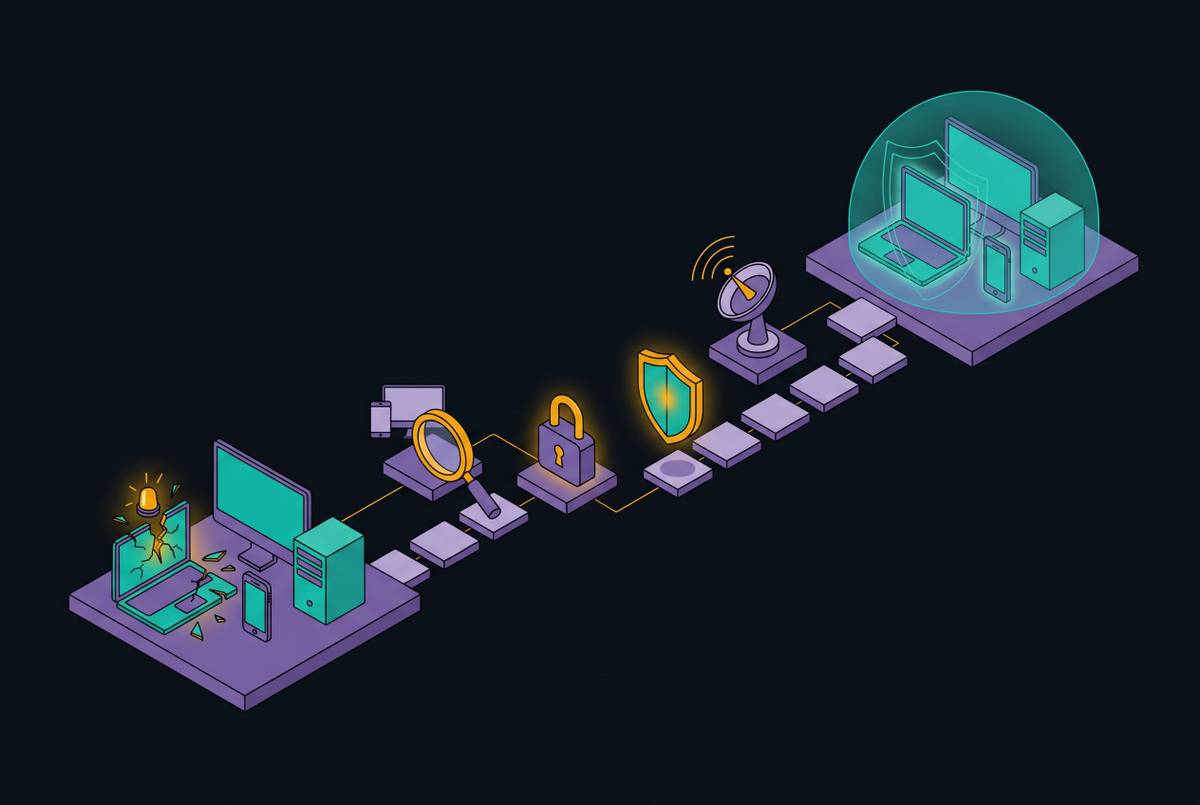
Endpoint security maturity for SMB and mid-market organizations is a sequencing problem. A real program starts with protected accounts, protected devices, and tested recovery, then adds consistent enforcement and evidence as the business grows. The fastest useful deployment closes those gaps first. A two-week tool rollout is not, by itself, proof that the company is protected.
Why endpoint security fails lean teams at every size — and why sequencing fixes it
The founder or IT generalist has enabled antivirus, bought backup, and asked people to use MFA. Yet it still feels hard to tell how exposed the business is. An order of operations is needed to connect each investment to a gap and show whether that gap is closed. Without it, tools accumulate while responsibility and enforcement remain unclear.
The SMB checklist of patching, training, backup, and endpoint protection becomes too thin as the environment grows more complex. At the other extreme, full enterprise programs assume specialists across identity, endpoints, cloud, applications, and governance. Lean teams rarely have that staffing. The result can be documentation nobody follows and compliance checkboxes disconnected from risk.
A maturity model gives the team a narrower question to answer. Given the controls working today, what comes next? This four-tier model uses that question to sort the gaps that need work now from the capabilities the team cannot yet run.
Who attackers target and why the mid-market sits in the most exposed position
Mid-market organizations have more valuable data and systems than small businesses, but less mature security operations than enterprises. That gap makes them exposed. Sophos’s State of Ransomware 2026 report found that small organizations stopped attacks before encryption or data theft at a notably lower rate than larger enterprises. Recovery costs average well over a million dollars per incident when disruption, remediation, and lost revenue are included, before any ransom payment.
The entry points explain the early priorities. Identity-based attacks, including phishing and stolen credentials, account for the large majority of attack entry points. Phishing and malicious email make up roughly half of ransomware entry points, and exploited vulnerabilities are another leading way in. Account protection, email defenses, and verified patching therefore belong near the start, ahead of an audit project.
Recovery alone cannot cover all of that exposure. Ransomware groups combine encryption with data theft and supply-chain pressure, so restoring files does not remove every source of extortion leverage. Insurers also expect MFA, endpoint detection and response, and immutable backups, while customers increasingly ask for proof through contract requirements.
How to read the maturity model and locate where your organization stands today
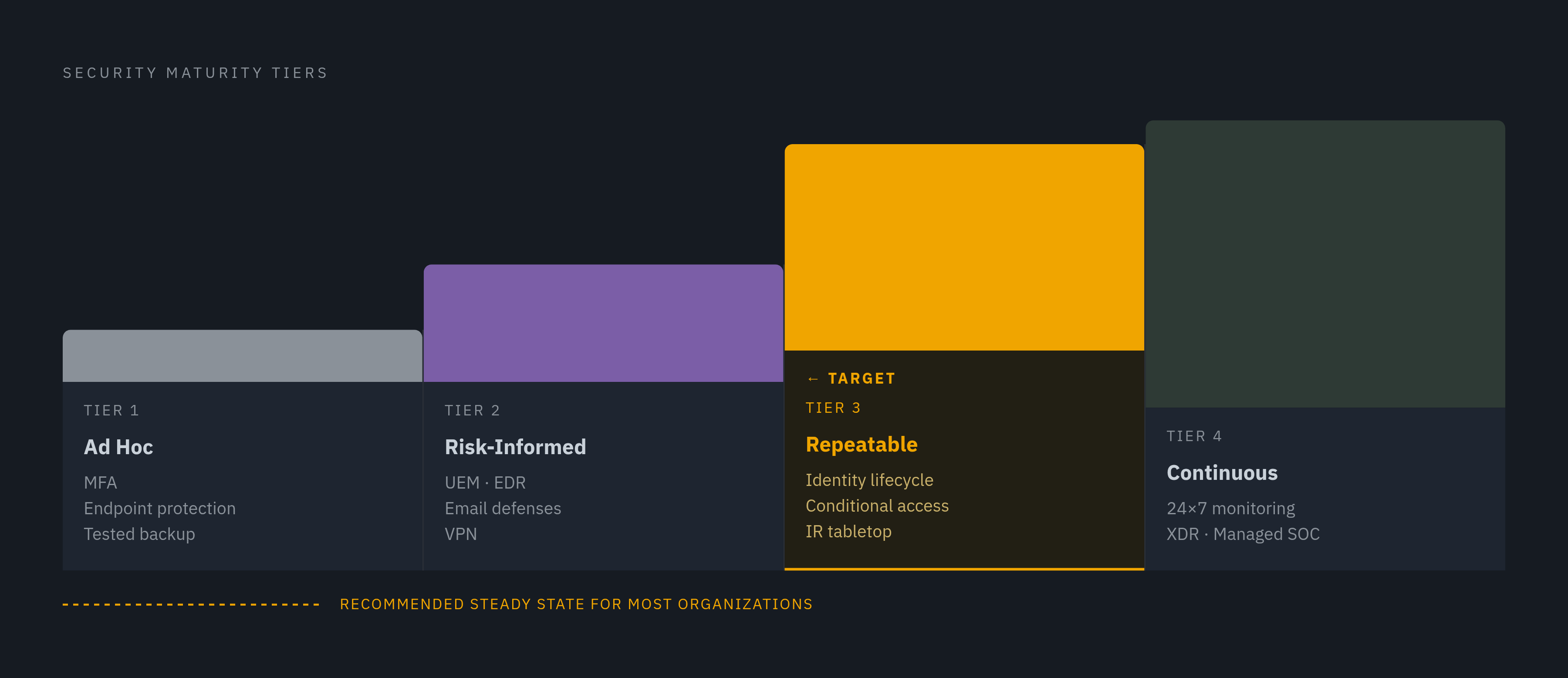
Tier 1 is ad hoc, with reactive responses and controls installed wherever someone happened to act. Tier 2 is risk-informed, with approved policies but uneven execution. Tier 3 makes the program repeatable, evidenced, and tested. Tier 4 adds continuous monitoring and changes to controls based on threats. Most organizations should target Tier 3 as their steady state.
Three questions help locate the gaps. Can the team list every device with corporate access and confirm that a baseline is enforced on each? If not, device coverage has a Tier 1 gap. Are policies approved and followed, with evidence available? Policies with uneven enforcement point to Tier 2.
Finally, does the team measure outcomes and use them in quarterly decisions? That points toward Tier 3 or Tier 4, depending on what the team can do with those measurements. Apply these questions to each function. Endpoint hardening can be at Tier 3 while identity lifecycle management remains at Tier 1. The sections below take those dependencies in order.
Tier 1 controls — what every organization needs before anything else
The first task is to confirm three controls actually work. Credentials need protection through MFA, every device needs basic endpoint protection, and corporate data needs recoverable backup. This baseline applies even to very small teams using low-cost collaboration tools and personally owned devices.
Start with a password manager and MFA for every external-facing account, including those for email, cloud storage, and SaaS applications. A password manager helps with passwords that people share or reuse, and MFA makes stolen credentials less useful. The software licenses the business already has often come with MFA at no extra cost. Coverage must extend beyond the accounts the IT generalist happens to remember.
On devices, confirm that operating-system-native protection is active, such as Microsoft Defender Antivirus on Windows. Apply operating system and software updates regularly. Corporate and customer data should have encryption at rest and backup to cloud storage or offline copies. Then test recovery rather than accepting a successful backup notification as proof.
Weigh ransomware coverage against the cost of an incident, and recognize that underwriting requirements may demand EDR before the organization otherwise planned to add it. These controls establish a baseline, but they do not enforce themselves as more people and devices arrive.
Tier 2 controls — what to add as the team and device count grow past a dozen people
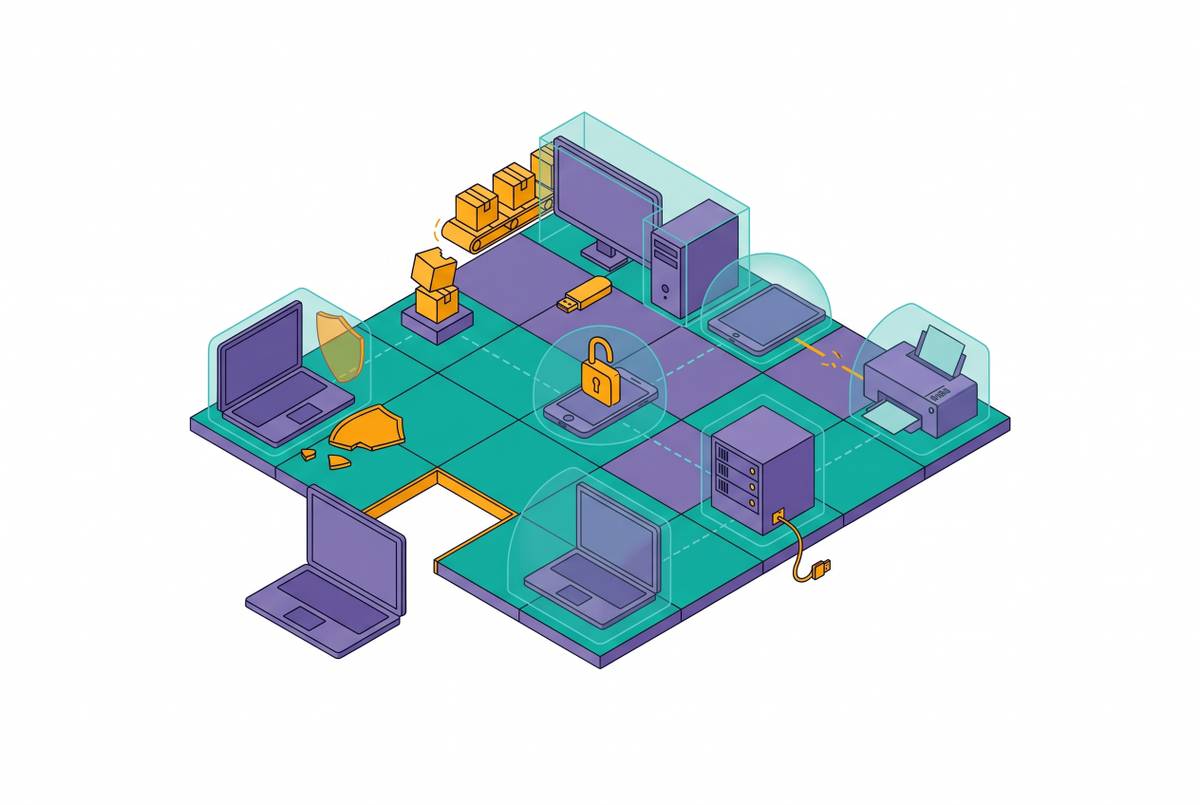
A growing SMB with a dozen to roughly a hundred employees often relies on one or two IT generalists. Those people must support company-owned devices and personal devices, as well as people who work remotely and the cloud applications they use. Individual follow-up stops being a dependable enforcement method. Tier 2 adds the management infrastructure that keeps the baseline consistent.
Unified Endpoint Management, or UEM, is the foundational addition. It enforces password rules, operating system updates, disk encryption, and device compliance across desktops, smartphones, and tablets. Mobile Device Management, or MDM, is the part of this work that handles device enrollment and management. Golden images establish a standard setup, while unsupported operating systems can be blocked from corporate access. Managing access to corporate Wi-Fi and VPN means the team can rely less on employees choosing to follow instructions.
Endpoint protection also needs to do more than check for known-threat signatures. An endpoint protection platform combined with endpoint detection and response, or EDR, adds behavior-based detection and the ability to isolate a compromised device. Containment becomes a practical response option for the team. Mobile Threat Defense brings behavioral detection to the smartphones and tablets that hold corporate data.
Remote access needs just as much care because VPN exploitation is a leading way for ransomware to get in. VPN or equivalent protection should cover employees who reach internal resources from home or while traveling. Per-app VPN options through UEM make access easier, so employees have less reason to work around controls. Email defenses should include phishing protection, SPF/DKIM/DMARC enforcement, and impersonation detection, supported by role-based training for finance and executive users.
For a lean team, an integrated platform is the right first investment. Device management, endpoint protection, and identity enforcement need to work together without someone having to keep them in step by hand. Compliance documentation ends up sitting on an unmanaged fleet, and the claimed controls do not hold during an audit or incident.
Tier 3 controls — building a repeatable, auditable program for mid-market organizations
Tier 3 turns consistent enforcement into documented, tested governance. This becomes pressing as organizations pass a hundred employees and face requirements such as SOC 2, ISO 27001, HIPAA, or PCI DSS. Legacy systems, third-party integrations, and remote work make this harder. The goal is a program the team can keep running, with no need to move on to Tier 4.
Identity lifecycle management is the highest-impact addition. Separate admin identities, just-in-time privilege elevation, and hardware-keyed break-glass accounts limit the reach of a compromised credential. Prompt offboarding and quarterly access recertification address access left behind through normal turnover. Phishing-resistant MFA, including passkeys and hardware security keys, should replace one-time-password-based MFA for admins and privileged roles first, then across the organization.
Access decisions should also depend on device health. Conditional access evaluates the user, device compliance, location, and risk, with compliant devices required for privileged tasks. Identity and endpoint protection now become one program. SaaS management extends that discipline by discovering sanctioned and shadow applications, assigning owners, and enforcing SSO and MFA on connected applications. Guest access expiration and quarterly admin-role reviews keep access from accumulating unnoticed.
Patching needs a process that records proof that the patches work each time they are applied. Prioritize known vulnerabilities, define remediation timelines, and verify that patches applied correctly. A central repository of policies, screenshots, test results, and attestations makes audits repeatable. Vendor risk needs similar structure, with vendors grouped by criticality and data sensitivity and contracts requiring minimum controls such as MFA, encryption, logging, and notification windows.
The team must write down and practice its incident response. A tabletop should cover finance approvals, legal and communications escalation, and pre-authorized containment actions. Those decisions let the team act during an incident without having to agree on who has the authority to do what. The results should show detection in minutes, monthly restore tests that meet their targets, and phishing simulation rates that fall over time.
Tier 4 capabilities — what continuous monitoring requires and when it is worth adding
For mid-market organizations pursuing Tier 4, it requires continuous monitoring, threat intelligence that changes controls, and a 24×7 function that validates and contains alerts. Extended detection and response correlates endpoint, identity, email, and network telemetry in a centralized detection pipeline. Someone still has to operate that capability.
The investment fits financial services and large healthtech organizations that need continuous monitoring. It can also fit organizations whose post-incident analysis identified a detection gap as the primary failure, or teams that have fully operationalized Tier 3 and have capacity to raise specific functions further. More tools alone do not satisfy those conditions. The operating cost includes sustained triage and response.
Managed detection and response, or a managed SOC, can provide continuous coverage without an internal analyst team. Contract terms deserve close attention here. When an alert fires at 2am, who is responsible for triage and containment, and which actions can they take without waking someone up? That answer is more useful than a promise of round-the-clock monitoring.
The practical sequence — which controls to add first when money and time are limited
For Monday morning, use risk reduction and operating effort to set priorities. Start with MFA everywhere, followed by managed endpoint protection and tested backup. Next comes UEM to enforce consistency, then email security and patching with verification. Identity lifecycle management comes next, along with an incident response plan that the team has written and practiced. These steps deal with common gaps before moving on to rare zero-days.
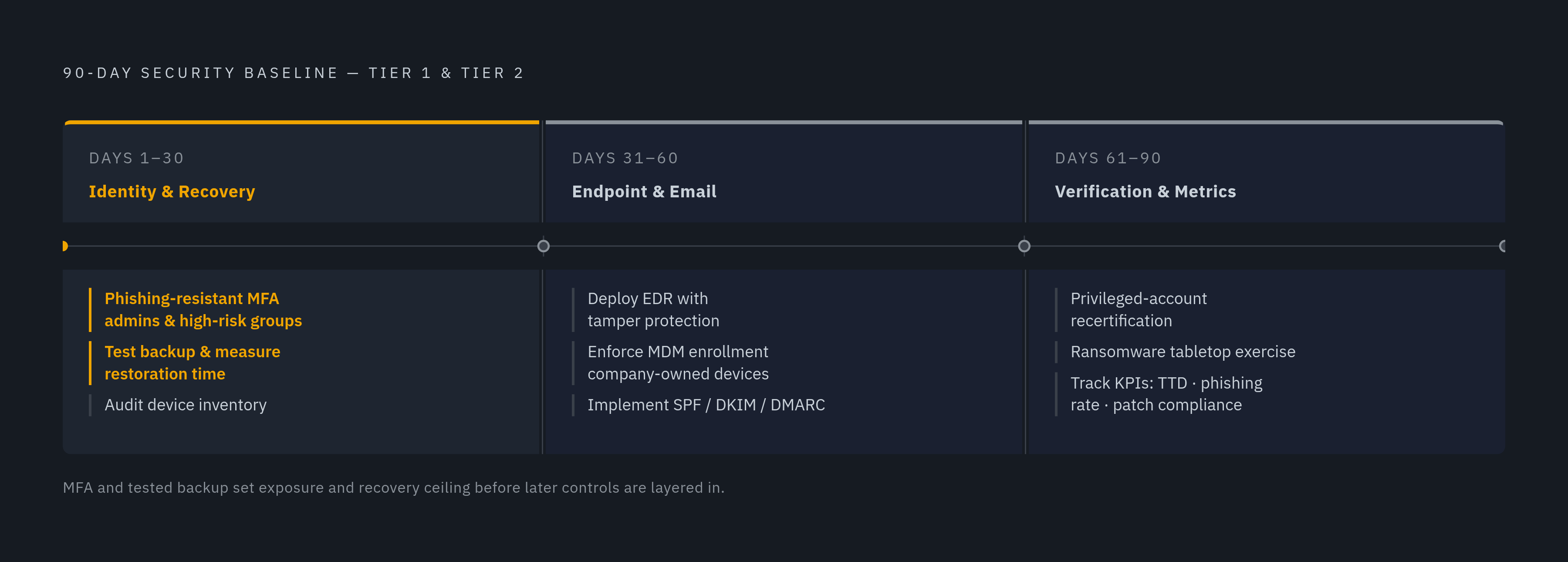
The priority order is not permission to leave recovery untested while an EDR rollout runs. For organizations at Tier 1 or Tier 2, the first 30 days should enable phishing-resistant MFA for admins and high-risk groups, test backup, establish restoration time, and audit the device inventory. These tasks define both exposure and recovery capability. Use the 3-2-1-1 backup rule with an immutable offsite copy.
During days 31–60, deploy EDR with tamper protection across all endpoints. Enforce MDM enrollment for company-owned devices and implement SPF/DKIM/DMARC on outbound email. During days 61–90, start privileged-account access recertification and run a ransomware-response tabletop. Begin tracking two or three security KPIs, such as time-to-detect, phishing simulation rates, and patch compliance.
A two-week deployment should be evaluated against that broader work. The platform criteria are integrated device management, endpoint protection, identity enforcement, and compliance evidence collection, with deployment measured in weeks. Lean teams also need controls that stay enforced without an expert having to set them up. Consolidation earns its place when it removes the burden of checking separate dashboards and leaves fewer gaps between controls.
How do you know if your company is actually protected from a cyberattack?
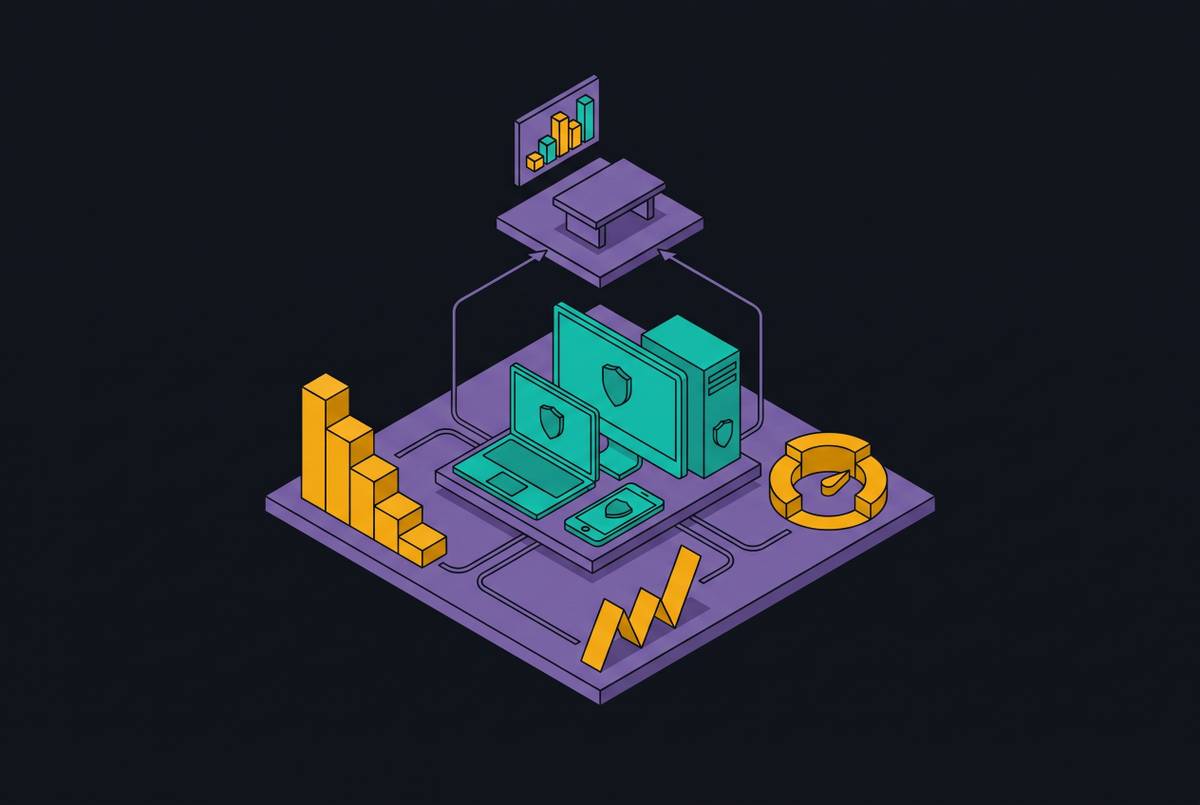
No tool inventory answers that question by itself. At Tier 1, track the percentage of external-facing accounts with MFA and endpoints with active protection. Record the date of the last successful backup restore test. If recovery has never been tested, that remains a baseline gap regardless of what the backup dashboard reports.
Tier 2 measures whether enforcement holds across the fleet. Track the percentage of devices enrolled in UEM and compliant with baseline policy. Measure patch compliance against the organization’s defined remediation window. Establish a phishing simulation click-rate benchmark before training, then track it quarterly.
Tier 3 measures response speed and operational evidence. Track median access-removal time after departures, aiming for the same business day where possible. Measure time-to-detect and time-to-contain in minutes. Monthly restore tests should meet the recovery time and recovery point targets set for critical applications and file shares.
Tier 4 adds evidence that the program adapts. Track how controls change in response to threat intelligence, how much time passes between tabletop exercises, and whether the response plan includes what the team learned. Review Tier 3 trend lines quarter over quarter. Insurers, customers, and partners expect this kind of proof more and more, and leaders need it to show why security spending is needed. Sequencing works when each new purchase makes things better in a way the team can measure.