Automated Offboarding as an Endpoint Security Requirement
Sixty percent of corporate breaches happen through access that should have been revoked.
An employee's last day at work rarely lines up with the last day their access actually works. That gap, sometimes hours, sometimes weeks, is where credentials, devices, and open sessions sit unattended. Offboarding is a security control that HR happens to trigger, not an HR task with a security side effect, and most companies have that backwards. Treat it as a paperwork step and the paperwork will be fine. The access won't be.
Grudges and sabotage are the version people picture first, but they're not the main event. Per Intecracy (2026), roughly 60% of corporate data breaches in 2025 happened after an employee's termination date, while their access formally stayed active. That number holds regardless of motive. It just measures how long a door stayed open after someone walked out of it.
Two patterns explain most of that 60%, and only one involves anyone trying to do harm. A former Cisco employee deleted more than 450 virtual machines after termination, a case that's become something of a textbook example. But the quieter pattern, the accidental insider, is far more common: someone who keeps access to a shared drive or an old email account for weeks with zero intent to cause harm. No malice required. Just a login nobody remembered to kill.
Insider incidents also cost more once they happen. IBM's Cost of a Data Breach report (2024) found insider incidents run about 20% more expensive than external attacks, on average, and the reason isn't mysterious: insiders already know where the sensitive data lives and how to move it without tripping alarms built for outsiders. Handled right, offboarding is identity containment aimed at a known, expensive failure mode. Handled as a box on a departure form, it's exactly the gap that 60% figure describes.
How the modern SaaS environment turns incomplete offboarding into a persistent vulnerability
Research cited in The Hacker News (2024) found the average employee uses 29 separate SaaS applications. Each one is its own island with its own shutoff switch, and turning off one account doesn't touch the other 28.
Enterprise SaaS estates run into the hundreds of applications. Every new tool a company adopts adds another line item to the cleanup list on someone's way out, and the scope doesn't grow slowly. It grows in steps, with every procurement decision made months or years earlier quietly adding to the pile.
Single sign-on gets treated like a kill switch, the assumption being that disabling the identity provider account makes everything downstream go dark too. It doesn't work that way. Many SaaS vendors charge extra for SSO integration, an arrangement Nudge Security (2024) calls the "SSO tax." Smaller companies that won't or can't pay that premium across every tool end up managing a large chunk of credentials completely outside the identity provider. The account gets disabled in the IdP, and stays logged in and functional in a dozen other places. VPN tokens keep working after the badge gets handed back at the front desk.
OAuth grants make it worse. When an employee connects one SaaS tool to another, say a messaging-platform integration or a calendar sync, that connection is often managed by a third party and never shows up in IT's asset inventory. Per Nudge Security (2024), revoking the user doesn't revoke the grant. The integration keeps running on borrowed authority long after the person who authorized it is gone.
Shadow IT undermines the whole premise of a clean asset list. Wing Security, cited again in The Hacker News (2024), found that 63% of businesses may have former employees with access to organizational data sitting in apps IT never knew existed. Offboarding, in practice, starts as a scavenger hunt across sanctioned tools and unsanctioned ones alike, with nobody holding a master list to work from.
Where manual processes break down under real operating conditions
The State of SaaS 2025 report puts a number on the lag: roughly a third of companies take more than 24 hours to fully offboard a departing employee. Every one of those hours is exposure sitting on the table, doing nothing but waiting to be found.
Mass layoffs are the real stress test. IT teams sometimes get a list of hundreds of names with almost no lead time and get told to deactivate accounts across every platform within hours, according to Security Magazine. Under that kind of pressure, human error isn't a risk, it's close to guaranteed. Nudge Security's 2023 survey found that 70% of IT professionals have personally dealt with the fallout from incomplete offboarding: security incidents, disrupted operations, SaaS spend wasted on licenses nobody remembered to cancel. That's despite plenty of companies already having automation somewhere in the stack, which says something about where that automation actually reaches.
Devices fail their own particular way, and it's rarely about the account itself. Capterra, cited in a 2026 Guardz report, found 71% of HR staff who handled an offboarding in the past year say at least one departing employee never returned company equipment. Only 55% of organizations could fully lock a former employee out of company-owned equipment. Fewer than half require employees to return security keys or physical tokens, and more than 40% have no formal policy stopping staff from walking out with company data on a personal drive, per ID Agent.
Ghost access is the norm, not the exception. Beyond Identity surveyed more than 1,100 workers and found 83% still had access to a former employer's accounts after leaving. Of that group, 56% admitted to actually using that access to cause harm, and that's the number that should reframe how anyone reads the 60% figure at the top of this piece. Verizon's 2026 DBIR ties 13% of all breaches to credential abuse, a figure that points directly at credential management failures.
None of this is a tooling problem at root. It's a people problem: in most companies, offboarding gets executed by a supervisor or an HR generalist with zero visibility into API keys, OAuth grants, or developer tokens. They can turn off an email account. They have no way of knowing a departing engineer still has a live personal access token sitting in a CI/CD pipeline, and no checklist fixes that if the person running the checklist doesn't know the token exists.
Why SMBs carry this risk at the highest concentration
Small and midsize businesses are a preferred target, three times more likely to be targeted than larger firms, and they account for 46% of all cyber breaches worldwide. Yet 47% of businesses with fewer than 50 employees put zero dollars toward cybersecurity, according to StrongDM (2025). The companies facing the most concentrated targeting are, in large numbers, the ones with the least protection in place. That mismatch is the whole story of SMB risk in one sentence.
Offboarding at a small business usually falls to whoever's left holding the operational load: an owner, an office manager, someone without a formal IT title. Passwords get shared across a whole shop floor. One login covers the register. The bookkeeper has the bank credentials memorized. Somewhere, a "temporary" admin account set up two years ago is still sitting active, because nobody built a master list of who has access to what. Without that list, nobody knows the scope of the cleanup before they start it, so the cleanup, when it finally happens, is guesswork.
The math doesn't forgive guesswork at this scale. VikingCloud (2025) found 40% of SMBs say an attack costing $100,000 or less could put them out of business. Verizon's 2025 DBIR found 88% of SMB breaches involved a ransomware component, compared to 39% at larger organizations, and stale credentials left behind by incomplete offboarding are one of the more direct paths into that outcome. Security Week, cited by Guardz in 2026, found 90% of successful cyberattacks start at an endpoint device: the exact device that, in a lot of these cases, was never wiped, never recovered, or never pulled out of active enrollment after the person who used it left.
What complete automated offboarding must actually cover
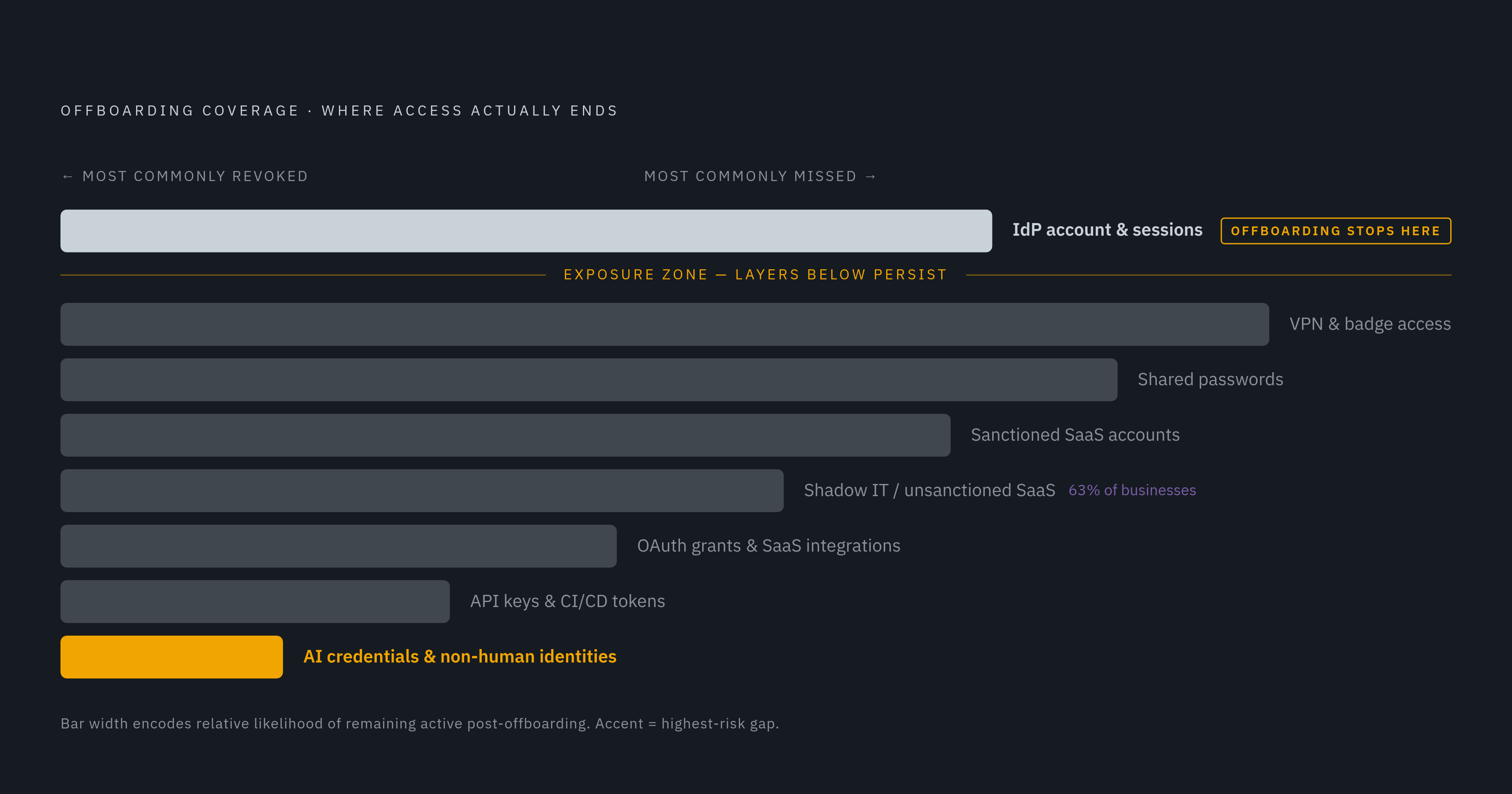
Disabling the account in the identity provider is where offboarding starts, not where it ends. Treating it as the finish line is the single most common mistake in this whole process. Guidance on emergency access revocation notes that disabling a user often isn't enough on its own. Administrators may also need to revoke refresh tokens, disable the devices tied to that identity, deprovision individual application accounts, and account separately for any app that manages its own session tokens outside the IdP's control.
A complete revocation covers more ground than most manual checklists ever reach:
- The IdP account and any active sessions tied to it, VPN access, physical access (badge, key fob, alarm code), and shared passwords rotated through a password manager
- API keys and personal access tokens across every developer platform in use, OAuth grants tied to SaaS-to-SaaS integrations, and ownership transfer for non-human identities
- AI tool credentials, a newer line item as those tools spread and bring their own credential surfaces with them
- Cloud storage access, every SaaS account whether sanctioned by IT or not, and a device wipe, full for company-owned hardware, selective through MDM for BYOD setups
Getting through that whole list manually, on a deadline, is what breaks down under pressure. Per Passwork (2026), HRIS-to-IAM automation built on SCIM is the only architecture that closes the latency window consistently. Ticket-based manual processes can't meet the timelines modern threats demand, and no amount of good intent from an HR generalist changes that math.
Execution alone isn't the finish line either. Zimyo frames the real goal as a process that's automatic, instant, and leaves behind an audit trail, not one that depends on a stressed employee remembering a long list of accounts on someone's last day. And none of it works without knowing what to revoke in the first place. Nudge Security (2024) points to SaaS discovery, tools that look past the sanctioned app list to find what's actually in use, as a practical prerequisite. Deprovisioning built on an incomplete inventory is incomplete by design, no matter how fast it runs.
The compliance dimension: what regulators require and what incomplete offboarding costs
ISO 27001:2022, Annex A 6.5, requires prompt removal of access rights after termination or a change in employment. NIS2, Article 21, sets access control as part of baseline security hygiene for covered entities, and access that outlives someone's departure runs counter to that baseline requirement.
HIPAA and financial regulators expect something concrete on demand: an immediate, comprehensive audit trail proving access was terminated the moment someone left. BetterCloud (2025) notes that failing to produce one can expose a company to significant penalties. GDPR and CCPA add another layer, since former employee accounts often still hold personal data that's legally required to be purged, and any delay in that purge opens up fine exposure, again per BetterCloud (2025).
Auditors see this pattern often enough to have a name for it. Missing or delayed app access revocation is a routine cause of SOC 2 Type 2 and ISO 27001 audit failures, tied directly to incomplete access logs and no proof of timely deprovisioning. Compliance and security aren't two separate tracks here, whatever the org chart says. The same automated process that closes the security gap is what produces the paperwork the regulator wants to see.
What an integrated security platform does that point solutions and manual processes cannot
Most companies run device management in one tool, identity in another, and SaaS access management in a third. Offboarding needs all three to move at the same moment, and when the tools don't talk to each other, that coordination gap is exactly where access slips through. Point solutions were never built to close it, because each one only sees its own slice of the problem, and stitching them together after the fact is a losing bet against the clock.
An integrated setup changes the mechanics. A single trigger from the HRIS kicks off revocation across every connected surface, identity provider, MDM, SaaS accounts, without a human routing tickets between five different admin consoles. Device enrollment status sits next to identity status in the same view, so a device that hasn't been wiped shows up as a flagged, visible problem instead of an unknown quantity nobody's tracking. The audit trail builds itself across every surface, instead of getting stitched together after the fact from five dashboards nobody wants to open.
For a small business without a dedicated security team, the real test is whether the person actually running the business can trigger a complete, verifiable offboarding without needing to know what an API key is or how an OAuth grant works under the hood. Deployment speed matters just as much: a platform that takes months to configure creates its own version of the exact gap it's supposed to close. For a lean team, a two-week deployment window means protection is in place before the next departure happens, not sometime after.
BetterCloud's 2025 State of SaaS Report found 48% of IT teams worry that a missed offboarding step will leave their organization exposed. Adding another checklist item won't solve that worry. Cutting the number of handoffs between systems that were never built to talk to each other will. Offboarding sits at the exact intersection of device management, identity, and compliance, and a platform built to unify those three functions treats offboarding as a native workflow, not a custom integration project stitched together after the fact, and not a task anyone has to remember to do right on a chaotic Friday afternoon.
Sources
- How to build offboarding workflow to keep data safe | BetterCloud
- AI-powered offboarding: defending against insider threats in 2026
- 36 Endpoint Security Statistics MSPs Should Know in 2026
- 2025 Guide to IT Offboarding & SaaS Automation
- New Research Warns About Weak Offboarding Management and Insider Risks
- The Security Risk No One Talks About During Layoffs: Offboarding
- passwork.pro
- app.stationx.net