Endpoint Security Tooling Decisions for Lean Security Teams
Managed response beats manual detection when your security team is too small to monitor alerts.
Most endpoint security shopping still runs on feature checklists, analyst quadrants, and vendor demos. That process assumes something that just isn't true for a huge share of the market: that the buyer has staff sitting around to deploy the tool, tune its settings, and act on what it finds.
Many of the companies that call cybersecurity a top priority still run with very few dedicated security professionals. A significant share have none at all. The checklist model breaks down at the exact moment it matters most, because a tool that fires off alerts nobody reads doesn't lower risk. It just makes everyone feel covered when they aren't.
For a lean team, a self-managed EDR tool with no one watching the console is close to useless, no matter how good its detection engine is. The right endpoint tool is the one that matches how much capacity the team actually has to deploy it, watch it, and respond to what it finds. That means, for most teams under 100 employees, managed response beats do-it-yourself detection every time capacity is the real constraint, which it almost always is.
The threat environment lean teams are defending against
Small and midsize businesses stopped being incidental targets a while back. They're primary ones now. SMBs get targeted roughly three times more often than larger firms, and they account for half of all attacks despite representing a sliver of overall economic output.
Ransomware is the headline threat, and the numbers back that up hard. Across a dataset of tens of thousands of incidents, ransomware appears in 88% of breaches hitting SMBs, compared to 39% at large enterprises. That gap says something about who attackers think is worth the effort, and who they think will actually pay.
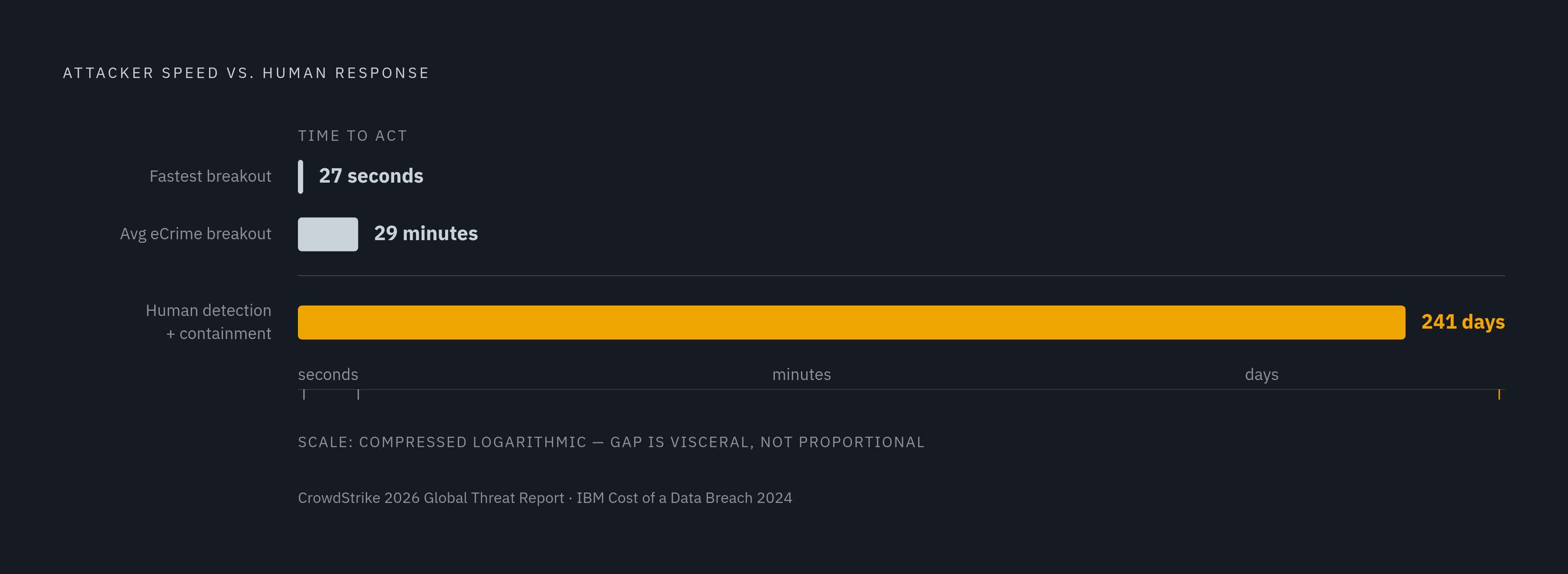
Speed is the variable that changes the operating math, though. CrowdStrike's 2026 Global Threat Report clocks average eCrime breakout time at 29 minutes, with the fastest recorded case at 27 seconds. Any security model that depends on a human noticing an alert, logging in, and starting an investigation is too slow by design, not by accident. Attackers using AI assistance pushed operations up 89% year over year, squeezing the gap between initial access and lateral movement even tighter than it already was.
Antivirus, NGAV, EDR, and MDR for a lean team
Traditional antivirus checks files against a list of known bad signatures. Fine against threats someone's already catalogued. Blind to fileless attacks and living-off-the-land techniques, the ones that abuse PowerShell, WMI, or scheduled tasks and never write a file to disk.
Next-gen antivirus (NGAV) adds behavioral heuristics and machine learning on top of that layer. It catches more than signature-based AV does, but it's still a prevention tool at heart. Investigation depth stays thin, and thin investigation depth means a real incident still needs a human to chase it down.
Endpoint detection and response (EDR) goes further. It watches endpoint behavior continuously, flags activity that looks wrong even if nobody's seen that exact threat before, captures forensic detail, and can isolate a compromised machine on its own. An alert firing, though, isn't the same thing as a problem getting fixed. EDR assumes someone qualified is watching the console and ready to act on what it surfaces. That assumption is exactly where it falls apart for a five-person IT shop already juggling helpdesk tickets.
Managed detection and response (MDR) wraps EDR with an actual security operations center. Analysts investigate the alert, confirm it reflects a real threat, and act on the customer's behalf. This is where the math changes for a lean team: the staffing burden moves off the customer's plate and onto the provider's. For a team with zero dedicated security headcount, that shift is essential. It's the whole point.
The operational questions that matter more than feature comparisons
Before comparing any specific product, a lean team should work through a short set of questions. These sort the field faster than any spec sheet will, and they affect how quickly a lean team can rule out mismatched products, carrying more weight than whatever's on page one of a vendor's datasheet.
Who responds when an alert fires? If nobody's watching around the clock, a self-managed EDR tool is a detection system with no response function attached. That gap has a real cost: a small business without dedicated security staff faces breaches that take an average of 241 days to identify and contain. This single question splits the market into two camps, managed response (MDR) and do-it-yourself (EDR), and most lean teams already know which camp they belong in before they open a single demo.
How many endpoints actually need coverage, and are they all accounted for? A 10-person company can easily have 30 or more endpoints once home offices, phones, and on-site hardware get counted. The ones that get forgotten most often: mobile devices, networked printers, BYOD laptops, and cloud workloads or VMs sitting somewhere nobody's tracking. Scope drives both licensing cost and management complexity, and both scale right alongside headcount.
How long will deployment actually take, and who owns it? A tool that needs months of professional services just to get configured is a liability for a small team, full stop. It delays protection and eats up bandwidth the team doesn't have to spare. Deployment timeline gets underweighted in almost every vendor evaluation out there, and it shouldn't be.
Main endpoint protection options: comparison on operational fit
The comparison here runs on managed versus DIY, deployment complexity, the alert model, and how well the tool fits a team with no dedicated security staff. A feature-by-feature scorecard is not the point, since feature scorecards are what led lean teams into this mess to begin with.
Huntress Managed EDR
Built from the ground up for organizations without a security team on staff, this is an MDR model where the 24/7 SOC comes standard by default. It handles behavioral and living-off-the-land detection, including PowerShell and WMI abuse, and pairs that with human-led investigation and response. The reported false-positive rate sits under 1%, and remediation notes come back in plain language rather than raw log output, which matters more than it sounds like when the person reading them isn't a security analyst.
Average mean time to respond runs about 8 minutes for EDR incidents and 3 minutes for identity-based threats, with optional Managed ITDR and Managed ISPM layers for hardening Microsoft 365 specifically. Pricing starts at $8.99 per month.
Operational fit for a lean team is high. Huntress analysts handle the response, so the internal team receives a finished finding instead of a raw alert. The tradeoff: it's a weaker match for a company that wants to run every security layer in-house rather than hand off response to a third party.
Microsoft Defender for Business
For organizations already on Microsoft 365 Business Premium, this is often already paid for, which makes it the cheapest marginal option for a Microsoft-heavy SMB. It runs as a single SMB tier that folds in Defender for Endpoint Plan 1 features along with select Plan 2 capabilities, including EDR and automated investigation, and it draws on one of the largest threat-intelligence networks in the industry.
The DIY model produces detection without resolution. Alerts still need internal staff, or a managed partner, to investigate and close out, and without that layer sitting on top, the same gap that occurs with any standalone EDR tool occurs here. It fits best for SMBs standardized on Microsoft's ecosystem with at least some internal IT capacity, or ones willing to pair it with a managed response service on top. Buying it alone and assuming it's "handled" is the mistake to avoid.
Sophos Intercept X / Sophos MDR
Sophos pricing varies by tier, with MDR bundled in if the organization buys the MDR tier. Known for deep learning malware detection, anti-ransomware rollback, and exploit prevention. The MDR tier closes the same staffing gap that Huntress addresses directly. The base tier alone is detection-only and still needs internal follow-through to be useful, so anyone buying it should expect that, not a hands-off solution. It's the strongest fit for organizations already standardized on the Sophos ecosystem.
Matching tool choice to team size: three operating profiles
Profile 1: The micro-business
Under 10 employees, no dedicated IT, and security is whatever the founder or office manager can squeeze in between everything else. Micro-businesses see a 43% breach success rate on attempted attacks, compared to 18% at mid-sized organizations. That gap is operational: the attacks aren't more sophisticated, but there's just nobody there to catch them.
This team can deploy an agent. It cannot tune an EDR console, and pretending otherwise is how breaches turn into 241-day discoveries. So the direction here is MDR by default, something where the SOC owns response from day one. Huntress Managed EDR fits this profile well given its per-endpoint pricing and lack of a contract minimum. Sophos's MDR tier works too for a company already inside that ecosystem.
Alongside whatever endpoint tool gets picked, a few things matter just as much: MFA on every application, disk encryption turned on everywhere, and backups that actually get tested rather than just scheduled. None of that needs a security expert to set up, and all of it closes off the attack paths that get used the most.
Profile 2: The growing SMB
Somewhere between 10 and 100 employees, one or two IT generalists on staff, Microsoft 365 as the backbone. This team has more capacity than the micro-business, but it's still stretched thin. They can manage a console. They cannot staff round-the-clock alert review on top of everything else already on their plate.
Microsoft Defender for Business is probably already licensed here, so the real question is which tool to buy. It's whether to layer a managed response service on top of what's already running. A service that sits above Defender and investigates what it surfaces keeps the familiar tooling in place while adding the response function that's missing. BYOD devices and remote endpoints are the likeliest coverage gap, and mobile device management enforcement closes the policy hole that endpoint agents alone don't touch.
Patch management deserves more attention than it usually gets, too. Unpatched vulnerabilities remain a leading root cause of ransomware incidents, and no endpoint tool, managed or not, fixes an unpatched server on its own.
Profile 3: The regulated or compliance-driven SMB
Size matters less here than the framework hanging over the business, HIPAA, SOC 2, or something similar. Cyber insurance carriers increasingly require EDR as a condition of coverage, and both SOC 2 and HIPAA call for documented endpoint controls with a clean audit trail behind them. For this profile, the tool has to produce evidence, not just protection: the reporting and audit-log capability of whatever's chosen matters as much as its detection quality, sometimes more, since an auditor doesn't care how fast the malware got caught if there's no paper trail proving it.