Endpoint Policy Standardization Across Heterogeneous Device Fleets
Unified platforms catch policy drift before audits expose misaligned device rules.
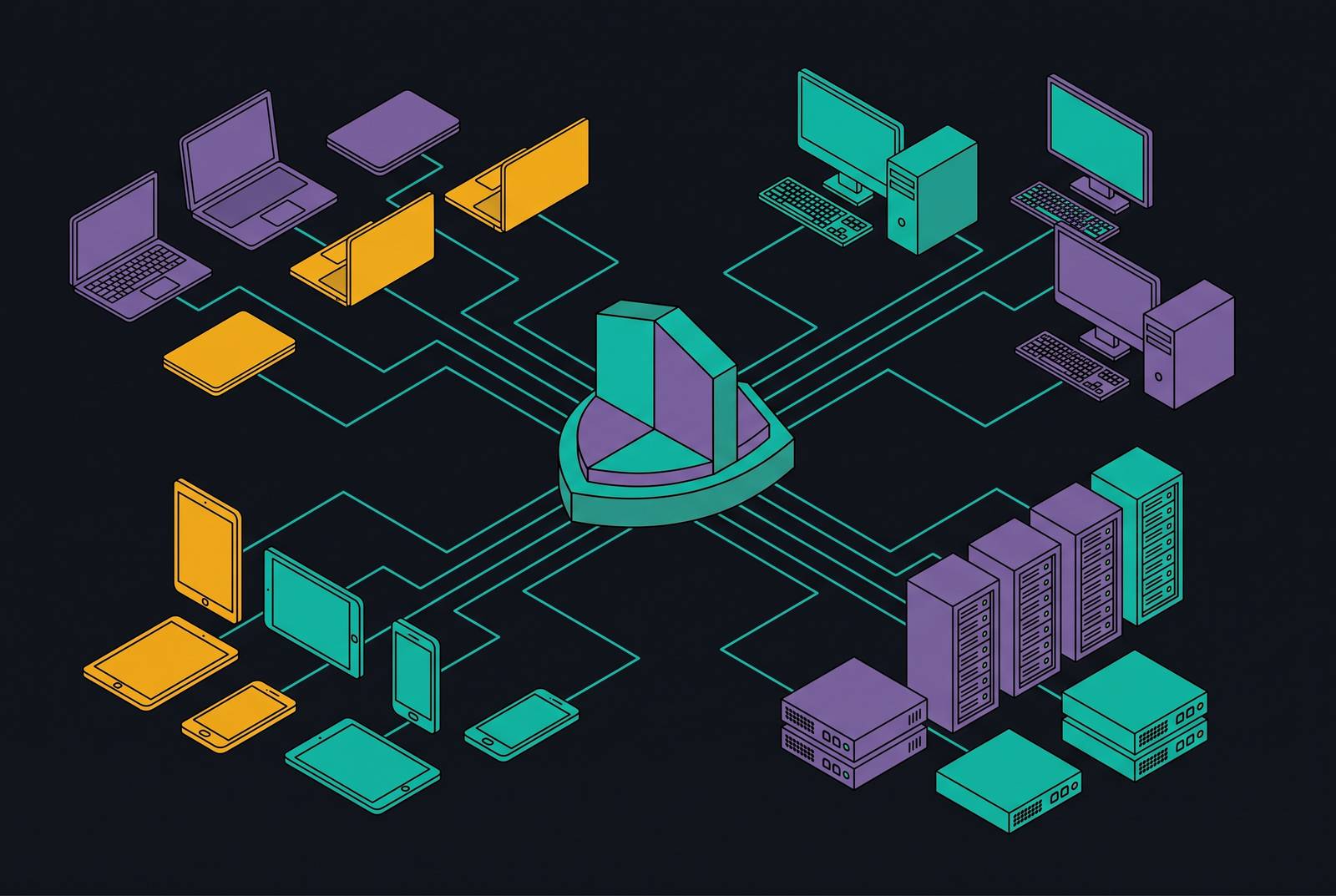
Policy drift is what happens when a security rule stops meaning the same thing everywhere it's supposed to apply. A company sets a rule, say, every device must run disk encryption. On paper, that's one rule. In practice, if Windows machines get that instruction from one console, Macs from another, and Linux boxes from a third, the rule stops being one thing. It becomes three separate implementations, each reported on its own schedule, each with its own definition of "done." The gap between the rule as written and the rule as actually enforced on a given machine, that gap is policy drift, and it's rarely visible until an audit or an incident goes looking for it.
This isn't a story about someone fat-fingering a setting. Drift is structural. It shows up because the tools governing different parts of a fleet were never built to talk to each other, and the fragmentation between them creates room for the intended state and the actual state to quietly diverge. A profile can fail to apply on a laptop and the management console will still show it as compliant, because most tools only confirm that an instruction went out, not that anything actually changed on the device. That silence is the whole problem in miniature.
How heterogeneous fleets stay fragmented
Nobody sets out to run three device management platforms at once. It happens in stages, usually for reasons that made sense at the time.
Sometimes it's team preference: the Mac group picks a tool built around Apple, the Windows admins pick something else, and neither group ever circles back to reconcile the two. Sometimes it's device specialization: a company picks an Apple-focused mobile device management platform because it handles macOS and iOS enrollment better than anything general-purpose, then bolts on a separate agent to cover Linux servers because the first tool never touched that OS well. And sometimes it's just leftovers: a merger brings in a second fleet running a second toolset, growth outpaces IT's ability to consolidate, and five years later nobody remembers why there are two products doing the same job.
Whatever the path, the destination looks the same. Many organizations end up running multiple endpoint management tools side by side, each with its own enrollment flow, its own compliance dashboard, its own patch and remediation timeline. Enrollment is where the fragmentation actually starts, well before any policy gets enforced. Apple, Microsoft, Android, and Linux each hand off a device through a different mechanism. One "desired configuration" for a new laptop turns into four separate provisioning paths depending on what operating system that laptop happens to run, and each path has its own quirks, delays, and failure points.
The tool market reflects this split. Apple-centric device management platforms are built for speed and depth on macOS and iOS, and they've gotten better at reaching beyond Apple's own ecosystem over time, though for a long stretch they needed a companion tool to cover Windows or Linux devices in the same fleet. Other platforms go deep on macOS and iOS specifically and lean on outside tools for Windows or Android. And there are cloud directory platforms built around the opposite premise: put identity and device control in one place from the start, so a company isn't running separate systems for authentication and for endpoint policy. Each approach solves a real problem. None of them, on its own, erases the seams between operating systems unless it was built from day one to cover all of them.
Where drift shows up: the practical failure modes
Drift isn't abstract once you look at where it actually lands. Four failure modes appear repeatedly in mixed-OS fleets.
First, the same rule gets expressed differently by OS. "Require disk encryption" sounds like a single policy, but the technical mechanism enforcing it, and the way each platform verifies it's actually on, differs by operating system. The result: three different real-world outcomes from one intended rule.
Second, compliance evidence has blind spots. Frameworks like SOC 2, HIPAA, PCI-DSS, ISO 27001, and NIST all want the same basic things: inventory, encryption status, audit trails. But if three tools are generating three different report formats for three different slices of the fleet, "build the evidence once, reuse it for every framework" stops working. Someone has to manually reconcile formats before an auditor even sees the data.
Third, remediation slows down. Chasing a single device incident across two or three consoles adds real time to every investigation, and if the security team (or the one IT person wearing that hat) can't say in five seconds which console is the system of record for a given control, the organization is already carrying governance debt it doesn't know about yet.
Fourth, licensing and ownership sprawl. Separate tools for MDM, patching, and policy create overlapping subscriptions and overlapping ownership, and no one function always knows which console holds the authoritative record for a particular device. The tell here is overlapping licenses, inconsistent reports, the same manual step done three different ways, and long resolution times whenever someone has to jump between tools to chase down one alert.
Drift isn't limited to laptops and servers, either. Multifunction printers sit at an odd intersection: they handle physical documents, they're networked, and they process sensitive data constantly, yet in most security programs they get almost none of the patch discipline applied to a standard workstation. They're one of the most overlooked endpoint categories out there, quietly extending the same drift problem into hardware nobody thinks to check.
What consistent enforcement requires across Windows, macOS, and Linux
Consolidating tools isn't the goal. Consistent outcomes across every OS are the goal, and fewer tools is just one way to get there.
Four things have to be true for enforcement to actually hold together.
State verification has to replace command acknowledgment. A platform has to check what's really configured on a device. A profile that silently fails to apply should never appear compliant in the system just because the command went out; the system needs to check repeatedly and confirm the change actually took.
Evidence has to share one format. Device inventory and configuration status need to read the same way no matter which OS produced them, so a compliance report doesn't need a translation layer before an auditor can use it.
Remediation has to be automatic. Writing a policy is the easy half. Remediation has to be automatic: restrict an app, push a required update, or quarantine a device that's out of line, without waiting on a human to notice first.
And identity has to connect to device posture. Endpoint sprawl turns into an identity problem the moment device health starts influencing who gets access to what. Conditional access is the clearest example of this in practice: tie device compliance to access decisions, so a device without encryption or without a current OS version simply can't reach Microsoft 365 or other core systems until it's fixed. That single mechanism turns a policy statement into an actual gate.
There's also a shift underway in how the policy itself gets defined and changed. Instead of a setting living inside someone's memory of a console click from six months ago, some teams now write policy as declarative configuration, applied through the same CI/CD pipeline used for software, reviewed in a pull request like any code change, and corrected automatically the next time it runs if a device has drifted. That's config-as-code applied to endpoint policy, and it's becoming a real expectation for teams managing mixed fleets, because it makes posture something you can audit and roll back, not something you have to trust someone remembered correctly.
Unified Endpoint Management as the operational model for closing the gap
Unified Endpoint Management, UEM, is the model built to close this gap. It runs Windows, macOS, and Linux devices through one control plane, so policy, patching, compliance reporting, and remediation all live in a single system instead of three.
The sequence matters more than the label. Start by auditing every policy currently in force across every platform in the fleet, so the actual current state is on paper somewhere instead of scattered across three admins' heads. Then rationalize: sort those policies into clear categories, security, compliance, application management, device settings, and standardize what "compliant" means in each category regardless of OS. Only then does enforcement move to automated checks and automated remediation, replacing whatever manual review process filled that gap before.
Standardize the policy definitions before standardizing the tools. If a company rationalizes what "disk encryption required" actually means, in concrete terms, before it picks the platform that will enforce it, the transition between tools doesn't create a second wave of drift on top of the first.
And before licenses get consolidated or platforms get merged, every control needs a named owner, one system recorded as the authority for that control, one person or team accountable for it. Skipping that step doesn't make the governance debt disappear when the new platform goes live. It just moves house.
Policy drift as a compounding risk for SMBs with no security team
Small and mid-sized businesses feel this problem differently than a company with a dedicated security function, and the numbers back that up. According to Proton's SMB Cybersecurity Report 2026, 92% of SMBs said they'd invested in security measures. Even so, one in four had still suffered a cyberattack or breach in the past year. That gap between money spent and outcomes achieved is mostly a human one, not a tooling one.
Separately, 93% of companies rank cybersecurity as a top priority, yet more than half run with one or fewer full-time security professionals, and close to a third have none. Priority and staffing are two different things, and the distance between them is where drift lives.
Without a dedicated team, nobody's job is to notice when one console says a device is compliant and another platform, or a manual check, says otherwise. Drift sits there undetected for longer, because there's no one cross-referencing enforcement across tools day to day. It becomes visible during an audit, or worse, during an incident, when it's far more expensive to fix.
Human error compounds the technical side of this. Among SMBs, 39% report a cyber incident tied to human error, credentials shared over the wrong channel, or a routine security step skipped under deadline pressure, widening the exposure created by policy drift. None of that is a device-level failure. But layered on top of policy drift that's already going unnoticed, it widens the actual exposure well past what either problem would cause on its own.
The minimum controls that a unified policy framework must enforce from day one
For an SMB without a security team, certain controls are the floor. They're the floor.
- Multi-factor authentication, enforced at the device and identity level together, not bolted onto individual apps one at a time
- Disk encryption, enforced as a checked compliance state, not a guideline someone's supposed to follow
- OS updates, pushed and enforced on a schedule, not left up to whether a user feels like restarting their laptop
- An approved software list, so what gets installed is a matter of policy, not personal preference
- Endpoint detection and response, running on every device like a flight recorder, catching a threat where it actually starts
Two more controls round this out and don't fit neatly into a short list. Backups need to be encrypted and tested on a real schedule, with someone confirming a restore actually works. And network segmentation has to separate what a compromised device can reach from what it can't, so one bad laptop doesn't become a path to everything else.
Access itself needs the same discipline. Least privilege isn't a one-time project, it's an ongoing policy: give people only what their job actually requires, and when a company grows fast, go back and clean out the old permissions nobody remembers granting. Stale accounts and forgotten access are one of the more common ways a fast-growing company ends up exposed without realizing it.
Conditional access ties all of this together at the access layer. Limit entry to the applications that matter, Microsoft 365 among them, unless the device requesting access meets the baseline: encrypted, patched, current. It's the mechanism that ties the baseline requirements directly to the access decision itself. It's the mechanism that makes every other control on this list count for something at the moment access is requested, and at the moment a policy was written down.
Sources
- Hardening the Edge — Firmware Vulnerability Management for the MFP Fleet
- Unified endpoint management cuts cost and control gaps in multi-OS fleets
- Top 10 Unified Endpoint Management Best Practices for 2026
- How to Build a Modern and Unified Endpoint Management Strategy - Read More
- Top 11 endpoint management challenges for IT Admins in 2025 and best practices to solve
- Effective Endpoint Security Policy in 2026
- fleetdm.com
- nhimg.org