Tiered Endpoint Security for Contractors and Temporary Workers
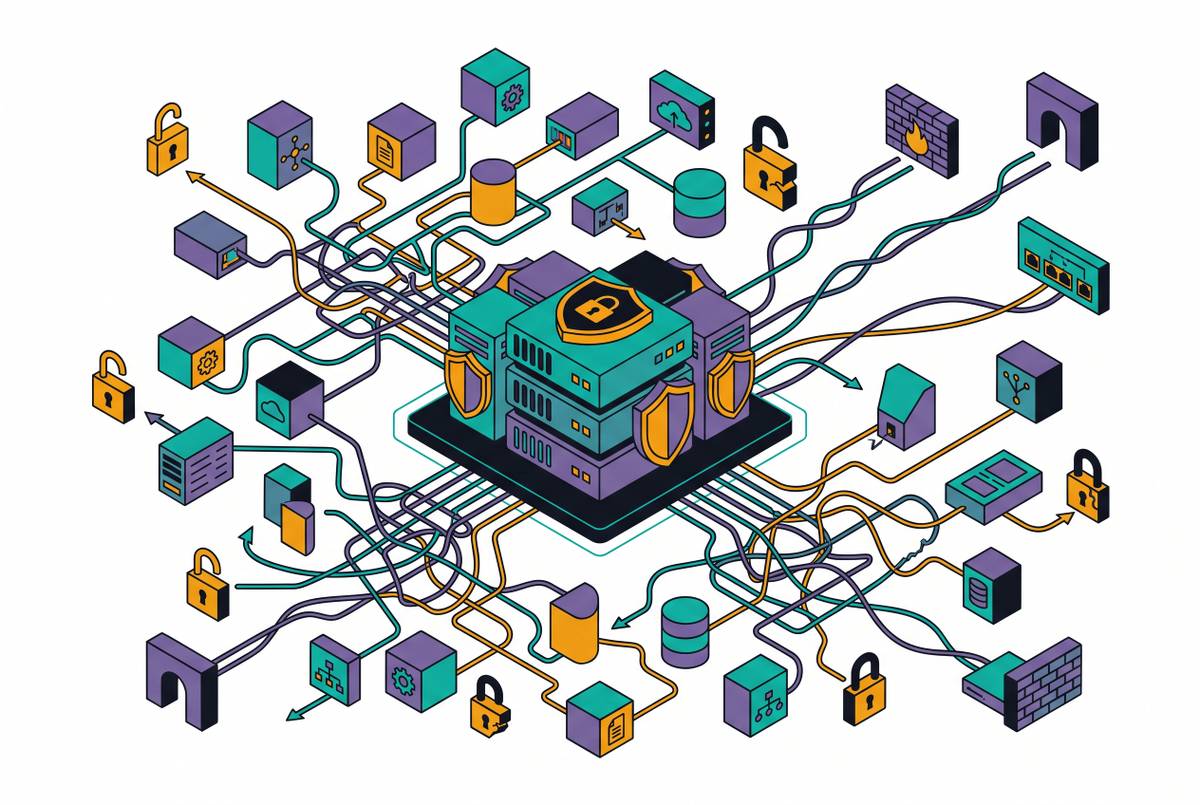
A tiered security model matches contractor access to engagement length and data sensitivity.

Contractors and temporary workers don't fit the standard employee security model, yet most companies hand them one anyway. The fix is a tiered approach, one that matches access, device policy, and offboarding to how long someone's actually around and how sensitive their access needs to be, without requiring a full security team to run it.
The contingent workforce is structural now. It's structural. The 2025 ISC2 Cybersecurity Workforce Study found that 20% of organizations outsourced work, 19% brought in third-party providers, and 17% hired temporary contractors specifically to offset gaps in security staffing. Contractor use is growing at the exact moment internal security capacity is shrinking. ISACA's State of Cybersecurity 2025 found that 65% of organizations have unfilled security roles right now and 55% describe their own teams as understaffed, with contractor use growing at the exact moment internal security capacity is shrinking. These aren't unrelated numbers. The organizations short on staff are the same ones leaning harder on contractors to fill the gap.
Contractors usually get the same onboarding as a full-time hire: a directory account, MFA enrollment, and often local admin rights, so IT doesn't have to field a support ticket every time something ne... Contractors usually get the same onboarding as a full-time hire: a directory account, MFA enrollment, and often local admin rights, so IT doesn't have to field a support ticket every time something needs installing. But none of the accountability that comes with being a long-term employee follows them. No manager checking in on their laptop hygiene six months in. No performance review nudging someone to ask what they still have access to. Local admin rights, in particular, are a strange thing to hand out casually. That "convenience" is precisely the privilege level an attacker wants once they've compromised the account, because it lets them move laterally through the network instead of getting stuck in one corner of it.
Contractors also break assumptions the standard employee policy was never built to handle: short timelines, a different employer signing their paycheck, personal laptops, home Wi-Fi instead of the office network, and sometimes a completely different country's legal framework. Every one of those variables changes the threat model. And all of it feeds into the same downstream problem: orphaned accounts sitting around with more access than anyone remembers granting. That's the tension the rest of this piece is built to resolve.
The offboarding failure that turns temporary access into permanent exposure
Access that was only ever supposed to be temporary has a bad habit of becoming permanent, simply because nothing happens when the engagement ends. Research into offboarding gaps has found that the vast majority of former employees still have access to sensitive corporate systems after they've left. Contractors, whose offboarding tends to be even less formal than a full-time employee's, aren't spared from that number. If anything, they're more exposed to it.
Research into offboarding practices has found that only about half of businesses even know that former employees still have live access to internal systems. Not half of them have fixed it. Half of them are aware of it. A meaningful share of those companies went on to experience a breach traceable to exactly that gap. And stolen credentials remain one of the leading initial access vectors in recent breach data. An over-provisioned, unmonitored contractor account is a steady supply of the kind of credentials that show up in that statistic.
Picture the account itself: someone who hasn't logged in for months, no longer under contract, admin rights still active, and nobody assigned to check it because nobody's job includes checking it. That's not a hypothetical edge case. That's the default state contractor accounts drift toward without a defined offboarding trigger.
Why does this keep happening? Because contractor offboarding rarely runs through the same process as employee offboarding. There's no HR exit interview, no return-of-equipment checklist, no system that automatically kills an account the day a contract ends. And the list of things that need revoking is longer than most people assume:
- Primary directory or SSO login, plus every MFA factor tied to it
- VPN and Wi-Fi credentials, email, and collaboration tools
- Cloud console roles, API keys, tokens, and access to code repositories or CI/CD pipelines
- Data platforms, third-party vendor portals, shared or privileged credentials, and physical badges
Missing even one item on that list means the offboarding was never really complete. This is the most expensive failure mode in contractor security, and it's the exact problem the tier framework below is built to close, by making deprovisioning automatic instead of something a human has to remember to do.
How to define the tiers: matching access controls to engagement duration and data sensitivity
Least privilege usually gets talked about in terms of permission scope alone. It should also apply to how long someone has access, what kind of device they're using, and what event triggers the account getting shut off. Two variables decide where a contractor lands: how long the engagement runs, and how sensitive what they're touching actually is.
Duration breaks into three rough bands: short-term work lasting days to a few weeks, project-based work running one to six months, and extended or recurring engagements past six months. Sensitivity breaks into three bands too: no access to sensitive systems at all, access to internal data, and access to privileged or administrative systems. Crossing those two axes produces three practical tiers.
Tier 1, low risk and short-term, gets read-only or narrowly scoped access on a company-managed or locked-down device, no local admin, and credentials that expire automatically the day the contract ends. Tier 2, moderate risk on a project basis, gets access to internal systems on either a managed device or a personal device with an MDM profile enforced, MFA required everywhere, and access scoped tightly to the specific project's resources. Tier 3, higher risk and often longer-term, covers anyone touching privileged or admin-level systems: company-issued managed device only, full EDR coverage, identity re-verification at onboarding and again at any role change, and a phased offboarding process tied directly to the contract's end date.
Identity verification isn't a one-and-done checkbox, especially at Tier 3. Anytime someone's role shifts mid-engagement or their access escalates, that's a re-verification trigger, not a formality to skip because the paperwork's already on file.
Tier assignment belongs at onboarding, not something improvised three weeks into the engagement once someone realizes the contractor needs more access than expected. It comes down to two questions asked before day one: what does this person actually need to touch, and when does this end. Naming the tiers explicitly gives a founder, an IT generalist, or an ops lead running things solo a shared vocabulary. Nobody has to interpret vague policy language on the fly. They just have to answer two questions and place the contractor in a bucket.
Device policy for each tier: company-owned, BYOD, and the MDM middle ground
Device ownership is where contractor security splits hardest from the employee playbook. Contractors show up with their own laptops, connect from networks the company has zero visibility into, and walk away at the end without returning anything, because there's often nothing company-owned to return. The old assumption, a firewall sitting in a server room protecting everything behind it, doesn't hold anymore. The actual front line now is a laptop on someone's home Wi-Fi that IT has never touched.
For Tier 1, keep it simple: browser-based access only, nothing stored locally, no device enrollment required. Scope it to what the contractor genuinely needs to do the job, not to whatever setup is fastest for IT.
For Tier 2, BYOD works, but only with an MDM profile enrolled as a condition of getting access. That enforces disk encryption, a screen lock, and the ability to wipe corporate data remotely, without touching anything personal on the device. Full-device MDM enrollment is different from an app-level or container-only profile, and for BYOD, the container approach usually fits better since it doesn't give the company control over the entire personal device.
Tier 3 doesn't leave room for BYOD. Company-issued, fully enrolled in MDM, EDR agent running, no local admin, software installs locked down by policy. The device gets returned or wiped the day the contract ends, and that return event is what triggers deprovisioning on the account side too.
The MDM middle ground is where small and midsize companies actually save money. It gives visibility into whether a BYOD laptop is encrypted and patched, without the company having to buy and ship hardware to every contractor who signs on for a six-week project. A 2026 endpoint security pricing guide found that basic endpoint protection runs $2 to $6 per device per month. EDR coverage suited to Tier 2 or Tier 3 runs $10 to $25 per device per month. Fully managed endpoint security, for companies without anyone in-house to run it, runs $25 to $80 or more per device per month. Tiering is a budgeting decision here too. It's a budgeting decision, since paying Tier 3 pricing for a Tier 1 contractor is money spent on protection nobody needed.
Pricing model matters almost as much as the tier itself. Per-device pricing fits a tightly controlled, company-owned fleet, which is typically the Tier 3 setup. Per-user pricing tends to work better for BYOD or mixed environments at Tier 2. Read the fine print either way: some per-user licenses quietly cap the number of devices included, and that cap raises costs or blocks access right when a contractor switches laptops mid-project.
A phased offboarding workflow that doesn't depend on anyone remembering to do it
Offboarding has to be triggered by the contract end date sitting in a system somewhere, not by a person remembering to file a ticket on someone's last day. Memory is not a control. A calendar date is.
For planned contract endings, access reduction should start during the notice period, not on the final day:
- One week before the end date: elevated and admin privileges come off first. A Tier 3 contractor should lose privileged access before they walk out the door, not after.
- Final week: remaining access on sensitive systems drops to read-only.
- Final day: everything else gets shut off, across every system the person touched.
That last step needs a full checklist, not a quick pass on the main login. It should cover: the primary IAM or SSO identity, every MFA factor, VPN and Wi-Fi credentials, email and collaboration tools, cloud console roles, API keys and tokens, code repositories and CI/CD pipeline access, database and object storage access, third-party or vendor portal logins, any shared or privileged credentials, physical badges and smartcards, and access into customer or partner environments if the engagement touched any.
Device return matters just as much as credential revocation, and it's the physical half of the same process. For a company-issued Tier 3 laptop, the return itself should trigger a confirmation step in the offboarding record. For BYOD under an MDM container, the wipe of the corporate side of the device happens on the final day, leaving the contractor's personal files untouched.
None of this runs itself without an owner. Someone has to be named, by name, against a specific engagement, responsible for working through that checklist. Not "IT" in the abstract. A person. Without that, the checklist is a suggestion nobody's accountable for finishing, and the broader research finding about businesses not even knowing former employees still have access isn't really a policy failure. The policy usually already exists somewhere in a document. It's a trigger failure: nothing in the system forces the checklist to run.
Applying this framework when there's no dedicated security team running it
None of this works if it requires a security analyst sitting around dedicated to babysitting contractor accounts, which most small and midsize companies don't have and can't hire for. Proton's 2026 SMB Cybersecurity Report found that 39% of SMBs report facing a cyber incident caused by human error. A tiered framework cuts down the number of judgment calls a person has to make in the moment, and fewer judgment calls means fewer chances to get one wrong.
The staffing math doesn't help either. The 2025 ISC2 study found 59% of organizations report critical or significant skills gaps in security, up from 44% the year before. The teams that would normally run a program like this are the same teams already stretched too thin to take it on.
The practical path forward is consolidation: device management, identity protection, and compliance enforcement living in one platform, rather than five separate tools for MDM, EDR, identity, and offboarding that someone has to manually keep in sync. A platform built around this kind of framework should enroll a device at onboarding with the correct tier's policy already configured, enforce least-privilege access without an admin manually setting every permission by hand, kick off offboarding from the contract end date automatically, and show device compliance (encryption, patch status, EDR coverage) across both company-owned and BYOD devices in a single dashboard.
For a company without a dedicated security team, that kind of platform is usually a better first move than either handing security off to a managed service provider as a bolt-on, or piecing together five point solutions that each need expert-level setup to run correctly. An MSP model wasn't built with adversarial defense as its core job, and a fragmented stack demands the exact in-house expertise that's already in short supply. Deployment speed affects how quickly a contractor engagement is secured: a platform that gets running in weeks, not months, means a new contractor engagement can be secured from day one instead of sitting exposed while configuration work drags on.
The same rule from the offboarding section applies here again: someone has to own it. One named person whose job includes reviewing contractor access every quarter. If the dashboard is doing its job and surfacing the right data automatically, that review might only take fifteen minutes. It still has to be someone's job, on the calendar, not a task that floats without an owner until it quietly stops happening.
Even a well-configured platform benefits from a short, plain document handed to every contractor at the start. Not a full security awareness course, just one page covering what devices and credentials are acceptable, what to do if something looks off, and who to contact. It's a scope-setting document, not training. But it closes the gap between what the system enforces and what the contractor actually understands they're supposed to be doing.
Sources
- 2025 ISC2 Cybersecurity Workforce Study
- Endpoint Security Cost: 2026 Pricing Guide (Per Device)
- When the Contract Ends but Access Doesn’t: Securing Privileged Access for Temporary Staff
- Contingent Workforce Risk: A Complete Guide
- Why do delayed offboarding processes create security risk?
- Employee offboarding: Guide to secure access revocation in 2026
- User offboarding gaps expose security and SaaS costs
- deel.com