Lean IT Team Endpoint Security Benchmarks
Measurable security goals built for IT teams without a dedicated security staff.
Cybersecurity has become one of the top concerns keeping small business owners up at night heading into 2026. That ranking checks out once you look at staffing: most SMB owners handle security themselves, and a significant share report that whoever's in charge lacks sufficient training for it. Small business is the target now. This piece lays out six benchmarks built for teams without a dedicated security staff, so lean IT can measure where it stands and fix the gaps that actually get exploited.
Why enterprise benchmarks fail lean teams and what "calibrated" means
Most published security frameworks (CIS controls, NIST guidelines, SOC 2 audit criteria) assume somebody's around to tune detection rules, sort through alerts every day, and run tabletop exercises on a monthly schedule. Fair assumption for a company with a security operations center. Fantasy for a five-person IT department supporting a company ten times that size.
More than half of companies run their security function with one or fewer full-time security people, even though most of them call cybersecurity a top priority. The staffing never matches the stated concern, and it isn't close. A large share of small companies, under 50 employees, have no dedicated cybersecurity budget at all, which means any benchmark built around "buy enterprise-grade tooling" fails before anyone finishes reading it.
A benchmark that actually works for a lean team has to clear three bars. Measurable without specialist tooling or a consultant on retainer. Hittable with the headcount already on staff. Tied to a documented attack path, not an audit checkbox. The six that follow were picked because they clear all three.
The five attack paths lean teams must close first
Before setting targets, it helps to know exactly where attackers get in. Verizon's 2025 DBIR points to credential theft, phishing, and exploited software vulnerabilities as the dominant entry methods, with exploited vulnerabilities climbing 180% year over year. Unpatched systems have become a faster way in than they used to be, and that shift alone should reorder how a lean team spends its time.
Attackers are also abusing the remote-management tools a business already trusts, instead of dropping obvious malware a scanner might catch. That kind of abuse is climbing fast across the endpoint data security vendors track. Ransomware shows up in the overwhelming majority of SMB breaches, at a rate far higher than what larger organizations see. Small business is where ransomware operators focus first.
The last piece is technique. Living-off-the-land attacks use built-in Windows tools, PowerShell, WMI, scheduled tasks, instead of a file a scanner can flag. Standard antivirus looks for known malicious signatures, so it mostly can't see this kind of activity happening. That single fact reshapes what "endpoint protection" has to mean for the benchmarks below.
Benchmark 1: Patch latency: how fast unpatched endpoints get you breached
Target: critical and high-severity patches applied within 14 days of release, across 95% or more of managed endpoints.
Why 14 days? Exploited vulnerabilities are climbing fast, and in a majority of incidents, ransomware gets deployed within seven days of the initial break-in. Fall behind by two weeks or more, and the patch cycle runs slower than the attacker's timeline. That gap is exactly where breaches happen, and it's a gap that's easy to measure once you know to look for it.
Most mobile device management and unified endpoint management platforms report patch compliance as a percentage right on the dashboard. No manual audit needed.
The failure mode is coverage. Office desktops get patched on schedule. Remote laptops and employee-owned devices connecting to company systems often don't. The benchmark only counts if it covers every managed endpoint, including the ones nobody in the IT room can actually see.
Benchmark 2: Credential and identity hygiene: the targets attackers hit most reliably
Target: multi-factor authentication enforced on 100% of accounts touching business-critical apps or admin consoles. No exceptions for executives, none for IT admin accounts either, since those are exactly the accounts attackers want most.
Credential theft drives more breaches than any other entry method, which makes MFA the single highest-leverage control a lean team can flip on. Cheap. Fast to deploy. It shuts the most commonly exploited door in the building, and there's no version of a security budget too small to afford it.
Two supporting benchmarks matter almost as much. Offboarding comes first: zero active accounts for departed employees as quickly as possible after their last day. Accounts left live after someone leaves are consistently flagged as a top-tier risk. Password hygiene comes second, unique credentials enforced through a password manager rolled out to every employee, since reused or shared passwords are one of the most common ways human error turns into a breach.
Benchmark 3: Endpoint detection coverage: the difference between knowing and guessing
Target: behavioral endpoint detection and response (EDR) on 100% of managed endpoints. Not antivirus. EDR. Signature-based antivirus doesn't catch living-off-the-land techniques, because there's no malicious file signature for it to catch.
The real failure mode isn't a missing tool, it's partial coverage. A business running EDR on 80% of its endpoints hasn't cut its risk by 80%. It's told attackers exactly where the unmonitored 20% lives, and that's the door they'll try first.
Round-the-clock alert monitoring isn't realistic for a lean team. Almost no SMB can staff a 24/7 alert queue, and detection tooling without a response process behind it doesn't reduce risk, it just piles up data nobody reads. Sub-hour response time needs a staffed security operations center most lean teams will never have, so skip that goal. The achievable target is full coverage paired with a clear escalation path: who gets notified, and what they do next.
Benchmark 4: Security configuration baselines: the posture checks that prevent the breach before it starts
Four checks, all binary, all required on every managed endpoint. Full-disk encryption on. Screen lock enforced. The OS firewall active. No stray unauthorized local admin accounts sitting around.
These map directly onto CIS benchmark controls, and they're the exact device-level evidence SOC 2 and ISO 27001 auditors ask for. Automate these four checks and it does double duty: posture improves and the audit trail builds itself at the same time.
Most SMBs don't clear this bar. Fewer than half operate at what gets classified as full "Advanced Protection," meaning endpoint protection, enforced secure access, centralized security management, and regular OS and software updates all running together as one system, not four separate projects. Everyone else is missing at least one piece of that stack, and usually doesn't know which one.
Shadow IT belongs in this category too. Every SaaS app touching business data should be known and approved, not quietly adopted by a team that liked a tool it found on its own. That same logic that applies to unapproved AI tools covers any unapproved app touching company data, AI or otherwise.
Benchmark 5: Employee security behavior: the human layer most SMBs leave unmeasured
Human error appears somewhere in the chain of nearly every SMB breach, and social engineering attacks target SMB employees far more often than the average across all company sizes. The human layer is the primary surface attackers are working against. It's the primary surface attackers are working against.
A large share of SMBs run no security awareness training at all, and that's the baseline this benchmark exists to fix. The concrete target: phishing simulation training for every employee, at least once a quarter, with click rates tracked over time. Whether the click rate actually trends down over time determines the training's success.
Quarterly is the right cadence because phishing keeps changing shape under everyone's feet. AI-generated phishing emails now pull open rates substantially above what the older, clumsier attacks ever managed. Training on an annual cycle can't keep pace with tactics moving that fast, so annual training is close to worthless on its own.
Benchmark 6: Incident response readiness: the one benchmark most lean teams have zero score on
Most SMBs have no incident response plan. A plan nobody has tested is a document sitting in a folder, not a capability a team can actually execute under pressure.
CISA's target for recovering critical systems runs 4 to 24 hours. Without tested backups and a rehearsed recovery playbook, most SMBs blow past that window by a wide margin, and every extra day translates into lost revenue, not just a bad afternoon.
The benchmark has three parts. A written incident response plan exists. Roles get assigned ahead of time (Incident Commander, Technical Lead, Communications Lead, Legal/Compliance contact), and on a small team it's fine for one person to hold two or three of those hats. And the plan gets run through a tabletop scenario at least twice a year, not written once and filed away to gather dust.
Backups need a specific callout, since the vast majority of ransomware attacks deliberately go after backup locations first. Having a backup isn't the benchmark. An air-gapped or immutable backup, paired with a restore process that's actually been tested, is.
Measuring your current position against all six benchmarks without a security audit
Put together, the six benchmarks produce six clear scores: patch compliance rate, MFA and offboarding coverage, EDR coverage, configuration baseline pass rate, training completion rate, and a plain yes-or-no on incident response readiness. None of it needs an outside audit to calculate.
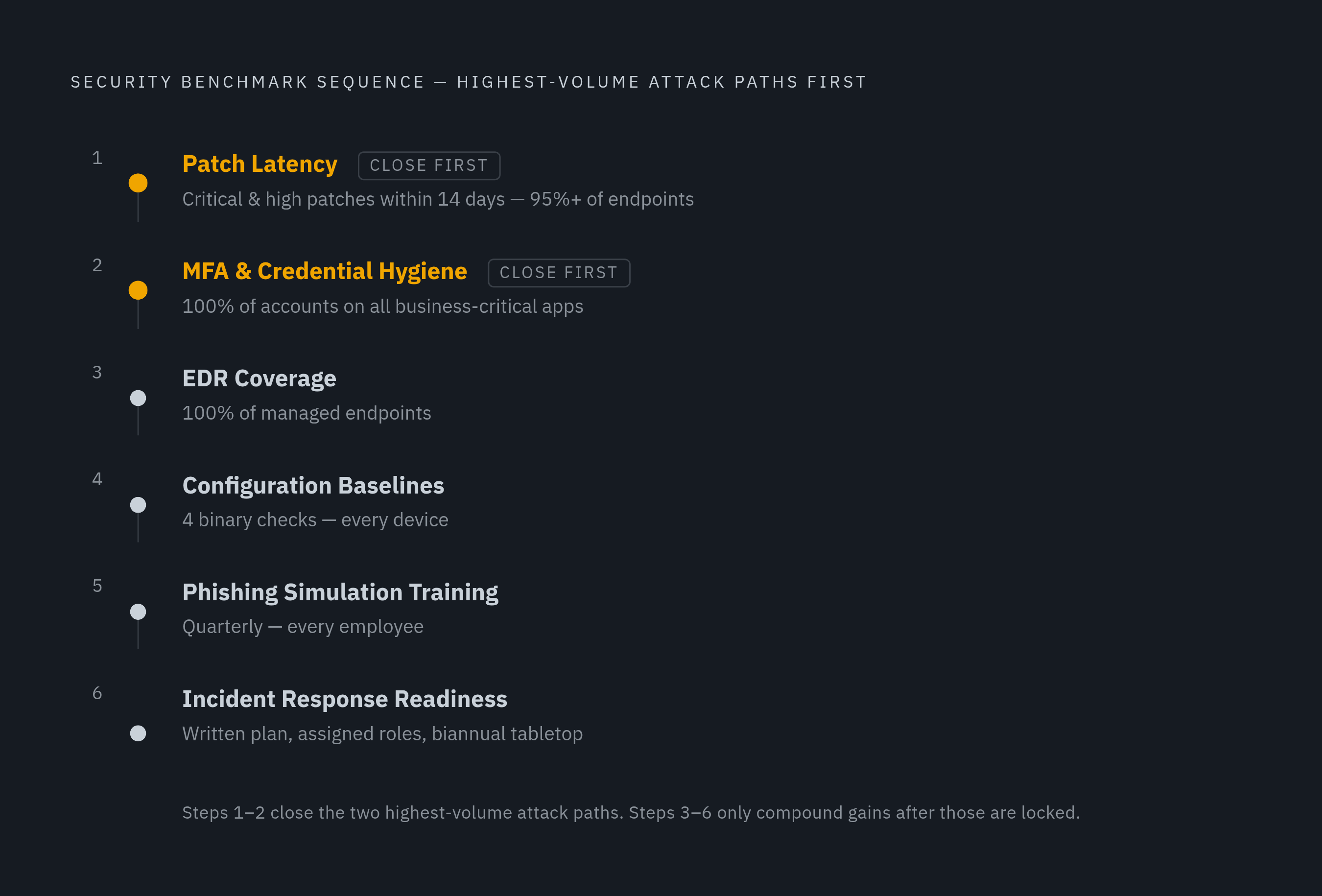
Sequence matters for a team starting from zero. Patch currency and MFA come first, since those close the two highest-volume attack paths covered above. EDR coverage comes next, then configuration baselines, then training, then incident response planning. That order isn't arbitrary. It closes the most probable breach paths before spending time on the rarer ones.
Weight these unevenly, because they aren't equal. A team at 80% patch compliance with MFA enforced everywhere sits in meaningfully better shape than a team at 100% patch compliance with no MFA. Coverage on the highest-leverage control beats perfection on a lower-leverage one, every single time, and any scoring system that treats these six as equally weighted is measuring the wrong thing.
None of this needs a dedicated security hire to pull together. MDM and UEM platforms already report patch compliance, configuration drift, and device coverage. Identity providers report MFA enrollment directly. Training platforms track completion automatically. Incident response readiness is the one item that's self-reported, since it's a plan and a rehearsal, not a system spitting out a log. Six numbers, pulled together in an afternoon, no consultant, no audit, no guessing where the real gaps sit.