HIPAA Endpoint Security Requirements for SMB Healthcare Organizations
Regulators are tightening HIPAA enforcement as small practices face rising ransomware threats.

The federal government is no longer treating HIPAA's Security Rule as paperwork to file away. The federal agency responsible for enforcement is treating it as a working cybersecurity program, one that has to hold up during a ransomware attack, survive a formal audit, and produce hard evidence after a breach.
Three things are happening at the same time, and together they explain why endpoint security is getting harder to fake. OCR has revived its HIPAA Audit Program, and the 2024-2025 round is reviewing 50 covered entities and business associates specifically on the Security Rule provisions tied to hacking and ransomware. A proposed rule (the NPRM) would tighten the Security Rule's language considerably, making it more specific about what counts as compliant. And OCR keeps bringing enforcement actions that point to the same root failure: an inadequate or missing risk analysis.
The NPRM has not been finalized. A coalition of hospital and provider groups sent HHS a letter in December 2025 asking the agency to withdraw the proposal entirely rather than revise it, and to start a new, more collaborative outreach process with providers instead. There's no confirmed date for a final rule. That makes the proposal a strong signal of where enforcement is headed. But OCR's audit program and its enforcement actions are happening now, under the current rule, and both are already pointing small practices toward the same set of controls the NPRM would make mandatory.
The NPRM's biggest structural change would be getting rid of the "required vs. addressable" distinction. Under the current rule, a small organization can treat something like encryption or multi-factor authentication as optional, as long as it writes down a reasonable alternative or an explanation for why the control doesn't apply. For years, a practice could skip real technical controls as long as its documentation looked reasonable. Under the proposal, that option mostly goes away. The same uniform baseline would apply to a solo practice and a large hospital system alike, regardless of size. HHS says the rule stays flexible in how entities can meet that baseline, but the baseline itself wouldn't bend for a smaller IT budget or a five-person office.
OCR's settlement with Comprehensive Neurology shows what "small" means in practice under current enforcement. The practice was hit by ransomware, and when OCR investigated, the core citation wasn't a missing firewall or an unpatched server. It was the absence of an accurate, thorough risk analysis. Size affects what's considered reasonable for a given organization to implement, but it doesn't remove the underlying requirement to know where the risk sits and address it.
What HIPAA's Security Rule requires at the device level
The Security Rule's technical safeguards translate into a specific, concrete set of things a practice has to do on every device that touches patient data. Knowing that mapping, from regulatory language to device-level practice, is the starting point for building an actual program instead of a binder of policies nobody follows.
Access controls require unique user IDs for every person, emergency access procedures for when normal login isn't possible, automatic logoff on idle sessions, and encryption or decryption processes for protected data. Every remote access point, every EHR login, and every privileged account needs strong authentication behind it, not just a password.
Audit controls need every endpoint to generate logs, keep them, and actually review them. That covers logons, privilege use, EHR access, and activity on removable storage devices. HIPAA expects this kind of record to be retained for six years, and the logs themselves need protection from tampering. A log an attacker can edit after the fact isn't an audit trail.
If unauthorized changes happen to systems that handle patient data, integrity protections stop them, through things like application control and file integrity monitoring. For data moving across a network, transmission security means current TLS encryption, and when something goes to someone outside the organization's own domain, it means secure email or a patient portal. Device and media controls govern how laptops, phones, and storage media get set up, wiped, and retired, plus what happens when one gets lost or stolen. Security incident procedures define how a practice detects, reports, and responds to an incident, and that process needs practice through drills.
Most small practices underestimate how much hardware and software this actually covers. An "endpoint" in a healthcare setting isn't just the desktop at the front desk. It includes shared nursing workstations, physician laptops, tablets and smartphones, personal devices used for work, imaging consoles, lab analyzers, infusion pumps, other connected medical devices, virtual machines, thin clients, telehealth equipment, and any peripheral or removable media capable of storing or moving data. All of it falls inside the scope of the rule.
The "minimum necessary" principle adds another layer: access should match what each role actually needs, nothing more. A billing clerk and a treating physician shouldn't have identical access to the EHR. Access controls have to be mapped to roles rather than applied the same way across the whole staff.
Administrative safeguards set the policy. Technical controls are what make that policy real and enforceable day to day. The direction coming out of the NPRM is clear on this: OCR won't just ask whether a control exists on paper. It wants evidence the control is actually operating, through tickets, scan reports, access review logs, restore test results, and configuration baselines.
Why small healthcare practices are the preferred ransomware target
Small and mid-size healthcare practices have become the path of least resistance for ransomware attackers, for two structural reasons: their defenses tend to be thinner, and the leverage an attack creates, disrupted patient care and the threat of exposed medical records, is worth more relative to how cheap the attack is to carry out.
Ransomware-as-a-Service has industrialized this economy. Groups that build the attack infrastructure license it out to affiliates who go find and compromise targets. That arrangement lowers the technical skill needed to run an attack and multiplies the number of people actively hunting for small, under-defended organizations.
Modern attacks also use double extortion. Attackers steal patient data before they encrypt a system, then they threaten to publish it if the ransom isn't paid. A practice with solid backups used to be able to recover and move on. Now, even a clean recovery doesn't stop the threat of a public data leak, so backups alone no longer contain the damage.
A handful of specific weaknesses recur in small practices that get hit. Third-party vendors, billing processors and EHR hosting companies among them, create a single point of failure: one compromised vendor can expose patient data across every affiliated practice it serves at once. Medical devices running outdated software are another weak spot, because legacy operating systems and restrictive vendor support contracts can make timely patching hard or even impossible. Remote access points without proper authentication, home networks, VPN connections, and telehealth tools, are common ways in. Ransomware groups also target backup systems themselves, because if they destroy or lock the backup, that maximizes how much disruption the ransom demand can threaten.
Most of these attacks still start the same simple way: a phishing email lands in someone's inbox, and a staff member clicks it or hands over a credential. The technical sophistication of the attack comes after that first step, not in getting it.
The four endpoint controls that form the non-negotiable foundation
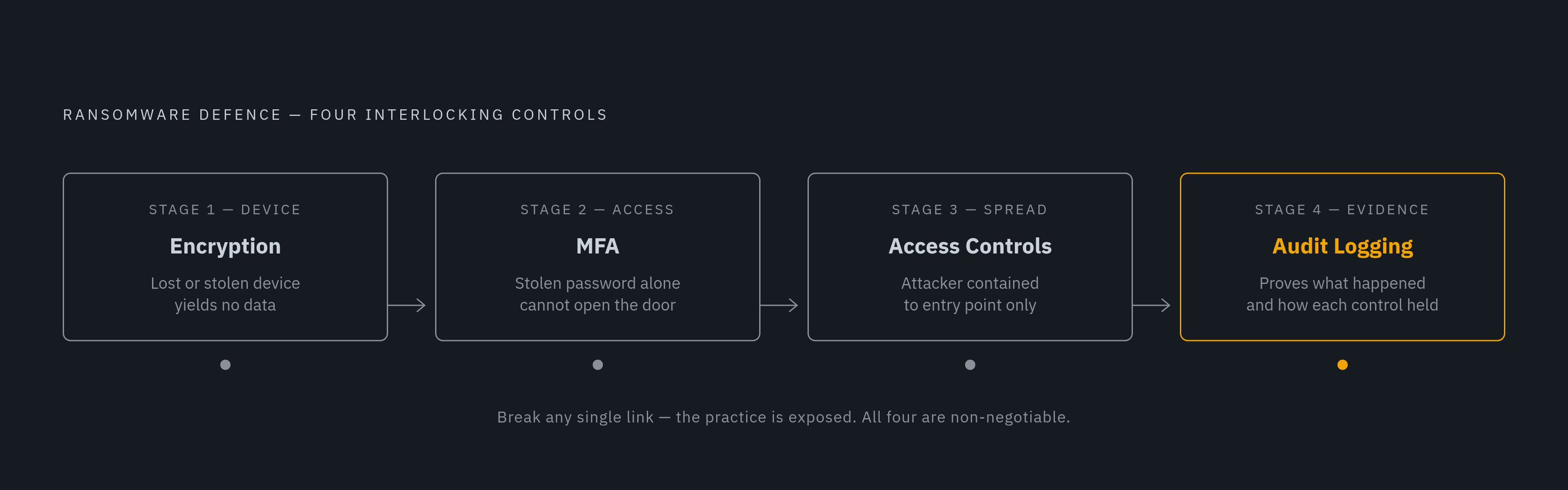
Four controls sit at the exact point where HIPAA enforcement history, the proposed rule, and the realities of ransomware all line up: encryption, multi-factor authentication, access controls, and audit logging. An endpoint program missing any one of these four is a liability waiting for an incident to expose it.
These four work as a set. Encryption limits the damage when a device gets lost or stolen. MFA limits who can get into a live system even with a stolen password. Once an attacker gets in, access controls limit how far they can move. Audit logging gives a practice the evidence trail to show an investigator what actually happened and how the other three controls performed.
You need full-disk encryption on every laptop, phone, and device that touches patient data. OCR has repeatedly cited a single lost or stolen unencrypted device as the triggering event behind a reportable breach. One unprotected laptop can turn into a major fine on its own. Encryption needs to cover data sitting still, full-disk encryption on laptops and desktops, plus file, folder, or database encryption on workstations that cache patient data locally, and data on the move, current TLS for network traffic and secure email or a portal for anything leaving the organization. Backups and removable media need the same encryption and the same enforced key policies, since an unencrypted backup creates a parallel exposure that undermines everything else. Key management matters here too: keys should be held centrally, access to them should follow role-based rules, and recovery procedures need to be documented without ever compromising the secrecy of the keys themselves.
Multi-factor authentication needs to reach further than most small practices assume it does. The NPRM proposes extending MFA past remote access alone to cover every system that touches patient data, so if a staff member logs into patient records, they would need a second factor beyond a password. MFA belongs on remote access tools like VPN and VDI, EHR logins, privileged accounts, cloud applications, email, and practice management software. An authenticator app is a reasonable, low-cost place to start. Hardware tokens offer stronger protection for administrative or privileged accounts. Conditional access rules check a device's health or location before granting access, so if a device fails a basic health check, it doesn't get in no matter whose credentials it's using.
Least-privilege access depends on unique user IDs for every person. Shared logins break HIPAA's audit control requirement, because a shared account makes it impossible to trace an action back to the person who took it. Standing administrator rights are a structural weakness on their own; just-in-time elevation, where elevated access is granted temporarily through an approval step, removes that standing privilege without blocking the legitimate work that requires it. When a workstation at a nursing station or in an exam room sits unattended for long stretches, automatic logoff on that shared clinical device limits exposure.
Audit logs need to hold up under an OCR investigation. They need to capture logins, file access, configuration changes, and remote connections, and they need to be kept for HIPAA's retention window, which reaches six years. They need protection from tampering, since an attacker who can edit logs after a breach can erase the evidence OCR would use to judge how the organization responded. And logs need a review process tied to them. A log that's collected but never reviewed doesn't function as an audit control, no matter how complete it is.
Building the asset inventory and risk analysis that make everything else defensible
The single most common finding in OCR investigations is a missing or inadequate risk analysis. A practice can deploy encryption and MFA across every device and still be exposed, if it can't produce a documented, evidence-linked risk assessment showing why those controls were chosen and how they're performing.
You still see failing to conduct a thorough, accurate risk analysis as the most frequently cited Security Rule violation across OCR's compliance investigations and breach reports. Without a clear picture of where patient data actually lives and how every endpoint is configured, a risk analysis can't be complete, no matter how carefully it's written.
The NPRM's proposed asset inventory requirement targets this exact gap. For years, organizations could run risk analyses that missed whole categories of exposure, because unknown devices and untracked paths let patient data travel without anyone realizing it. The proposal would make that blind spot a direct compliance failure rather than an invisible one. The inventory itself would need to cover every piece of hardware, mobile devices, servers, workstations, peripherals, and every piece of software, operating systems, databases, clinical and health record systems, that creates, receives, stores, or transmits patient data, or that could affect its confidentiality, integrity, or availability. Alongside that inventory, you need a network map showing how patient data flows between systems, and you update it at least once a year and again whenever something in the environment changes enough to affect that data. Informal familiarity with "how things work around here" doesn't meet that bar.
The risk analysis has to connect directly to the asset inventory. Under the proposed approach, the inventory becomes the foundation a credible risk assessment is built on. You need risk assessments that are thorough, written down, and updated whenever technology or operations change. If a review happens informally, in someone's head, without documentation, it won't hold up to regulatory scrutiny.
Every control a practice puts in place needs to trace back to that risk analysis. When OCR reviews a program, it asks whether the organization can show why a control was chosen, whether it's operating the way it was designed to, and what evidence proves it, tickets, scan reports, configuration baselines, access review logs, restore test results. Building this out in practice starts with walking the asset inventory first, then mapping how patient data moves across those assets, then checking that map against the four-control baseline described above to find the gaps.
Vulnerability scanning, patch management, and the controls that keep the baseline current
Encryption and MFA give you a starting posture, but that posture doesn't stay still. New vulnerabilities get discovered constantly, vendors release patches on their own schedules, and devices drift out of their original configuration the moment they're deployed. A compliance program that only checks a box once a year falls out of date within weeks.
Vulnerability scanning needs to run on a regular schedule across every endpoint in the inventory, including workstations and devices beyond servers. A scan finds the software that's running an outdated version, the service exposed to the network that shouldn't be, the configuration that's drifted from the baseline a practice originally set. Patch management turns those findings into action: a defined process for testing and deploying updates on a schedule, rather than waiting for a device to fail or an auditor to ask about it.
Medical devices complicate this more than office computers do. Legacy operating systems and vendor support agreements can restrict how and when a practice is allowed to patch an imaging console or an infusion pump. Those devices often need compensating controls, network segmentation, restricted access, closer monitoring, when a direct patch isn't available on the practice's own timeline.
This operational layer is what keeps the four foundational controls meaningful over time. Encryption only protects a device if its keys are still managed correctly months after deployment. MFA only works if you still enforce it on every account, including ones added after the original rollout. Access controls only hold if nobody quietly picked up standing admin rights along the way. Audit logs only matter if someone is still reviewing them on a cadence, and if the review itself can be shown to an investigator as a working process rather than a one-time setup.
Every one of these ongoing checks produces the same thing the risk analysis depends on: evidence. Scan reports, patch records, access reviews, and configuration baselines are what let a practice answer OCR's real question, not whether a control was installed once, but whether it's still operating as intended today.
Sources
- 5 HIPAA Security Rule Changes in 2026 and How to Prepare
- HIPAA Security Rule 2025: Say Goodbye to "Good Enough"
- HIPAA Security Rule: what's changing, what's coming, and how to prepare now - Qubika
- HIPAA Security Rule Changes: 2025 & 2026 HIPAA Updates
- Federal Register :: HIPAA Security Rule To Strengthen the Cybersecurity of Electronic Protected Health Information
- HIPAA Security Rule Notice of Proposed Rulemaking to Strengthen Cybersecurity for Electronic Protected Health Information
- The 2026 Ransomware Surge Is Targeting Small Medical ...
- Proposed HIPAA Security Rule: Small-Practice Risks