SOC 2 Endpoint Controls That Emerge From Good Configuration
Well-configured endpoints generate the audit evidence SOC 2 requires automatically.
A deal stalls at the finish line. Verbal commitment is in hand, the contract is nearly signed, and then the prospect's security team asks for a SOC 2 report. Scrambling begins: someone starts a spreadsheet, someone else asks IT which laptops have encryption turned on, and a project that should have taken weeks turns into a monthslong fire drill. That scramble is the wrong response to the wrong question. SOC 2 auditors check whether endpoint configuration hygiene was enforced consistently over time, and the evidence they want is what a well-run device environment already produces on its own. Treating SOC 2 as a separate initiative makes it an expensive one. Treating it as the natural record of good configuration leaves most of the work already done.
Endpoint-Related SOC 2 Criteria and Audit Time
SOC 2 comes from the AICPA, a principle-based attestation framework rather than a prescriptive checklist. It doesn't tell a company which product to buy. It defines outcomes that controls have to demonstrate, and leaves the implementation up to the company. What gets produced at the end is an opinion report, not a badge or a certificate. It's an opinion report from a CPA firm, stating whether controls were suitably designed (a Type 1 report) or whether they actually operated effectively over time (a Type 2 report). Enterprise buyers ask for Type 2, and Type 2 covers a minimum three-month observation period that often runs a full year. That single fact reframes everything else in this piece: the evidence an auditor wants can't be manufactured the week before the audit. It has to accumulate from months of ordinary operations.
Availability, Confidentiality, Processing Integrity, and Privacy are optional Trust Services Criteria.
CC6, Logical and Physical Access Controls, is the largest section in the whole framework, with eight control points covering multi-factor authentication, encryption, role-based access, data loss prevention, network segmentation, and endpoint protection. Most audit hours land here. CC7, System Operations, is smaller, with five control points covering security event monitoring, incident response, vulnerability management, and remediation tracking.
Two sub-points inside CC6 matter most for endpoints specifically. CC6.1 requires a named asset inventory, encryption at rest, and multi-factor authentication where it's warranted. CC6.8 requires anti-malware deployment, restricted software installation, and change detection, the group most directly tied to how endpoint detection and response tools get configured. A couple of supporting criteria round out the picture: CC5, Control Activities, covers how policies get deployed, and CC4, Monitoring, covers whether there's continuous evidence that controls are actually working. Endpoint controls concentrate in two criteria groups: between CC6 and CC7, with CC4 and CC5 supporting them, nearly every endpoint decision a company makes has a direct line to a specific letter-and-number code an auditor will check.
The five enforced endpoint configurations that generate the evidence auditors collect
The baseline auditors expect isn't exotic or expensive. Five enforced controls, password policy, encryption at rest, antimalware, session timeout, and a local firewall, cover the bulk of what shows up under CC6. What separates a passing audit from a failing one is whether these controls are enforced by policy across every device, provably, for the length of the observation period.
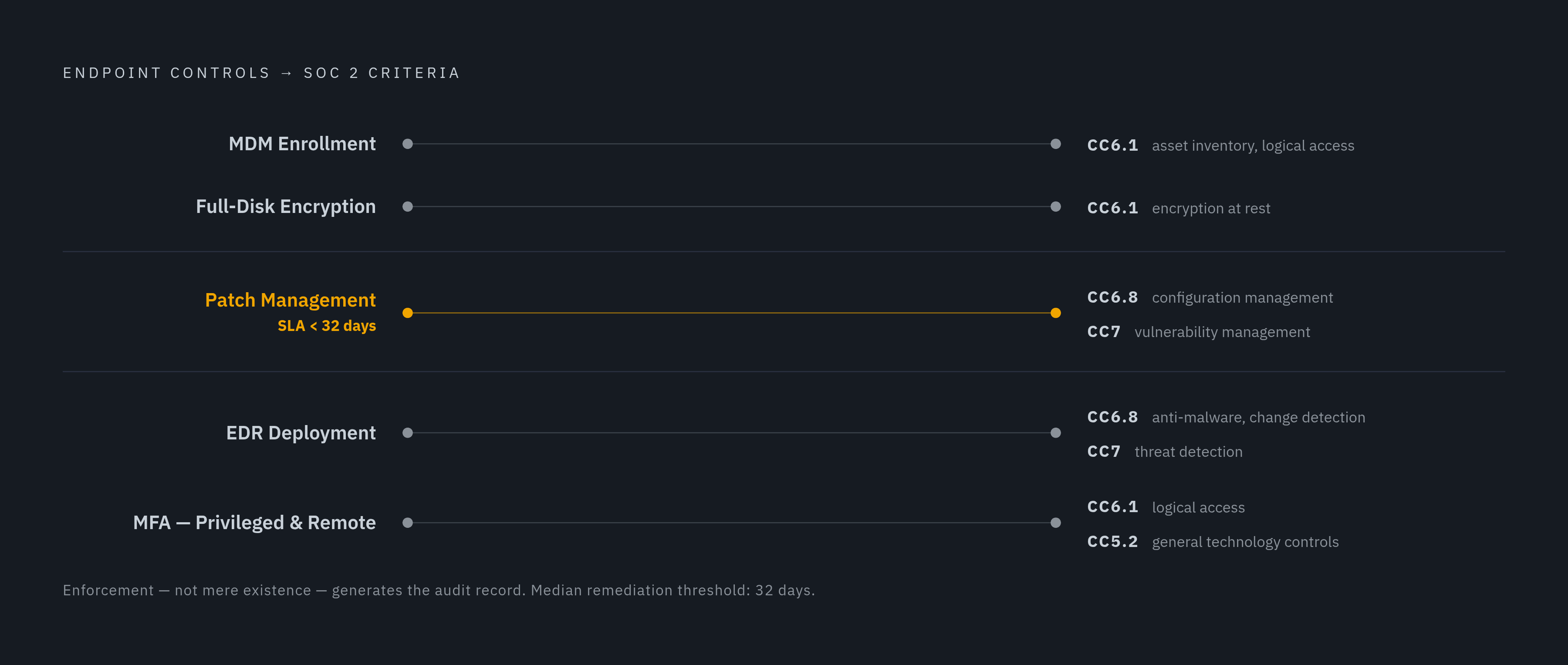
MDM enrollment for every in-scope device produces enrollment records proving all managed devices sit under policy, satisfying CC6.1's asset inventory requirement and CC6.8's configuration management requirement. Enrollment matters because it's the mechanism, not the intent, that generates the record: a company can have a written policy that every laptop must be managed, but only enrollment produces a timestamped list an auditor can check against reality.
Full-disk encryption enforced by policy, not just switched on by default, produces configuration compliance reports showing encryption active across the fleet, satisfying CC6.1's encryption-at-rest requirement and the Confidentiality criterion C1. Auditors draw a sharp line here: encryption enabled on a device is not the same claim as encryption enforced across a fleet. A policy that requires MDM enrollment before it will confirm encryption status is what actually generates the report an auditor accepts.
Patch management with defined remediation SLAs produces patch logs showing updates applied inside a set window, satisfying CC7's vulnerability management requirement and CC5.2's general controls over technology. NIST SP 800-53 Release 5.2.0, released in August 2025, specifically addresses secure software updates and patches. Keeping endpoints patched has moved from best practice to compliance expectation. The friction point auditors care about is timing: the median remediation time for exploited vulnerabilities runs 32 days, so an SLA enforced by tooling and set shorter than that is what separates auditable patch management from updates applied whenever someone gets around to it.
EDR deployment confirmed across all endpoints produces deployment confirmation plus alert and response logs, satisfying CC6.8's anti-malware and change-detection requirements and CC7's threat-detection requirement. EDR is where both breach entry and breach propagation concentrate, and it is the control most directly evaluated under CC6.8.
MFA enforced on all privileged and remote access produces access provisioning logs and MFA enrollment records, satisfying CC6.1's logical access requirement and CC6.3's requirement around access modifications and role-based authorization.
Across all five, the same pattern repeats: a setting that exists is not the same as a setting that's enforced and logged. Enforcement is what turns a good habit into an audit trail.
Why human behavior breaks otherwise sound configurations
Configuration only holds up when it doesn't depend on someone remembering to do the right thing. Guardz's 2025 research, cited in Konfirmity's 2026 SOC 2 endpoint security walkthrough, found that a significant share of employees delay security updates, most store passwords on personal phones, and nearly all remote workers use personal devices for work tasks. Every one of those habits undercuts a control that looks solid on paper.
BYOD is where this compounds fastest. A personal device used for work tasks is the single surface where an unpatched operating system, a browser-saved credential, and a weak or absent second factor can all stack up at once, and each one is a separate audit failure point under CC6. This is what happens when a control's success depends on a person choosing correctly every day, for months, without anyone checking, not a character flaw in employees.
That's the practical stakes for a Type 2 audit specifically. The report requires evidence that controls operated effectively across the entire observation period, so a single misconfigured or unenrolled device turning up during that window counts as a control failure. MDM enrollment, forced encryption, and MFA enforcement solve this by removing the decision from the individual entirely. A control enforced by policy is either provably active or it isn't. There's no middle state where someone meant to turn it on.
The real SOC 2 challenge for SMBs: proving consistency, not designing controls
Most SMBs preparing for a first SOC 2 audit assume the hard part is figuring out which controls to build, but it isn't. The minimum baseline is well established and easy to state. The hard part is proving that every one of those controls held, on every device, for the entire length of the observation period.
Auditors checking CC6 and CC7 want a specific set of artifacts: MDM enrollment records, configuration compliance reports showing encryption, firewall, and screen lock status, vulnerability scan results with remediation tracked over time, patch logs showing updates landed inside the defined SLA, and EDR deployment confirmation. Thoropass's control implementation guide describes how a gap analysis actually works in practice: a compliance architect starts by sorting which controls exist and are operational from which are missing entirely, and that sorting comes down to one question, whether tooling is generating records automatically or not.
Two gaps appear constantly at companies without dedicated security staff. Asset inventory is the first: SOC 2 requires a named list of every in-scope device, and without MDM that list is a spreadsheet that goes stale within weeks of a single new hire or device swap. Change management evidence is the second, documenting patches and configuration changes before they go live, which becomes a manual reconstruction project when there's no automated log to pull from.
A small company might assume it's too small for this level of rigor. Type 2 evidence is time-stamped and cumulative, so there's no shortcut available at audit time that reconstructs six months of logs that were never generated in the first place. Company size doesn't change what the observation period demands.
What Integrated Endpoint Management Platforms Produce
An endpoint platform that enforces MDM enrollment, encryption policy, patch management, and EDR at the same time isn't doing two jobs, one for security and one for the audit. It's doing one job that happens to satisfy both at once.
Running that kind of environment correctly generates four things automatically, without anyone opening a spreadsheet. Every enrolled device becomes a standing record, satisfying CC6.1's asset inventory requirement. Policy state, encryption, firewall, screen lock, gets logged continuously, satisfying CC6.8's configuration compliance requirement. Update history gets timestamped against the defined SLA, satisfying CC7's patch currency requirement.
Endpoint security systems that provide automated asset inventory alongside monitoring and logging of company machines end up satisfying two separate audit requirements through a single vendor relationship. Compliance automation platforms take this a step further: tools like Strac Comply map live system evidence, cloud configuration, SaaS audit logs, endpoint posture, directly to each SOC 2 control, so the same layer protecting the environment is the layer producing the proof that it's protected.
For a company without a dedicated security hire, that removes an entire job function that would otherwise need to exist: someone manually collecting evidence every month, cross-referencing device lists, and chasing down patch confirmations by hand. An integrated platform, one that combines device management, endpoint security, identity protection, and compliance automation in a single system, earns its keep here for a lean team specifically because the evidence generation runs continuously and doesn't need extra headcount to sustain through a full twelve-month Type 2 window.
Endpoint Configuration Gaps as Audit Findings
The evidence categories that cause the most trouble for IT teams share one trait: they demand continuous proof rather than a single point-in-time snapshot. Patch logs, configuration compliance reports, and MDM enrollment records all fall into that category, because an auditor reviewing a Type 2 report is asking whether a control stayed correct across the whole window, not just whether it was correct on the day someone checked it.
That's the reason waiting until an audit gets scheduled to think about endpoints backfires so badly. A gap in MDM enrollment discovered partway through a twelve-month observation period can't be patched retroactively. The missing months of records simply don't exist. The fix has to start before the clock does: get every device enrolled in MDM, confirm encryption is enforced rather than just available, set a patch SLA shorter than the 32-day median for exploited vulnerabilities and enforce it with tooling, deploy EDR across the full fleet, and require MFA on every privileged and remote account.
None of these five moves exist because an auditor demands them. Each one is a baseline decision about running devices well, and each one happens to generate exactly the record an auditor is going to ask for. Get the configuration right first, and the audit evidence follows as a matter of course, not as a separate project bolted on at the end.
Sources
- SOC 2 Endpoint Security: A Walkthrough with Templates (2026)
- SOC 2 Requirements 2026: A Comprehensive Guide to Getting Compliant Quickly
- SOC 2 Controls: The Complete 2026 Reference (CC1-CC9 + A, C, PI, P Criteria)
- SOC 2 Compliance Guide: Requirements & Audit Prep
- Control implementation for SOC 2 compliance - Thoropass