Continuous Compliance Monitoring vs Point-in-Time Audit Preparation
Modern cloud environments drift daily, but annual audits only catch compliance once a year.
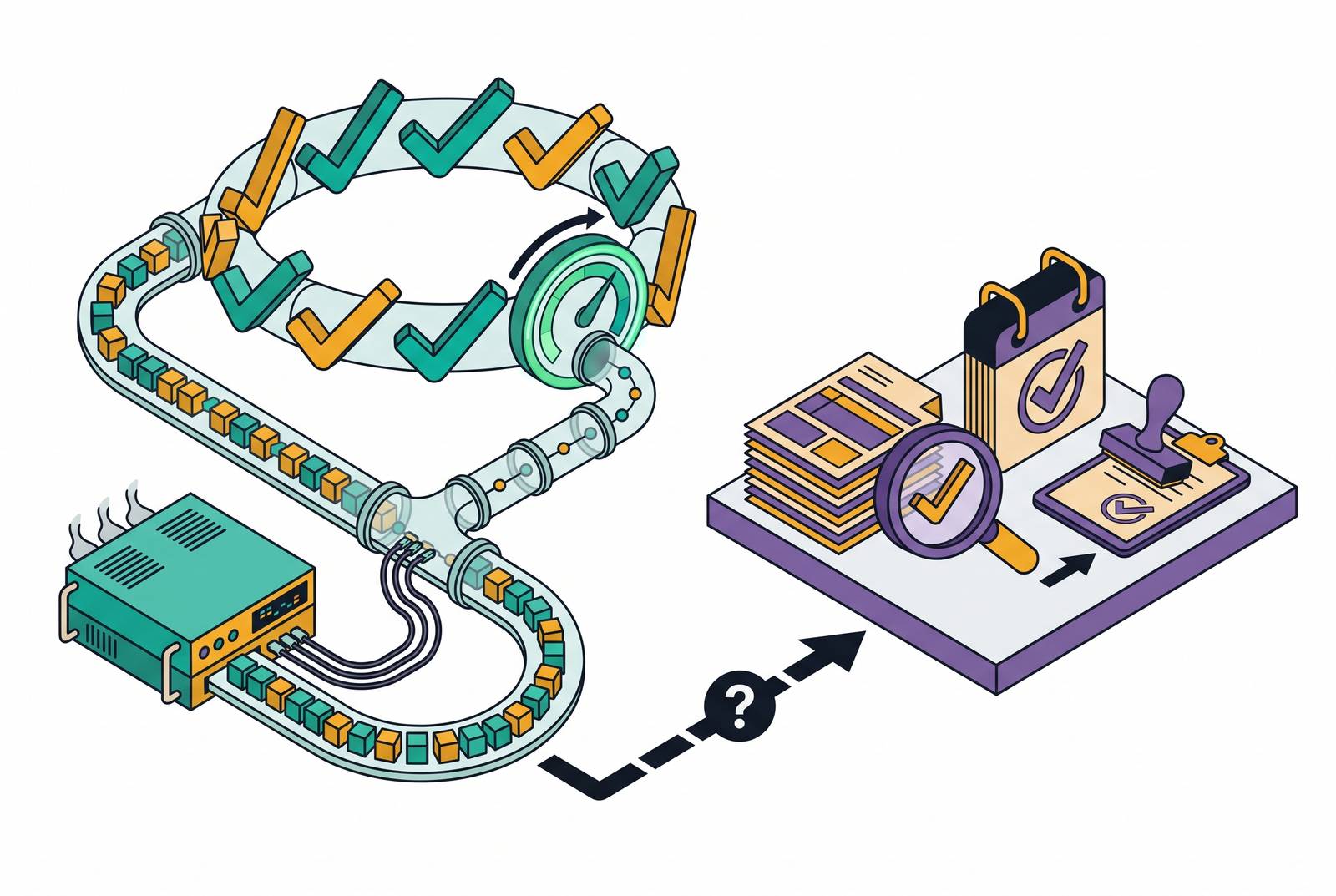
An MFA enforcement log is an example of a single piece of evidence that satisfies ISO 27001, SOC 2, NIS2, and DORA requirements simultaneously, eliminating duplicated effort across workstreams. That scramble is the point-in-time audit model working exactly as designed, and the design is the problem.
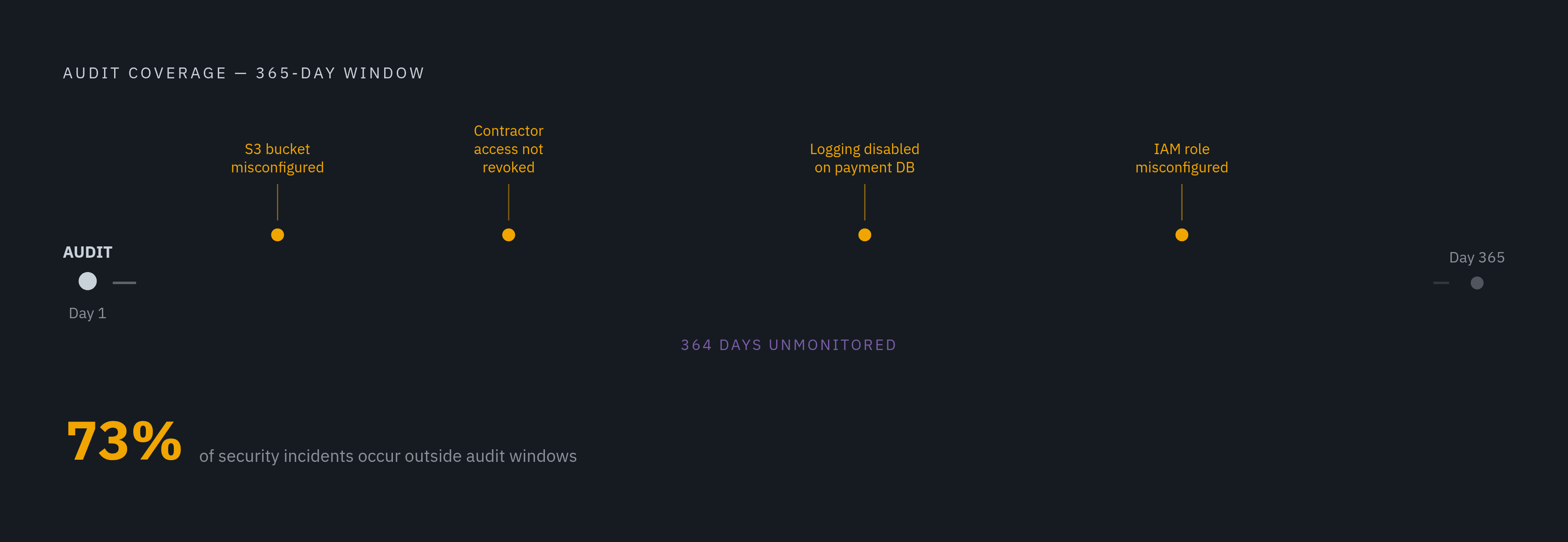
The model itself is simple. An auditor shows up, reviews controls on a single date, signs off, and leaves. The certificate that results stands in for assurance until the next cycle begins, a full year later. That only works if the snapshot stays representative of what comes after it. In practice, evidence lives scattered across a dozen different tools, nobody owns the job of keeping it current, and the only real incentive to assemble it arrives the week before the deadline. The system rewards looking compliant on one day. It says nothing about the other 364.
That tradeoff made sense once. Technology changed slowly. Regulatory frameworks held still for years at a time. Orbiq's 2026 analysis frames the shift directly: annual compliance audits made sense when technology changed slowly and regulatory frameworks were stable, and in 2026, neither condition holds. The model was built for an environment that no longer exists, and the gap between what it certifies and what is actually true grows the moment the auditor walks out the door.
Cloud velocity and the audit gap
Cloud environments change multiple times a day. Every deploy, every permission change, every new service connected to a production system is a chance for a control to slip. This is configuration drift, and it is the mechanism that turns a minor flaw in the audit model into a structural failure of it.
Drift does not announce itself. A developer pushes a configuration change without a security review, and nothing breaks immediately, so nobody notices. A contractor's project ends and their access stays active, because offboarding access review was never anyone's single job. A critical server misses a patch window during a busy sprint. A configuration change quietly disables logging on a database holding payment data, as a side effect of something else. An IAM role gets misconfigured, or an S3 bucket flips to public, and the condition appears and disappears between audit cycles without a single person flagging it. None of these require malice. They require only the normal operational pace of a modern cloud environment, running at the speed infrastructure actually runs at now.
NHI Management Group's September 2026 guidance draws the sharpest line on why this matters: a point-in-time audit answers whether controls were present when sampled, while a continuous check answers whether they still are, and those are fundamentally different questions. An annual audit can answer the first question perfectly and still leave the second one wide open for 364 days.
The gap is not a hypothetical. 73% of security incidents occur outside of audit windows. Something that failed during audit prep had already been failing, invisibly, for weeks or months beforehand. The audit model has no mechanism built in to catch that earlier, because its entire structure is a once-a-year glance at a system that changes daily. Infrastructure-as-code deployments, CI/CD pipelines, and containerized applications move faster than any annual snapshot can track, and a system can pass its audit in the morning and drift out of compliance by the following day. The certificate stays on the wall. The environment it was meant to describe has already moved on.
Regulators moving past the annual checkpoint model
Regulators have caught up to a reality the infrastructure already forced. The shift now in force is from documentation that controls existed on one date to ongoing evidence that controls are actually implemented. Organizations leaning solely on annual audits are not only operationally exposed; they are increasingly out of step with enforceable law.
DORA came into full enforcement on 17 January 2025, and NIS2's transposition deadline was 17 October 2024, with national enforcement still rolling out across 2025 and 2026. Both regulations demand continuous operational resilience testing and ongoing monitoring as a periodic attestation filed once a year and forgotten no longer satisfies them.
PCI DSS 4.0 is the clearest example of a major framework formalizing this shift. Effective March 2024, it kept the existing quarterly vulnerability scanning requirement in place but added authenticated internal scanning and automated web-application monitoring on top of it, signaling a broader move toward continuous, year-round compliance practice. Organizations handling payment data can no longer point to a periodic check as proof of ongoing protection.
The pressure is not only regulatory. The modern B2B sales cycle now routinely includes a security review round, where a procurement team or security team asks for current evidence of controls. A PDF dated six months ago does not answer that question. A live compliance posture does, immediately. Gartner has taken note of the shift at the market level, tracking "DevOps Continuous Compliance Automation" as its own distinct category and projecting that by 2028, a large majority of organizations will have built compliance automation directly into their DevOps workflows. Regulators, buyers, and the infrastructure itself are converging on the same expectation at the same time.
What continuous compliance monitoring does, in operational terms
Continuous compliance monitoring replaces the once-a-year evidence sprint with three disciplines that run all the time: automated evidence collection, continuous control monitoring, and real-time drift alerts. Each one is built to close a specific failure mode of the point-in-time model.
Automated evidence collection starts with the platform connecting to source systems, cloud environments, identity providers, device management tools, through read-only APIs, and generating evidence on its own rather than through someone manually taking screenshots. Evidence produced this way stays current, carries a timestamp, and attaches to the correct control automatically, so nobody has to reconstruct a year's worth of history in a three-week scramble.
Continuous control monitoring answers the questions an annual audit can only answer once a year. Is MFA enforced right now? Are backups configured correctly today? Are patch SLAs being met? Automated checks run on a defined schedule instead of a defined calendar date, so an admin account created without MFA gets caught within hours instead of sitting exposed for months.
Drift alerts close the gap between when a problem starts and when someone notices it. When a control falls out of compliance, an S3 bucket turning public, a logging configuration getting disabled on a production database, the platform flags it within minutes, well before it has a chance to become an audit finding or a regulatory incident.
A single piece of evidence can also do more than one job. An MFA enforcement log, for instance, can satisfy ISO 27001, SOC 2, NIS2, and DORA requirements simultaneously, eliminating duplicated effort across workstreams. NHI Management Group's September 2026 guidance identifies the specific control surfaces where cloud compliance failures tend to concentrate: identity and access, storage exposure, encryption settings, network segmentation, logging, and account hygiene, and these are exactly the areas continuous monitoring is built to cover.
None of this means treating every deviation as a violation. A well-built implementation classifies issues by business impact, by who owns the remediation, and by how long the condition has existed, which separates a genuine weakening of compliance from harmless noise. It also distinguishes a deliberate, documented, time-bound exception from uncontrolled drift that nobody approved. Orbiq's 2026 continuous compliance guide describes the underlying shift this represents: compliance moves from being an event that happens once a year to a state the organization maintains continuously.
Comparing the two approaches on outcomes that matter to a lean team
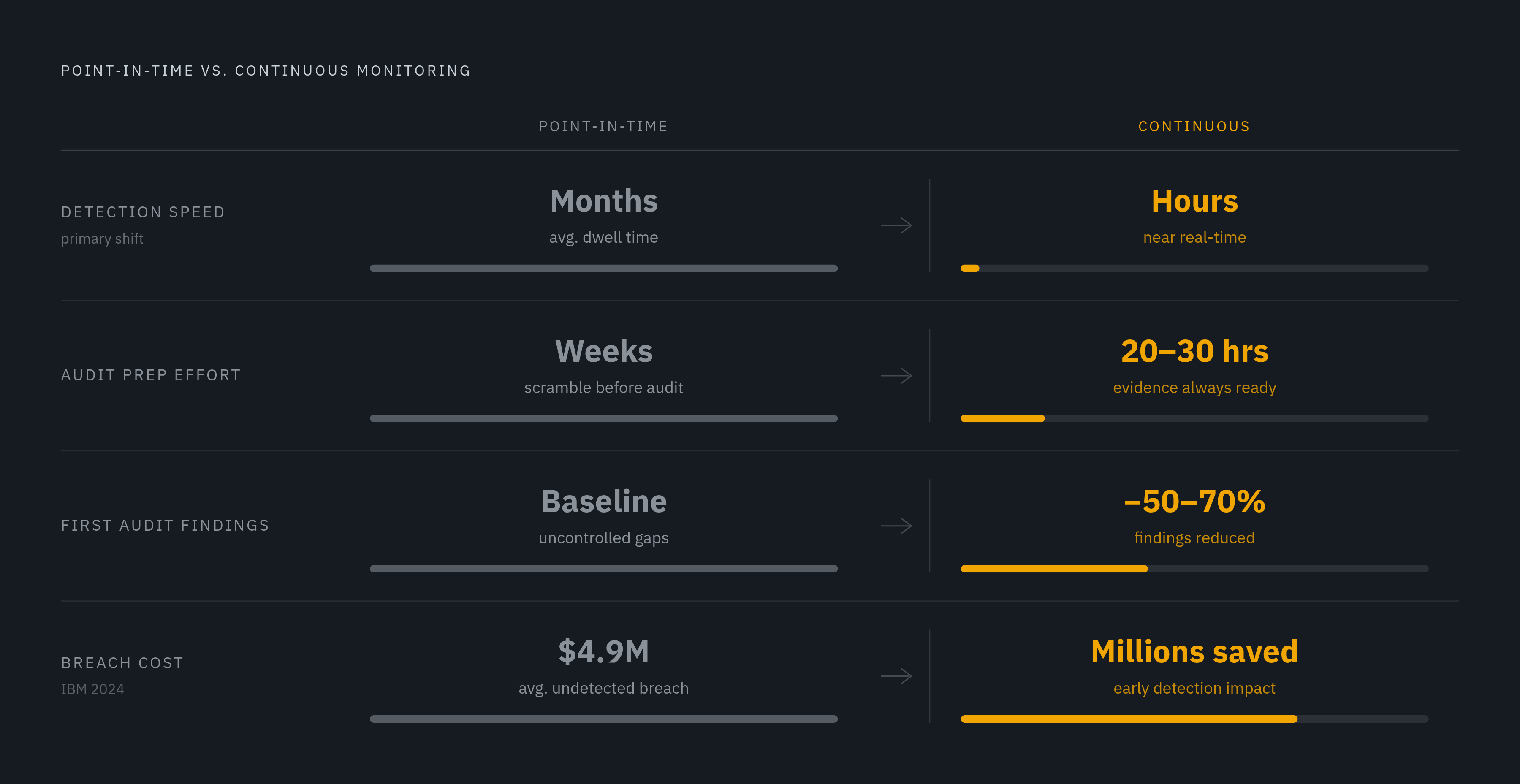
Measured against the outcomes a resource-constrained team actually cares about, speed of detection, effort spent preparing for an audit, and cost when something goes wrong, continuous monitoring wins on every axis.
On detection speed, organizations implementing continuous monitoring reduce mean time to detection from months down to within hours, and Orbiq's 2026 analysis puts the detection advantage at more than twice as fast compared to manual checks and periodic reviews. On audit preparation effort, organizations using continuous monitoring can compress the work down to 20 to 30 hours, because the evidence already exists and the controls are already documented rather than reconstructed from memory. Orbiq's 2026 analysis separately describes a typical substantial reduction in audit prep time, paired with substantially fewer findings on an organization's first external audit.
Findings themselves drop by a substantial margin under continuous monitoring, because the organization already knows about its own issues and has fixed or documented them before an auditor ever walks in. And when something does go wrong, the cost difference is measured in millions: IBM's 2024 Cost of a Data Breach Report found that organizations using extensive security automation save millions of dollars per breach compared to organizations without it.
| | Point-in-time audit | Continuous monitoring | |---|---|---| | What it proves | Controls worked on audit day | Controls work every day | | Evidence source | Manual screenshots and spreadsheets | Automated, system-generated logs | | When gaps surface | Weeks or months after they start | The day they happen | | Audit prep effort | Weeks of scrambling | Ongoing, low-effort review | | Best for | Formal attestation and legal sign-off | Day-to-day security and audit readiness together |
For a team without dedicated security staff, the audit prep row carries the most weight of all. Weeks of manual evidence collection pulled onto an IT generalist's plate is weeks taken directly from everything else that person is responsible for. Continuous monitoring turns that same work into a background operational discipline that runs on its own, rather than a disruptive annual event.
Why continuous monitoring matters most for SMBs without security staff
For an organization with no dedicated security team, continuous monitoring is the only operationally realistic compliance strategy, because the alternative requires someone to manually check MFA policies, manually verify that terminated employees no longer have access, and manually audit encryption settings, on top of everything else already on that person's desk.
Picture what the manual alternative actually looks like day to day. Without continuous monitoring, keeping compliance intact between audits depends on an IT generalist or an operations leader periodically remembering to check whether MFA is still enforced, whether an offboarded employee's account is actually deactivated, and whether a recent cloud configuration change quietly altered an encryption setting somewhere. None of these checks has a dedicated owner, and none of them runs on a guaranteed schedule.
Small and mid-sized businesses are not swept up in this risk by accident. They hold data worth stealing, they run on stretched IT teams, they often rely on inconsistent backup strategies, and they rarely have the resources to run a round-the-clock security function. The gap is predictable, and because it is predictable, it is exploitable.
The most dangerous part of this is invisible to the people most exposed to it. A large majority of SMB owners reported feeling well-prepared before they were breached, yet only about a third had a formal incident response plan in place, and very few conducted proactive cybersecurity audits of any kind. Confidence in a clean point-in-time audit result is not the same thing as an ongoing security posture, and that gap between felt security and actual security is where the real damage accumulates.
An integrated platform that handles device management, endpoint security, identity protection, and compliance automation within a single system is a direct answer to this problem. It replaces five separate vendor relationships, and the specialized expertise it would otherwise take to run each of them, with one continuously enforced program that does not need a dedicated security team to operate it. Under that kind of system, the annual audit stops being a source of dread. When evidence already exists, controls are already being watched, and gaps are already fixed or documented well before the auditor shows up, the audit becomes validation of what the organization already knows rather than a discovery process. The compliance officer finds the MFA gap before the auditor does, not two days before the auditor arrives.
How to think about point-in-time audits and continuous monitoring together, not as rivals
Continuous monitoring does not make the point-in-time audit obsolete. It makes the audit survivable. Organizations that shift to continuous compliance see 50 to 70% fewer findings on their first external audit.
The point-in-time audit still has a role: a formal attestation, a legal sign-off, a moment of external validation that a regulator or a customer can point to. Continuous monitoring is what makes that moment boring instead of harrowing, because the controls it certifies have already been true every day leading up to it, not just on the day someone checked. An organization running continuous monitoring walks into its annual audit with evidence instead of a scramble, and a clean result instead of a surprise.