Automated Endpoint Remediation as a Security Control
Attackers exploit the gap between detection and fix—automation closes it before they can move.
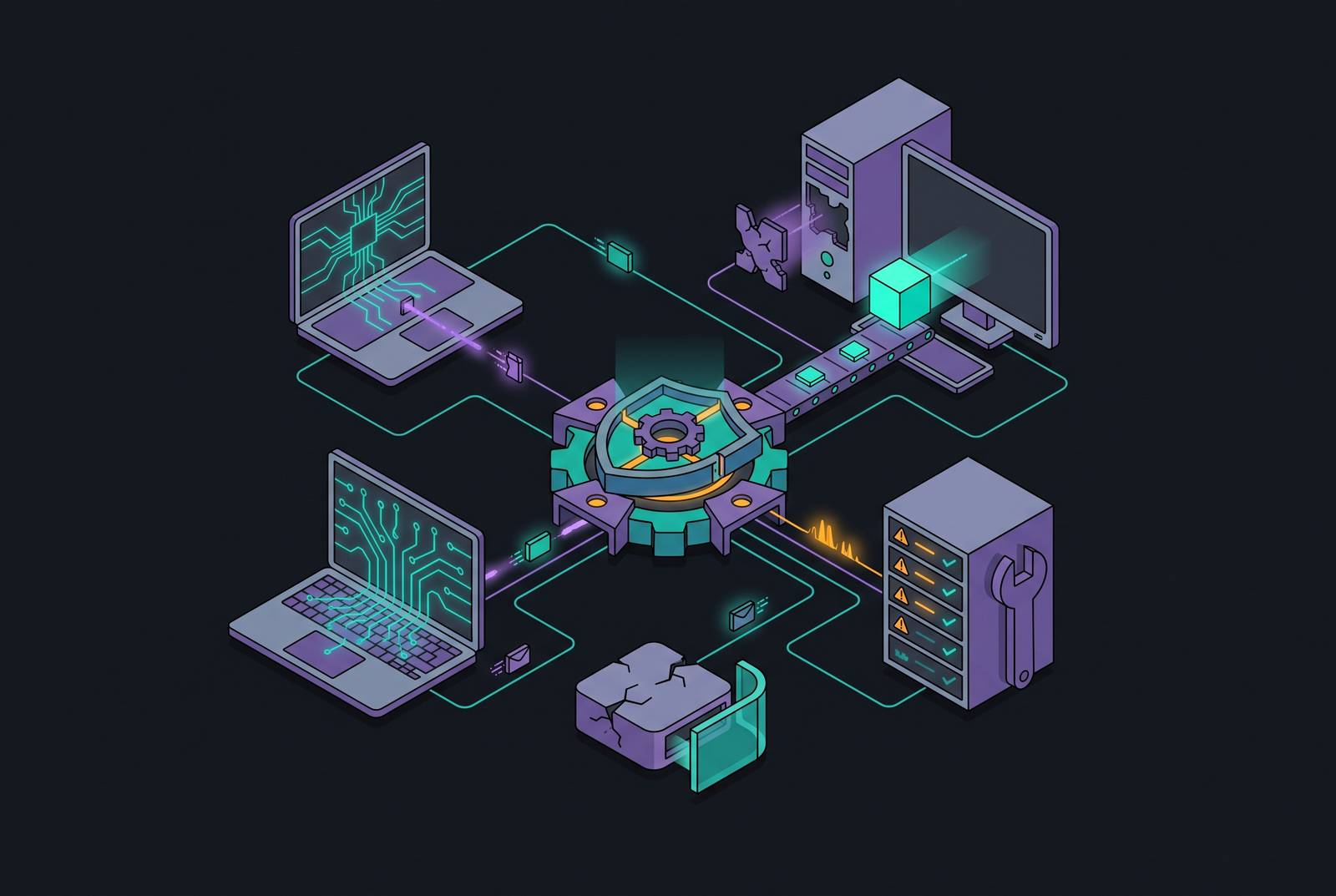
A patch rolls out to nearly every machine in the fleet. A misconfigured laptop sits open for months until the next scan finds it. An analyst gets forty alerts before lunch and triages the loudest one first, not the worst one. Automated endpoint remediation exists to close the gap between spotting a problem and fixing it, without waiting on a human to notice, decide, and act. That gap, not the initial breach itself, is where most attacks actually succeed.
Endpoint remediation, at its core, is the process of finding and fixing security gaps on devices: unpatched software, misconfigured settings, policy violations, active malware. Done manually, it runs as a loop: detect, analyze, respond, one ticket at a time. Done as an automated control, that same loop runs continuously and in parallel across every device in the environment, and the response, whether it's a patch, a config fix, killing a malicious process, isolating a machine, or rolling it back to a known-good state, fires the moment a condition is met. No ticket queue. No waiting for someone to get to it.
Why the window between detection and resolution is where most breaches succeed
Attackers don't need to be fast. They need defenders to be slow, and the numbers say defenders are getting slower, not faster.
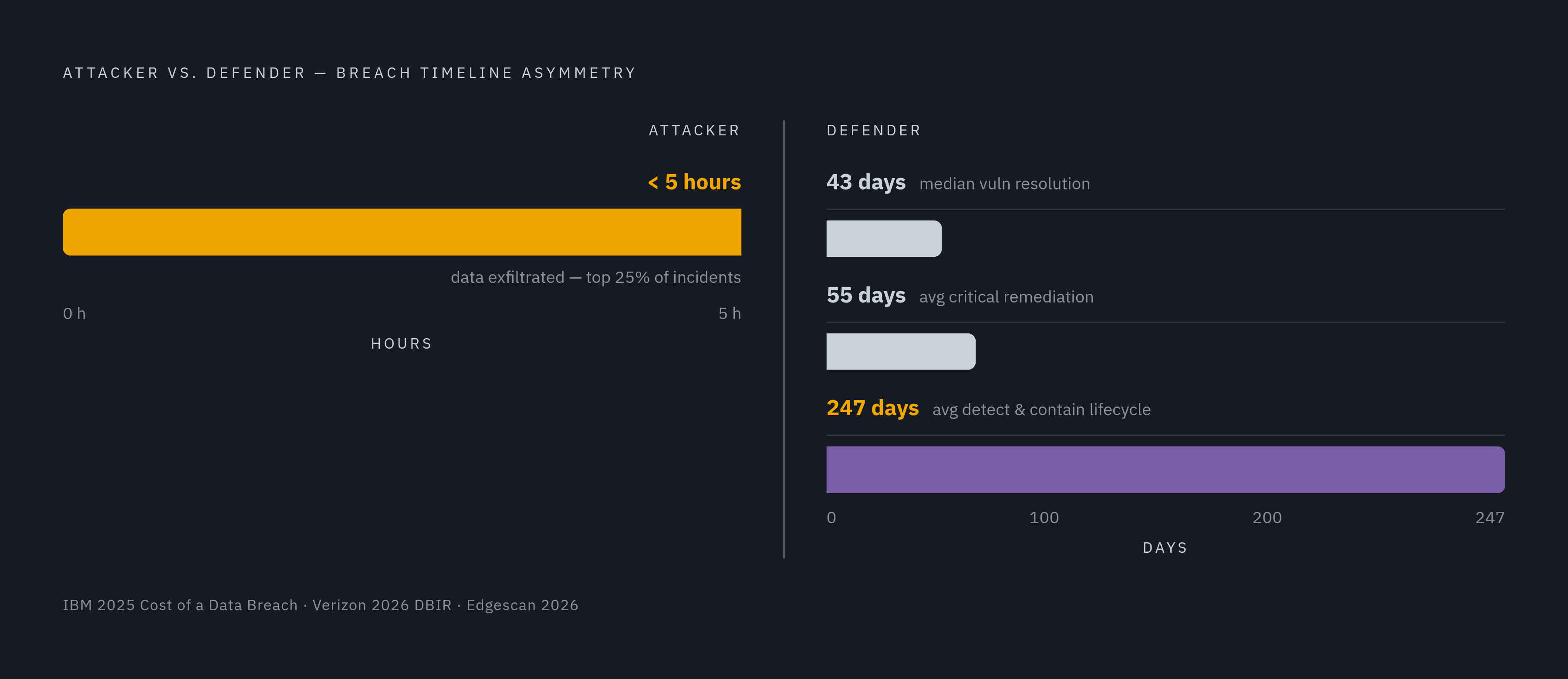
Industry research consistently shows attackers can sit inside a network for days or weeks before anyone notices, often long enough to move laterally and stage data for exfiltration. IBM's 2025 Cost of a Data Breach Report pushes the full picture out further: the average detection-and-containment lifecycle across the incidents it studied ran 247 days. In a quarter of those incidents, the attacker had already exfiltrated data in under five hours. The defender's clock and the attacker's clock aren't running at the same speed, and they're barely running in the same universe.
What's worse: even after detection, resolution is dragging. Verizon's 2026 Data Breach Investigations Report found the median time to fully resolve a vulnerability climbed to 43 days in 2025, up from 32 the year before. Edgescan's 2026 Vulnerability Statistics Report, published in April of that year, clocked the average time to remediate high and critical application and API vulnerabilities at just under 55 days across 2025. Both numbers point the same direction: worse.
Seeing a threat has gotten easier. Acting on it hasn't. And per that same 2026 Verizon report, vulnerability exploitation is now the leading initial access vector at 31%, with ransomware showing up in 48% of breaches, attack patterns built specifically to take advantage of slow remediation. For a smaller company running a lean IT setup, that same 43-to-55-day gap costs a lot more, because there's less bench strength to absorb the fallout.
How the SMB threat picture makes slow remediation especially dangerous
Ransomware doesn't hit small and large companies evenly. Per the 2025 Verizon DBIR, ransomware showed up in 88% of SMB breaches, versus 39% at larger organizations. That gap isn't random. Smaller IT teams, slower patch cycles, and thinner incident response mean attackers go where the resistance is lowest, and small businesses are, structurally, that path.
The staffing math backs this up. Secureframe's 2026 Cybersecurity and Compliance Benchmark Report found 93% of companies call cybersecurity a top priority, yet more than half run with one or fewer full-time security staff, and close to a third have none at all. Priority on paper, empty seat in practice. What fills that gap, usually, is a pile of tools bought in a hurry after a scare, stitched together without a plan, leaning on manual remediation that assumes headcount nobody actually hired.
Third parties widen the exposure further. Per the 2025 Verizon DBIR, third-party involvement in breaches had already doubled from 15% to 30%, and that exposure continues to widen. Every payroll vendor, payment processor, and outsourced email provider a small business relies on becomes one more door an attacker doesn't need to pick the lock on themselves.
And prevention alone doesn't hold the line. Across organizations broadly, 68% report endpoint attacks that got past their defenses and reached data or infrastructure. Zoom out to the aggregate cost, and the FBI's IC3 2024 Annual Report logged 859,532 complaints and $16.6 billion in losses, a 33% jump from 2023, with ransomware still named the most pervasive threat to critical infrastructure and complaints up 9%. A small business doesn't need more dashboards flashing red. It needs fewer decisions standing between detection and a fix.
Automated remediation as a continuously enforcing security control, not a cleanup tool
A cleanup tool shows up after the damage is done. A security control stops the conditions for damage from sticking around in the first place. That's the actual difference, and it matters more than it sounds.
Policy enforcement is the mechanism underneath it. Encryption standards, patch levels, access rules, configuration baselines, all of it gets checked against every endpoint continuously, not on a periodic scan schedule. The moment a device drifts out of line, the system corrects it. No ticket, no queue, no forgetting to circle back next week. It doesn't get pulled onto a different fire. It doesn't clock out.
Periodic scanning can't do this, and the gap it leaves is exactly where trouble lives. A device found out of policy on a quarterly scan has, by definition, spent months exposed before anyone knew. A patch pushed to 490 of 500 machines looks like 98% coverage on a report, right up until an attacker finds one of the other ten. Lateral movement, credential theft, fileless malware, none of it waits politely for the next scan window; it moves through the cracks between them.
There's an audit benefit too, almost as a side effect: every automated action gets logged and validated as it happens, so compliance paperwork comes out of enforcement instead of becoming its own separate scramble later. And the dollar figure behind all this is concrete. IBM's 2025 report found organizations using AI and automation extensively cut their breach lifecycle by 80 days and saved $1.9 million per incident compared to those without it. When remediation is policy-driven, malicious activity gets shut down in minutes, applications stay up, customers keep getting served, and the business avoids the kind of downtime that costs far more than the tool itself. The real payoff is measured in something other than a better security score. It's staying open.
The capabilities that define an effective automated remediation implementation
Not every tool that claims automated remediation actually delivers it. A few things separate a real control from a glorified alert feed.
Detection has to be good enough to trust. Malware matching that relies on known signatures alone misses fileless attacks, stolen credentials, and lateral movement, the stuff that doesn't look like a virus but behaves like an intrusion. Telemetry needs to stick around for investigation, not vanish after a point-in-time alert, and mapping detections to recognized attack stages helps make sure the response actually matches how far along the attack is, rather than just reacting to a generic alert category.
Response has to go deeper than "notify." Isolating a device to stop lateral spread while keeping it available for investigation. Killing a malicious process. Pulling a bad file. Rolling a machine back to its last known-good state. Deploying patches and enforcing configs proactively, not just cleaning up after something's already gone wrong.
Guardrails keep automation from becoming its own risk. Approval workflows for high-impact changes in production. Maintenance windows so a fix doesn't cause its own outage. Scoping tight enough that a response hits the one affected device, not the whole fleet by accident.
Coverage has to be complete, full stop. A blind spot in enrollment is a blind spot in enforcement, no exceptions. That means remote and hybrid endpoints, not just machines sitting on the office network, and it starts with knowing every device that exists in the first place. You can't enforce a policy on a laptop you don't know is out there.
It has to be usable by people who aren't SOC analysts. AI-guided interpretation that a generalist IT contact can act on. Single-click responses instead of ten-step investigation flows. One dashboard showing patch state, compliance status, and threat posture together, instead of five different screens.
And it needs to reach into identity. A remediation tool that can't revoke a credential or enforce authentication controls leaves a significant portion of the attack surface untouched.
How leading endpoint security platforms implement automated remediation
Platforms in this space are built for different audiences, and the differences matter more than any feature checklist suggests. Some assume a staffed security operations center with dedicated analysts on shift. Others assume a lean IT team wearing five hats. Fit depends on who's actually going to run the thing day to day.
SentinelOne's Singularity XDR leans on an automated detection and response model, meaning the platform acts on a threat without waiting for an analyst to weigh in. Its Storyline feature automatically strings related events into a visual attack narrative for forensic work afterward, and ransomware rollback is a built-in response action rather than a bolt-on. Pricing starts at $79.99 per endpoint annually for the Control package. It takes a technically skilled team to configure and tune properly, and the premium features carry a higher upfront cost, so it fits organizations that already have the in-house expertise to get the most out of an autonomous system.
Cynet 360 packages network guard antivirus, EDR, and XDR features into one platform, with managed detection and response included in its Elite and All-in-One tiers (not the base Protect tier). It offers custom automation workflows for incident remediation and starts at $7 per endpoint per month. Deployment is straightforward, and it's positioned squarely at SMBs and managed service providers that want simplicity and a low price tag over deep customization; it's less suited to large enterprises with complex, layered needs.
Palo Alto's Cortex XDR brings extended detection and response capabilities and is built with enterprise environments in mind, particularly ones already running Palo Alto infrastructure elsewhere.
Microsoft's Defender for Business, bundled into Microsoft 365 Business Premium for organizations up to 300 users, adds EDR, investigation, and response on top of the base Defender Antivirus prevention layer. That distinction matters: running Defender Antivirus alone, without the EDR layer on top, still leaves the continuous monitoring and response gap that this whole conversation is about. For a small business already inside the Microsoft ecosystem, knowing which layer they've actually turned on is worth checking.
Beyond any single point solution, an integrated platform that brings device management, endpoint security, identity protection, and compliance automation together in one deployment closes a gap that standalone EDR tools tend to leave open: enforcement without ongoing policy management is just detection with extra steps. And a feature label reading "automated remediation" on a spec sheet doesn't confirm much on its own. The response depth, the guardrails, and the coverage completeness described above are the actual measuring stick, not the marketing copy.
What SMBs without a security team need to look for when evaluating these tools
Enterprise EDR platforms were built assuming a staffed SOC with tier-3 analysts on call. For a company without a dedicated security function, that complexity works against it. It's a liability waiting to be discovered at the worst possible moment.
A few concrete questions cut through the noise fast. Can a generalist IT person read an alert and act on it without SOC training behind them? Does remediation actually happen on its own, or does someone still need to click approve on every single action? Is compliance documentation something the tool spits out automatically, or is it yet another project stacked on someone's desk?
Coverage completeness is the first filter, and it deserves a specific question, not a general one: how does the tool handle remote workers, BYOD devices, and third-party vendor access? A tool that doesn't reach every endpoint doesn't deliver the control it claims to.
Consolidation matters too. Bolting an automated remediation tool onto a stack of five disconnected vendors just creates new integration gaps and new places for an alert to get dropped during handoff. A platform combining device management, endpoint protection, identity controls, and compliance enforcement in one place removes coordination work that a small, lean team simply doesn't have the hours to absorb.
Deployment speed is worth weighing on its own. A company that's already exposed benefits from a tool that stands up in weeks, not months; a long professional-services rollout is itself a risk window, not a neutral transition period.
And the incident response plan a tool enables matters as much as the tool itself. Preparation before an incident, following established incident response guidance adapted for a small business context, is what makes response actually executable when it counts. Automated remediation is the technical layer that turns "contain and isolate" into something that happens on its own, instead of a manual scramble at 2 a.m. with someone's phone ringing off the hook.