Risk Surface Expansion From Endpoint Tool Context Loss
Disconnected security tools create blind spots attackers exploit faster than defenders can respond.
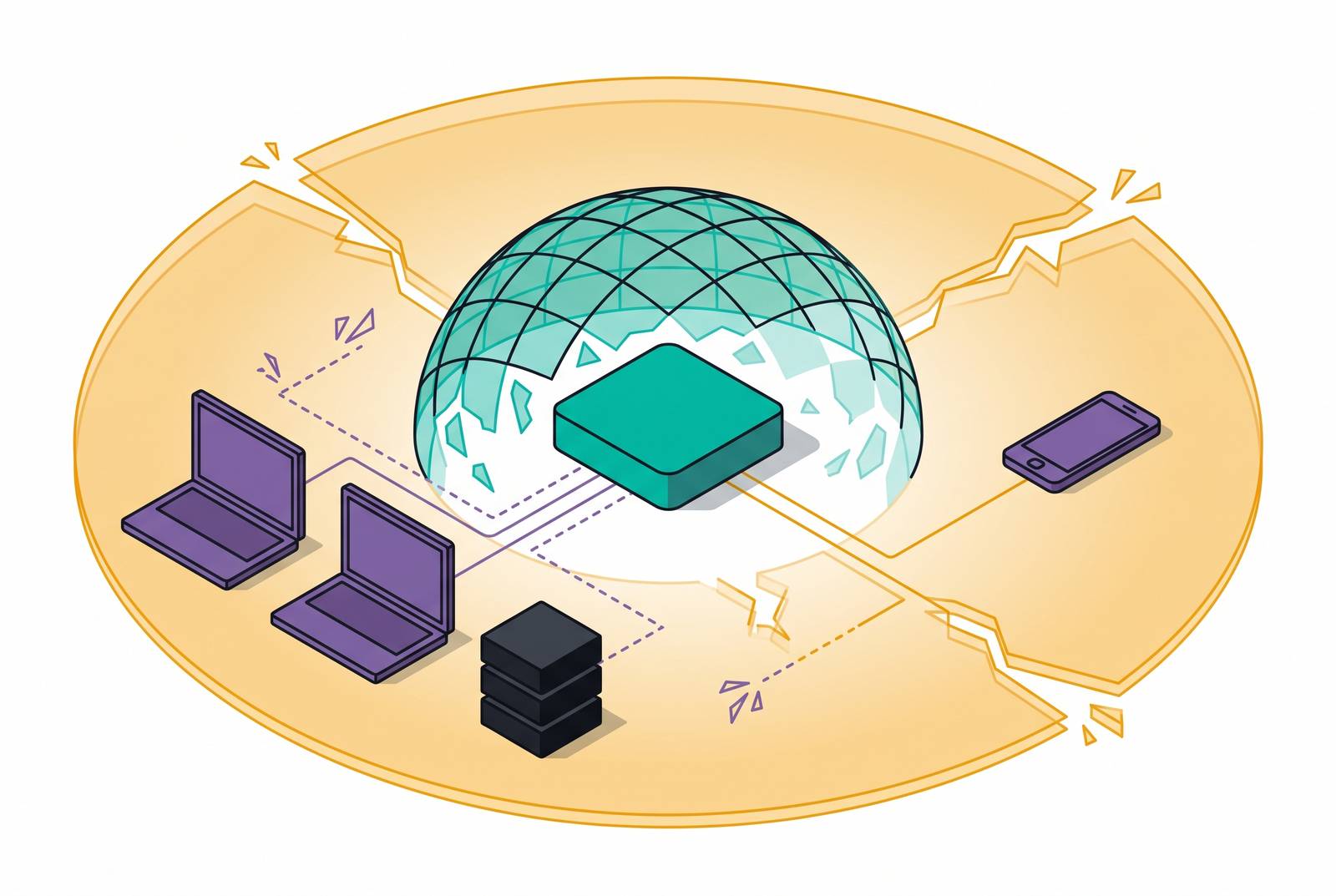
Endpoint tools operating in isolation don't just create blind spots. They expand the paths an attacker can use to reach something valuable, because each tool sees a fragment of an attack and none of them sees the whole thing. That matters most for small and mid-sized businesses running lean, where the gap between "we have security tools" and "we're actually covered" is wider than most owners think.
The assumption most businesses make is simple: more tools deployed means more coverage. Buy an endpoint detection product, add a firewall, layer in an email filter, and the surface area of risk should shrink. In practice it doesn't work that way. Each tool generates its own alert stream, running on its own console, watching its own slice of the environment, and none of them sees what the others see. An endpoint alert that never gets checked against identity activity or network traffic or email logs tells an analyst almost nothing. It's a data point sitting by itself, disconnected from the story around it.
Research has found that the average enterprise security stack now spans 61 separate tools, and separate findings still don't combine into one incident view. The issue was never a lack of coverage. It's a lack of shared context. That same research points to specific ways sprawl creates blind spots: products left running on default, out-of-box settings for months or years after purchase, redundant tools covering the same function and adding noise instead of clarity, and fragmented telemetry sitting in silos, impossible to correlate across the places an attack actually moves through.
Sit with that paradox before going further. The tools bought to reduce risk are, by the nature of how they're built and deployed, creating new attack surfaces of their own. Not through a flaw in any single product, but through the gaps between them. This piece works through why that gap exists, how fast attackers exploit it, and what closes it.
What "risk surface expansion" actually means when tools don't share context
Risk surface, in plain terms, is the total set of paths an attacker can use to get from "outside" to something worth stealing or holding for ransom. Every login, every device, every open port and permission adds to that surface.
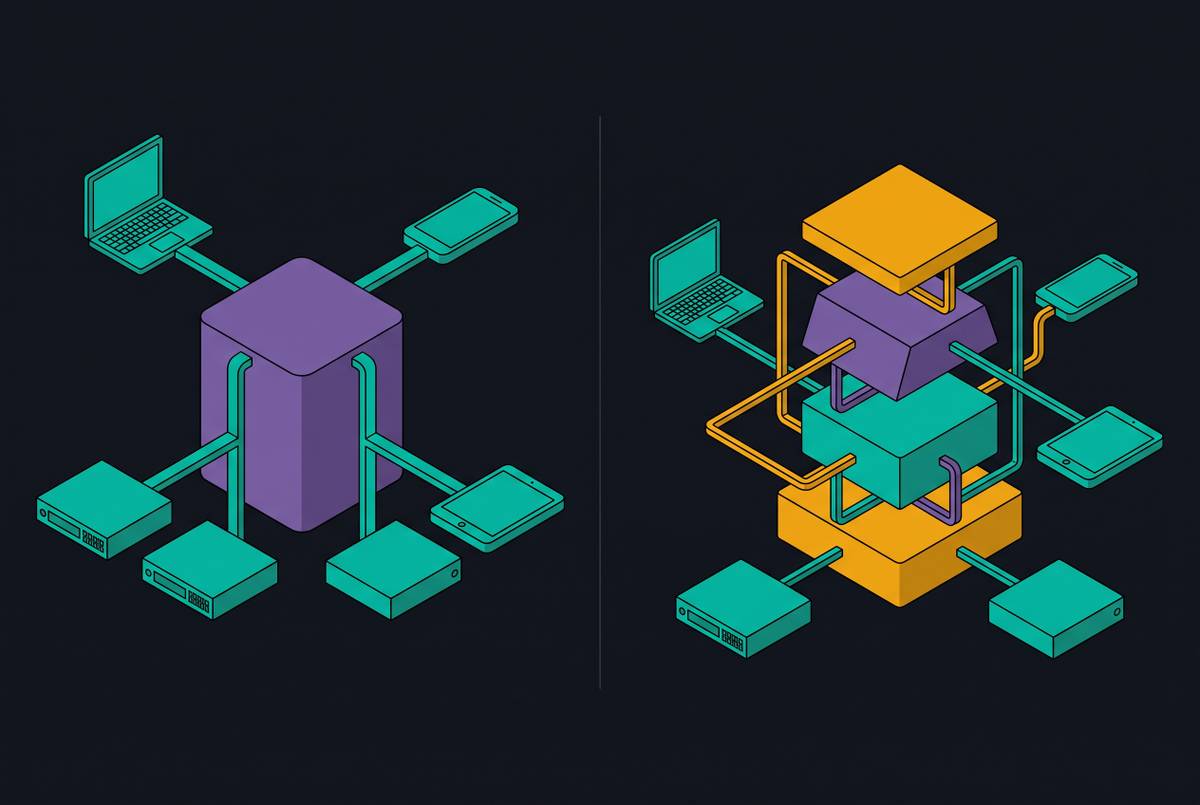
Isolation between tools doesn't expand that surface by adding new entry points. It expands it by leaving existing paths unmonitored and uncorrelated, which lands the same way for an attacker even though the mechanism is different. When device management, identity, and endpoint detection run as three separate products, a threat that crosses those boundaries (a compromised login that leads to a file transfer, say) is invisible to each tool individually. The identity system sees a login. The endpoint tool sees a process running. Neither one sees the connection between them, because neither one was built to look outside its own lane.
An endpoint alert by itself is close to meaningless. It only becomes useful once it's checked against what's happening on the network, in email, and in identity logs at the same time.
Selective protection makes this worse, and it's the part most SMBs get backwards. Traditional per-endpoint pricing pushes businesses toward covering the devices they can see easily: laptops, main servers. Secondary servers and edge devices go unmonitored because the budget runs out or nobody thought to include them. Attackers know this. They look specifically for the unguarded device sitting at the edge of the network, because that's the foothold that lets them move laterally without tripping an alarm.
A 2025 survey of 327 CISOs across 11 industries found that 71% reported incomplete telemetry from endpoints running outside their standard environment, and visibility gaps, not malware itself, ranked as the top concern. That's a structural gap, not a misconfiguration. Tools built to run independently will always leave this kind of hole, no matter how well each one is configured on its own.
How fast attackers move through the gaps disconnected tools leave open
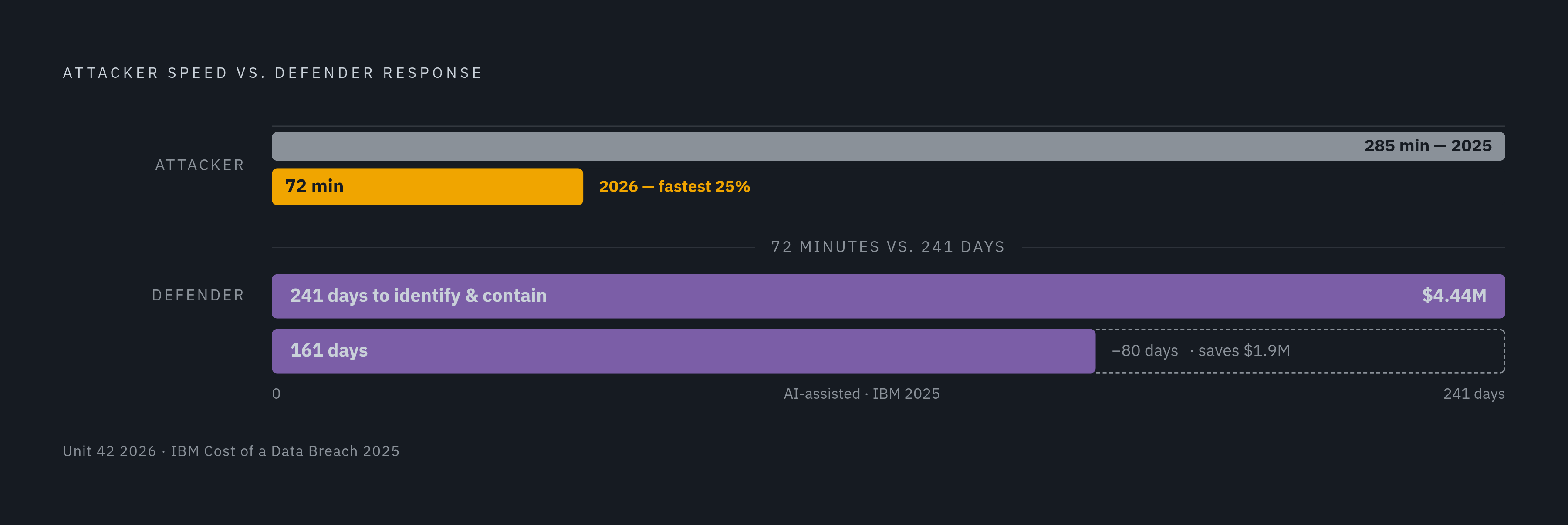
Speed is where this gap turns from theoretical into operational. The 2026 Unit 42 Global Incident Response Report found the fastest 25% of intrusions reached data exfiltration in 72 minutes, down from 285 minutes the year before. Four times faster in a single year. Incident response playbooks built around breach windows measured in weeks, the industry standard for years, are structurally outdated against that timeline. Not slow. Obsolete.
Now put that next to the defender's side of the clock. IBM's 2025 Cost of a Data Breach report puts the average time to identify and contain a breach at 241 days, and the average cost tied to that lag at $4.44 million per breach. That number isn't set by how good attackers have gotten. It's set by how disconnected detection tools are on the defending side.
The same report found a different outcome for organizations running AI-driven, consolidated security platforms: detection and containment cycles cut by 80 days, and an average savings of $1.9 million per breach. That's not a marginal improvement. It's the difference between catching an intrusion mid-attack and finding out about it eight months later from a customer or a regulator.
The 72-minute exfiltration window and the 241-day detection average are two ends of the same rope. Everything in between is where context loss lives, and it's the space attackers count on staying open.
Why SMBs feel this problem more acutely than larger organizations
Larger organizations have dedicated security teams working in their favor — people whose full-time job is stitching together what fragmented tools can't do on their own. That structural advantage helps compensate for context loss. Most SMBs have none of them.
More than half of small businesses, 52%, rely on untrained internal staff or the owner personally to manage cybersecurity. Not a security hire, the person who also does payroll and answers the phones. Coalition's 2025 research found that 74% of small businesses spend less than $10,000 a year on cybersecurity, nowhere near enough to fund the manual log correlation that fragmented tools demand.
Even if a small business wanted to hire its way out of the problem, the talent isn't sitting around waiting. ISC2's 2024 Cybersecurity Workforce Study put the global shortfall at 4.8 million security workers. That's not something SMBs can fix by offering a better salary. The candidates don't exist in the numbers needed.
Meanwhile, the targeting math runs the opposite direction from what most owners assume. Small businesses are three times more likely to be targeted than larger firms, and they account for 46% of all cyber breaches globally. In 2025, 43% of all cyberattacks targeted small businesses specifically, a number driven by Ransomware-as-a-Service kits that make SMBs cheap, reliable targets at scale.
And still, 64% of SMBs don't believe they're an attractive target, even though 79% experienced a cyberattack in the past five years. That's the false-confidence gap, and it's precisely where the risk sits unaddressed. Lean staffing, thin budgets, and misplaced confidence together mean fragmented tools don't just reduce visibility for SMBs. They leave SMBs functionally undefended against the attack most likely to hit them: ransomware.
Ransomware is the attack that most directly exploits the context gap at SMB scale
An industry breach report analyzing 22,052 security incidents and 12,195 confirmed breaches found ransomware present in 88% of breaches at small and mid-sized businesses, compared to 39% at larger organizations. That's the widest size split anywhere in the report, and it's the clearest evidence that context loss hits smaller firms hardest.
Ransomware showed up as a factor in 44% of all data breaches in 2025, up from 32% the year before. Separate research from ConnectWise, citing a Vanson Bourne survey, found 47% of small businesses under $10 million in revenue were hit by ransomware in the past year.
The context gap is exactly what makes this attack work. Ransomware operators get in through one narrow foothold, then move laterally, hopping from device to device, account to account, looking for the path to something valuable. That lateral movement is precisely what disconnected tools can't see, because it crosses the same boundaries that separate one console from another. The 2025 DBIR found that a third of all breaches start with phishing, an email-layer event an endpoint tool running in isolation never sees at all.
The financial toll at SMB scale lands hard, and it lands fast. Median ransom payment hit $115,000 in 2025 DBIR data, close to the entire annual IT budget of many small firms. Downtime from an attack costs roughly 50 times more than the ransom itself. Thirty-seven percent of SMBs attacked in 2025 lost more than $500,000 on the incident, and many face permanent closure afterward. The financial exposure from a ransomware hit routinely exceeds what a small business can absorb.
Those aren't abstract numbers. They're the difference between a business that survives a bad week and one that closes its doors.
How the attack surface expands further as endpoints multiply and AI tooling enters the environment
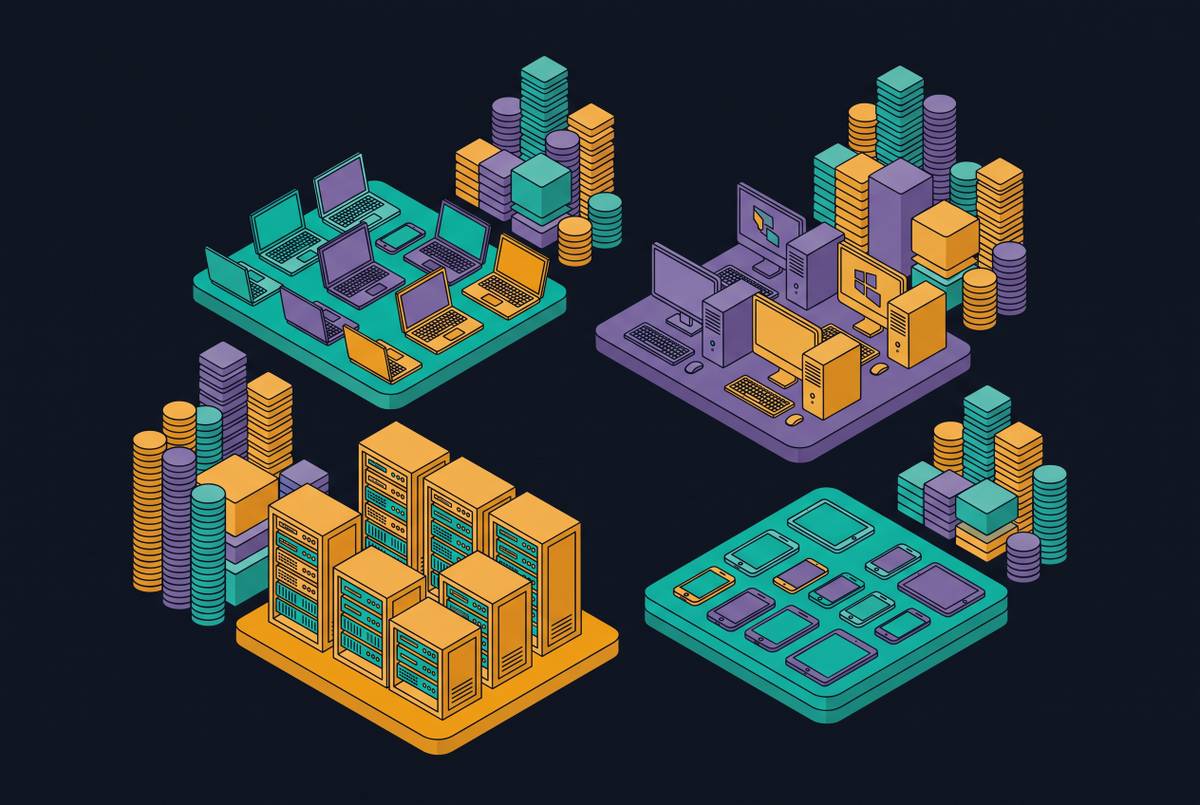
The endpoint isn't a laptop and a server anymore. It's mobile phones, IoT sensors, virtual machines, point-of-sale systems, cloud workloads, each running its own operating system, sitting in its own location, blurring what used to be a clean network edge. Every new category makes remediation harder, because there's one more place an attacker can sit undetected.
Cloud tools follow the same pattern seen on-premises, just under a different name. The Palo Alto Networks State of Cloud Security Report 2025 found organizations managing an average of 17 cloud security tools from five different vendors, producing the same fragmented data and slow incident response seen anywhere else tools don't talk to each other. Ninety-seven percent of respondents in that same report said consolidating their cloud security tools was a priority. That's nearly everyone surveyed agreeing on the same fix.
AI tooling adds a layer nobody built these defenses to monitor, and this is the part of the risk surface most teams haven't priced in yet. Wiz Research's State of AI in the Cloud 2026 report found Model Context Protocol (MCP) present in at least 80% of observed cloud environments in early 2026, a new integration layer sitting on top of infrastructure that existing endpoint tools were never designed to see into.
It's already a confirmed attack surface, not a hypothetical one. Invariant Labs demonstrated in April 2025 that a poisoned math tool could read SSH keys off a system and exfiltrate them disguised as a parameter in a math function. No user clicked anything. No persistent trace was left behind. And no tool watching in isolation had any way to catch it, because the attack lived entirely inside a layer none of them were built to monitor.
Security infrastructure itself has become a prime target — the tools meant to provide coverage are now, themselves, part of the surface they were bought to protect. The 2025 Verizon DBIR found vulnerability exploitation present in 20% of all breaches, up 34% from the year before, with servers showing up in 95% of breaches. The endpoint perimeter keeps expanding, and that expansion is a direct driver of how often breaches happen at all.
What unified, context-sharing tools change about the risk equation
The fix isn't a better individual tool. It's an architecture where endpoint telemetry integrates with network, identity, and cloud data inside one platform, instead of sitting in isolated silos that require a person to manually stitch them together after the fact.
Integration changes what's actually possible day to day. Real-time correlation means an endpoint event, checked alongside an identity event and an email event at the same moment, becomes something an analyst can act on immediately. Any one of those three sitting alone is just noise. Automated response can trigger the instant something is detected, rather than waiting on an analyst to pull logs from four different consoles and piece together what happened after the fact. And policy enforcement (encryption, patching, access control) gets applied the same way across the whole environment, not selectively based on which devices happened to fit the budget.
A 2025 CISO survey found organizations running two to three unified tools saw 41% fewer false positives and 29% faster containment than organizations running four or more fragmented agents. Fewer tools, better outcomes, backed by a real number.
Gartner projects that by 2026, organizations that prioritize consolidating their security platforms will cut security incidents by half. For SMBs specifically, the payoff is even more direct: integrated platforms automate the routine grind, patch deployment, configuration checks, freeing the one or two IT generalists on staff to chase down actual threats instead of cross-referencing dashboards from five different vendors. IBM's finding of $1.9 million saved per breach and 80 fewer days to containment translates, at SMB scale, into the line between an incident a business survives and one that ends it.
What SMBs without a dedicated security team should prioritize first
The real decision facing most SMBs isn't which individual product to buy next. It's whether to keep building a stack one tool at a time, or start with something that removes the context-loss problem from day one, by design.
Outsourcing to a managed security provider deserves a direct answer here, since it's the obvious alternative most SMBs consider, and it's the wrong default. A managed provider takes security operations off an SMB's plate and hands it to a third party, but it doesn't eliminate fragmentation. It moves that fragmentation into a vendor relationship the business still has to manage, still has to pay for every month, and still has to trust to correlate the same disconnected data sources on its behalf. Paying someone else to manage five disconnected tools is not the same as fixing the five disconnected tools.
A first security investment should get judged on a short list of capabilities, not brand names:
- Device management and endpoint protection running off a single shared data layer, not stitched together by API after each product was bought separately.
- Identity protection and compliance enforcement built into that same platform from the start, not bolted on later.
- Deployment measured in days or weeks. A two-person IT team can't absorb a months-long professional-services rollout.
- Automated enforcement that keeps running on its own, without needing a specialist to tune it every week.
A platform that brings device management, endpoint security, identity protection, and compliance automation together in one place is a more reliable starting point for an SMB than assembling separate point tools, or handing the problem to a managed provider. It closes the context gap structurally, instead of asking a lean team to manage around it forever.
CrowdStrike's 2025 State of SMB Cybersecurity Report captured the gap plainly: A large share of SMBs express confidence in their cybersecurity posture, yet far fewer are actively investing in updated tools to back that confidence up. That space between what businesses believe about their own readiness and what they're doing about it is exactly where undetected risk sits and waits.
Context loss was never a problem that needed a security expert standing by to diagnose it. It's an architecture decision, one SMBs can get right the first time by choosing integration over accumulation from the start.
Sources
- Understanding Model Context Protocol Security (MCP) in 2026 | Wiz
- The state of MCP security in 2025: Key risks, attack vectors, and case studies
- What is Endpoint Security? | Best Practices, Challenges and Tools | BeyondTrust
- Security tool sprawl and context loss: what practitioners ne...
- acsmi.org
- kitecyber.com
- paloaltonetworks.com
- connectwise.com