Why Separate MDM and EDR Contracts Fail the Moment a Small Business Needs Them Most
Separate MDM and EDR tools leave a dangerous gap only someone can own.
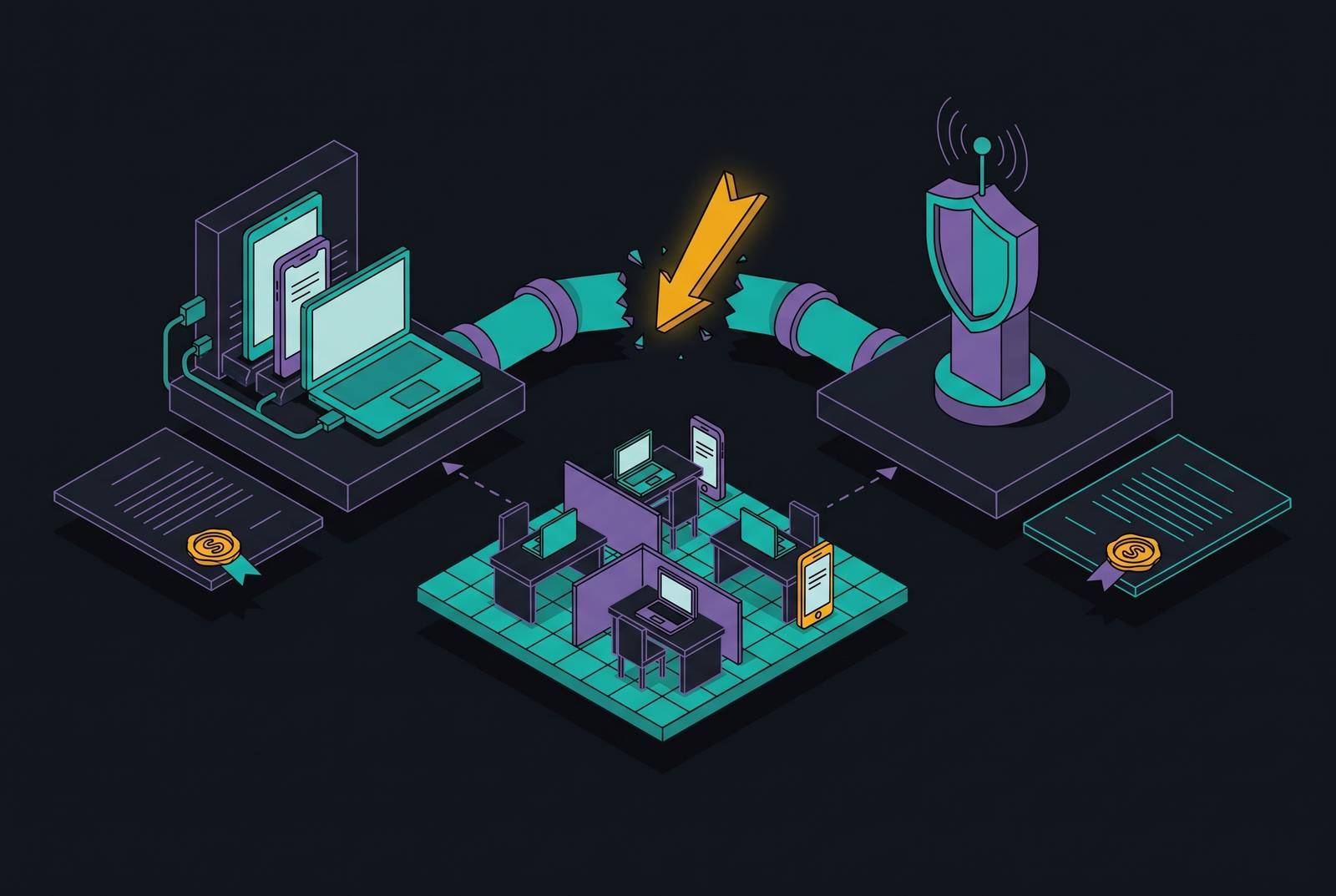
Separate MDM and EDR contracts can leave a small business with two working tools but no one responsible for the protection between them. To close that gap, one owner must be responsible for making device management, threat detection, identity controls, and compliance state work together. For a business without a security team, the test is not whether both tools are installed, but whether someone keeps them working and acts when trouble starts.
Why MDM and EDR address genuinely different problems — and why that division creates a seam
Mobile device management, or MDM, sets up and administers devices, enforcing policies such as encryption, passcodes, and updates while supporting remote lock or wipe. Endpoint detection and response, or EDR, watches what happens on a device for signs of an attack, including suspicious behavior that does not match a known malware signature. They do different jobs by design. MDM responds to a known administrative need, while EDR looks for an intrusion that configuration rules alone cannot prevent.
A laptop can have encryption enabled and its required settings in place while an attacker uses legitimate system tools to act on it. MDM will not detect that intrusion merely because it manages the laptop. The reverse is just as true. EDR does not enforce encryption or remotely wipe a device left in a taxi, so threat detection does not remove the need for device management.
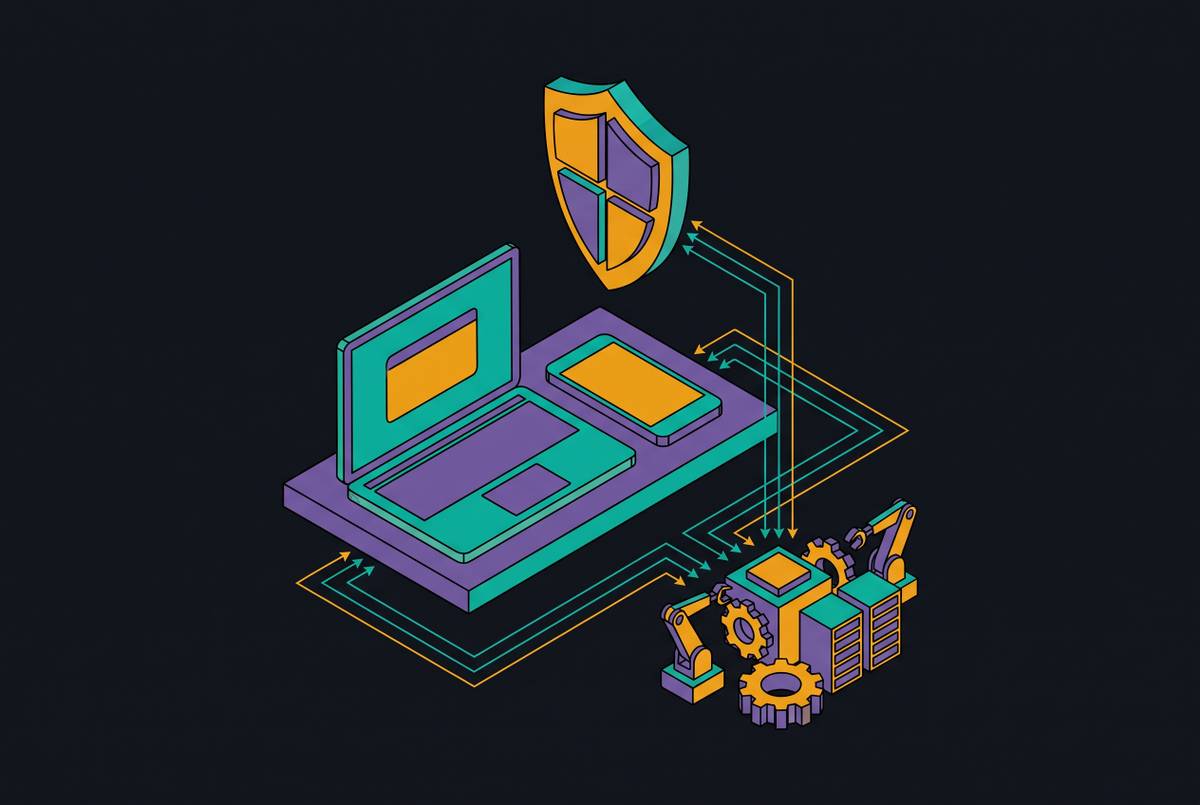
The division becomes a problem when each contract stops at its own tool. Device configuration and active threat response need to draw on what each tells them, but buying both does not make that happen. Someone must connect the device’s policy state to its protection state and own the action that follows. That is the seam between “device configured correctly” and “device under active attack.”
Why the seam between MDM and EDR stays invisible until something goes wrong
Separate dashboards can each report full coverage without verifying the other system’s state. The MDM view can show managed devices, while the EDR view shows the devices reporting to it. Neither view by itself shows for sure that every device is both managed and actively protected. Each answers a narrower question than the business needs. Taken together, those answers can look complete even when end-to-end coverage is not.
This is not a careless purchasing decision. The people who run small businesses have bought tools for two different needs, and both tools have sent reports that look reassuring. What is missing falls between those reports and outside what either product claims to cover. Unless someone reconciles them, the architecture gives the operator little reason to question the picture. A green dashboard is persuasive when there is no shared view showing what it leaves out.
Configuration drift makes that picture less reliable over time. An operating system update can break an EDR agent, a new device can arrive without MDM enrollment, or a prevention policy can remain disabled after troubleshooting. These are quiet failures. Separate contracts do not, by themselves, assign responsibility for finding them.
For a lean team, the coordination work compounds quickly. Separate enrollment, directories, and policy management add work for someone already handling user support, infrastructure, vendors, and backups. Alert review adds another ongoing obligation. An EDR tool can keep generating alerts while nobody investigates them, making activity on the dashboard look like protection. The intended feedback loop, where MDM deploys EDR and threat alerts appear beside each managed device, works only when someone is responsible for setting it up and keeping it running.
What the seam actually looks like when a breach is live
Consider a small business receiving an EDR alert at 2 a.m. on a Saturday. Suspicious activity has been detected on a laptop, but the alert is only the start of the response. Someone still has to act on it. If the service only sends a notification, the business has to act, and it may have no dedicated security analyst on hand. The first gap is therefore between detection and a person able to take action.
EDR can isolate the device from the network, identity controls can revoke access credentials, and MDM can lock or wipe the device when appropriate. Under separate contracts, different owners are in charge of these controls. The right sequence needs coordination across them. Detecting the threat does not automatically establish who can make each move or who decides that the response is complete.
In a fragmented setup, that coordination can become the emergency. The security provider may find the threat while another provider controls the device policy or account access. If they have to coordinate by email, the response stretches while an attacker may still be able to move laterally. The tools need not have failed for this to happen.
Some incidents also begin outside the behavior EDR detects. Compromised credentials, business email compromise, and MFA fatigue can resemble normal logins, so an EDR alert is not guaranteed. Identity and device controls are needed in those cases too. A managed provider can supply people to handle alerts, but unless its authority reaches across the relevant controls, the same seam remains between identifying the problem and containing it.
Why adding an MSP or MSSP on top of separate tools doesn't close the gap
A managed service provider, or MSP, generally focuses on IT uptime, help desk work, patching, and networking. A managed security service provider, or MSSP, watches for threats through a security operations center and brings together the people who handle incident response. Both can deliver real value to a small business. Their scopes, however, are not interchangeable. Hiring both does not automatically make either responsible for the point where a security finding needs a device or access change.
An MSSP may identify an issue but depend on the MSP or an internal team to fix it. That dependency creates a handoff with practical questions attached. Who is authorized to make the change, who performs it, and who confirms that the underlying weakness has been addressed. Unless they agree on who owns the response, each provider can finish its part while the response as a whole is still unfinished. Accountability fragments even when the people involved are capable and acting in good faith.
A broken agent, an unenrolled device, or a disabled prevention policy needs an owner who checks across systems. If neither contract includes finding and correcting those mismatches, the business still has to bridge them. The distinction is between a service that reports a problem and an arrangement that takes responsibility for getting the controls back into place.
An MSP or MSSP can be part of a coordinated model when responsibility for enforcement and response is explicit. But an additional service contract is not proof that the model exists. The gap closes only when someone owns the outcome across tools, rather than assuming that another provider will handle the next step.
Why small businesses absorb the worst consequences of this fragmentation
For a small business, the person receiving a security alert may also be handling employee support, vendor renewals, and everyday operations. Security is one duty among several covered by the same staff. That leaves little spare capacity for reconciling inventories, checking agent health, and reviewing alerts continuously. The work accumulates around a founder, IT generalist, or operations leader whose other responsibilities keep arriving.
Larger organizations have more room to put people in charge of that work across tools. A small business is more likely to discover that it bought a self-managed security workload. The mismatch is especially clear outside business hours. Someone has to pay attention to an alert and have the authority to act, and an EDR subscription alone does not provide either. A backlog of unreviewed alerts is the operational consequence.
Small organizations have less room to absorb the disruption and expense of a breach, yet gaps in their defenses can make them efficient targets at scale. Ransomware-as-a-Service has made it pay to target small organizations in a systematic way. Being small is not a dependable defense. The practical concern is that fragmentation slows the response when an incident does occur.
MFA on privileged accounts, EDR across endpoints, and immutable backups are common minimum requirements for coverage. If actual coverage differs from what the insurance application described, a policy may allow a claim to be denied. A business can thus pay for the tools and the insurance yet still be at risk because nobody kept enforcing the controls it said were in place.
How can a small business without a security team close the MDM and EDR gap?
A unified MDM, EDR, and compliance platform for a small business needs more than a shared vendor name. It needs one operational layer where device state, policy enforcement, and threat response share a data model, with one accountable owner. The practical test is what happens when protection changes. A common interface is useful, but it is not enough if people still have to discover mismatches and negotiate action between separate services.
For buyers, the first criterion is verified coverage. MDM should deploy the EDR agent and verify that it continues to report, so a broken agent becomes a detected coverage problem before an incident occurs. New devices should join both systems without a step that someone has to do by hand and could miss. Enrollment is only the starting point for protection. Continued verification is what connects a device listed as managed to a device that is actually reporting security activity.
The next criterion is shared context and action. EDR alerts should appear with the device’s compliance state so the person responding can see both the threat and the policy conditions on that device. Network isolation, credential revocation, and MDM actions should be available through a single workflow. That removes a coordination burden during containment. It also makes the relationship between detection and remediation concrete, because the platform connects the finding to the controls needed to address it.
The service terms deserve the same scrutiny as the interface. Buyers should ask who is accountable when an agent stops reporting, how new devices enter both MDM and EDR, and who responds outside business hours. They should also establish whether that response is included or requires another contract. An alert is not a completed response.
The recommended priority is MFA everywhere first, followed by EDR with monitored response, tested backups, verified patching, and email security with phishing protection. Integration does not replace those controls with a single feature. Its value is consistent enforcement without requiring a lean team to verify each tool separately. Compliance state belongs in that day-to-day view of protection, with the evidence kept alongside the work of protecting devices.
To examine the current arrangement against those criteria, the business should start by naming the party responsible for detecting a failure and the party responsible for fixing it at each handoff. Any answer that ends with “someone else handles that” needs a defined owner. That is the standard to apply to a platform, a managed service, or the contracts already in place.
Sources
- Best EDR for Small Business: A Buyer's Guide to Endpoint Security
- MSP vs. MSSP: Why Most Small Businesses End Up with the Wrong Security Model
- Connect Your Security Tools to Simplify Endpoint Security Management | Zip Security
- Endpoint Protection vs. Data Control: Understanding the Difference | Zip Security
- Identity Access and Device Management: A Simple Model for Modern SMB Security | Zip Security