Human Error Patterns in Manual Endpoint Configuration
Manual configuration produces predictable errors that no amount of training can prevent.
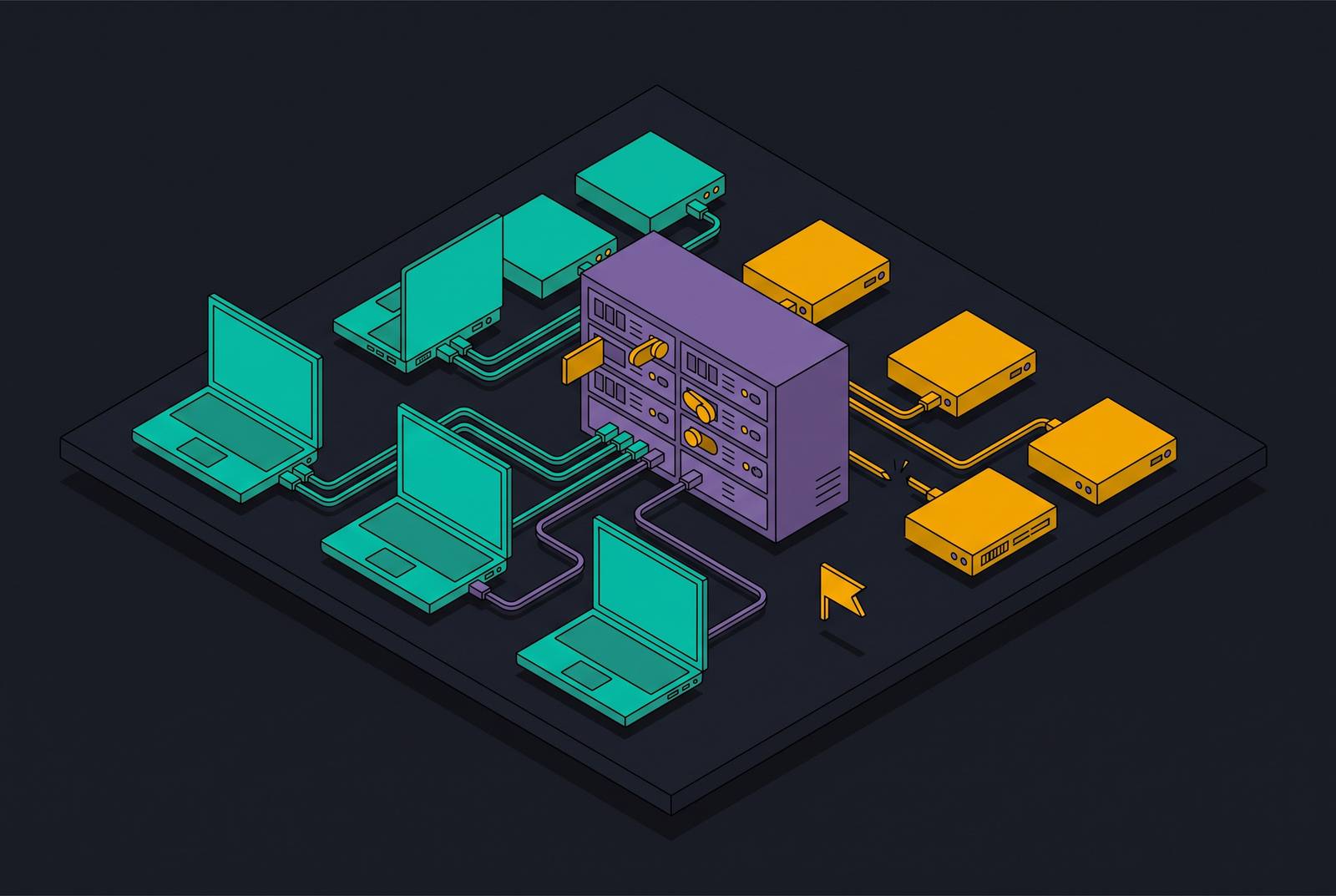
Endpoint misconfiguration doesn't happen because someone got careless or skipped training. It happens because configuring a device fleet by hand produces the same handful of error patterns no matter who's doing it. Skipped steps, inconsistent settings across machines, slow drift away from the original policy are ordinary conditions rather than signs of a weak team. It's what manual configuration reliably produces at scale, and blaming the person at the keyboard just guarantees the next hire makes the same mistakes the last one did.
The usual response to a breach is to go find whoever set things up and point fingers. That instinct is wrong, and it wastes time that should go toward fixing the actual system. A modern device fleet generates more configuration decisions than any one person can track without help: identity and access management, firewall rules, encryption, endpoint detection behavior, update policies, each one leaning on the others. Unlike a broken feature, a misconfigured setting rarely announces itself. The system still boots, still serves users, still looks fine on a dashboard. Nothing breaks. That's exactly the problem.
There's a behavioral layer underneath all this, too. Configuration work rarely feels urgent in the moment, so it's exactly the kind of task that gets done with someone's attention split three ways, wedged between a help desk ticket and a lunch meeting. What follows takes a different approach than offering a list of tips to fix that. It's a map of where the failure actually starts, so it's easier to catch in a given environment before someone else finds it first.
Skipped steps during initial setup
Setup is the single highest-pressure point in the whole configuration lifecycle. Speed to deployment gets noticed. Thoroughness doesn't, at least not until something goes wrong.
Most systems ship with permissive defaults, because permissive defaults are easier to use out of the box. That's fine as a starting point. The trouble is that under time pressure, the default stops being a starting point and becomes the final answer. Forbes Technology Council has flagged this pattern directly: "temporary" exceptions granted during setup, debug roles, open storage buckets, overly broad IAM permissions, often survive for years without anyone circling back to close them.
Checklists don't fix this, either. A checklist can get checked off on paper without every item actually being verified, and in a long setup sequence, skipping one item in the middle usually doesn't stop the system from going live. Nothing fails. Nothing alerts. The gap just sits there, waiting.
The Firebase incidents make this concrete. Researchers found roughly 916 websites running with missing or improperly configured security rules, exposing 125 million user records, including 19.8 million plaintext passwords. Chattr.ai, a hiring platform used by companies including KFC and Subway, exposed employee and applicant data, including billing details, after attackers exploited weak Firebase rules to gain full database read and write access, including access to an admin-level dashboard. None of that took a clever exploit. It took a setup mistake nobody caught in time, which is exactly why OWASP moved security misconfiguration to the No. 2 spot on its 2025 Top Ten list.
Inconsistent settings across devices as fleets grow
Configuring one device by hand is manageable. Configuring the fortieth device the same way, with the same judgment calls and the same exceptions, is a different problem entirely, and it doesn't scale in a straight line.
Inconsistency creeps in from a few directions at once. Different technicians read the same policy and apply it slightly differently, filling gaps in documentation with their own judgment calls. Devices set up months apart inherit different software baselines, because the defaults themselves changed in between. An exception granted for one person (say, a wider permission set for a manager) spreads informally to others without anyone ever signing off on it.
None of this drifts randomly. Under time pressure, every manual deviation leans more permissive, never less. A firewall rule that's too open is easier to leave alone than to tighten. Disabled EDR behavioral analytics solve an immediate complaint about performance friction, and turning them back on requires someone to make a separate, deliberate decision later, one that often just never comes.
Research puts a number on the human side of this: 82% of cloud misconfigurations trace back to human mistakes rather than software bugs. The result can be stated simply. An attacker doesn't need to find the most secure machine in an environment. They need to find the least secure one, and inconsistency across a fleet all but guarantees that machine exists somewhere. Endpoint misconfiguration now accounts for 27% of the entry points attackers use to get in, making it one of the most reliably available paths into a network.
Configuration drift after the initial deployment
Drift is the gap between what a device is supposed to be running and what it's actually running. That gap widens on its own if nothing enforces the original policy, no exceptions.
It builds up in a few predictable ways. Software updates quietly change default behaviors, so a setting that was secure last month turns permissive after an upgrade, with no announcement attached. A rule bent once for a user's convenience almost never gets restored. Changes made in a hurry, during incident response, during onboarding, during a troubleshooting call, tend to stay in place long after the emergency that justified them has passed. Forbes Technology Council calls this out specifically: "temporary" debug roles and open IAM permissions routinely outlive their purpose by years.
Drift is harder to catch than a bad setup, for a simple reason. Audits happen periodically, but drift happens continuously, so the gap between audits is an open window the whole time. Patch management tools and vulnerability scanners don't catch it either, since they track software versions, not configuration states. EDR tools generally catch compromise after it's already happened, not the misconfigured setting that let the attacker in to begin with.
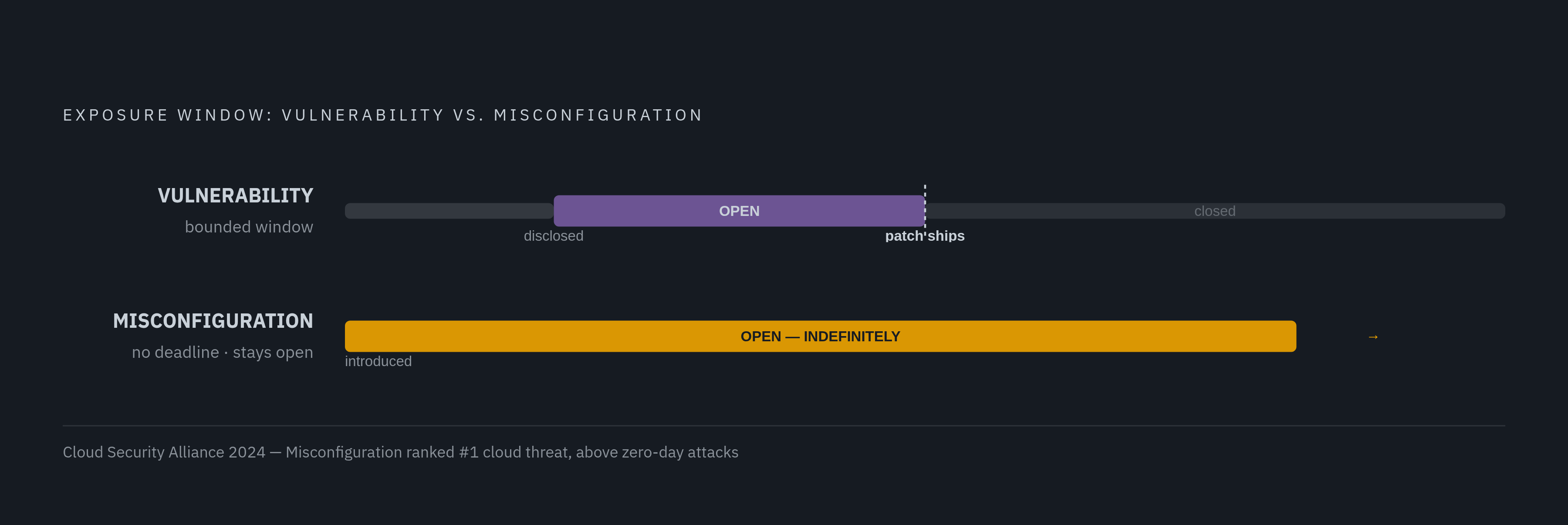
The Cloud Security Alliance's 2024 Top Threats report ranked "misconfiguration and inadequate change control" as the No. 1 cloud threat, ahead of zero-day attacks. That ranking gets at the real asymmetry here. A vulnerability gives attackers a limited window before a patch closes it. A misconfiguration is a door that stays open indefinitely, often for years, with no deadline pushing anyone to shut it.
The detection gap that keeps misconfiguration hidden until it is exploited
A misconfigured system still passes every functional test thrown at it. It processes requests. It serves users. It shows green across the monitoring dashboard. An IAM policy that's too permissive, a storage bucket left publicly accessible, disabled EDR analytics: none of it trips an alarm on its own.
The standard security stack isn't built to catch it, either. Vulnerability scanners look for unpatched software, not insecure settings. Patch management tracks software versions, not configuration state. EDR and XDR tools are built to catch attacker behavior once someone's already inside, not the open door that let them in to begin with. Manual audits happen too rarely, cover too narrow a slice of the environment, and carry their own risk of human error baked into the process.
Attackers see something defenders often miss: misconfigurations are low-effort, high-value targets. There's no exploit to write, no race against a patch cycle. Once inside through a misconfigured control, moving sideways across the rest of the environment tends to be easy, since internal segmentation usually assumes the perimeter held. Misconfigurations rank among the most common and consistently available causes of breaches, yet most detection tooling still points at the threat itself rather than the condition that made the threat possible.
Human review alone can't close that gap at the scale modern environments run at. What closes it is continuous, automated checking against known attack techniques, fast enough to catch a bad configuration before the next quarterly review even gets scheduled. A major provider's 2025 data breach report found a human element present in 60% of breaches, not because attackers need someone to slip up in the moment, but because the conditions people create through past configuration decisions stay open long after those decisions were made and forgotten.
Why SMBs carry disproportionate exposure from these patterns
Configuration complexity doesn't shrink just because a company is small. The people available to manage that complexity, though, often do, and that mismatch is where SMBs get hit hardest.
An IT generalist juggling five other responsibilities is exactly the setup where the failure patterns above show up fastest. Skipped steps at deployment happen more often when the person doing the setup is also running payroll and answering help desk tickets that same afternoon. Inconsistency across a fleet spreads faster when nobody's job is specifically to track configuration state device by device. Drift piles up unchecked when there's no one watching for it continuously in the background.
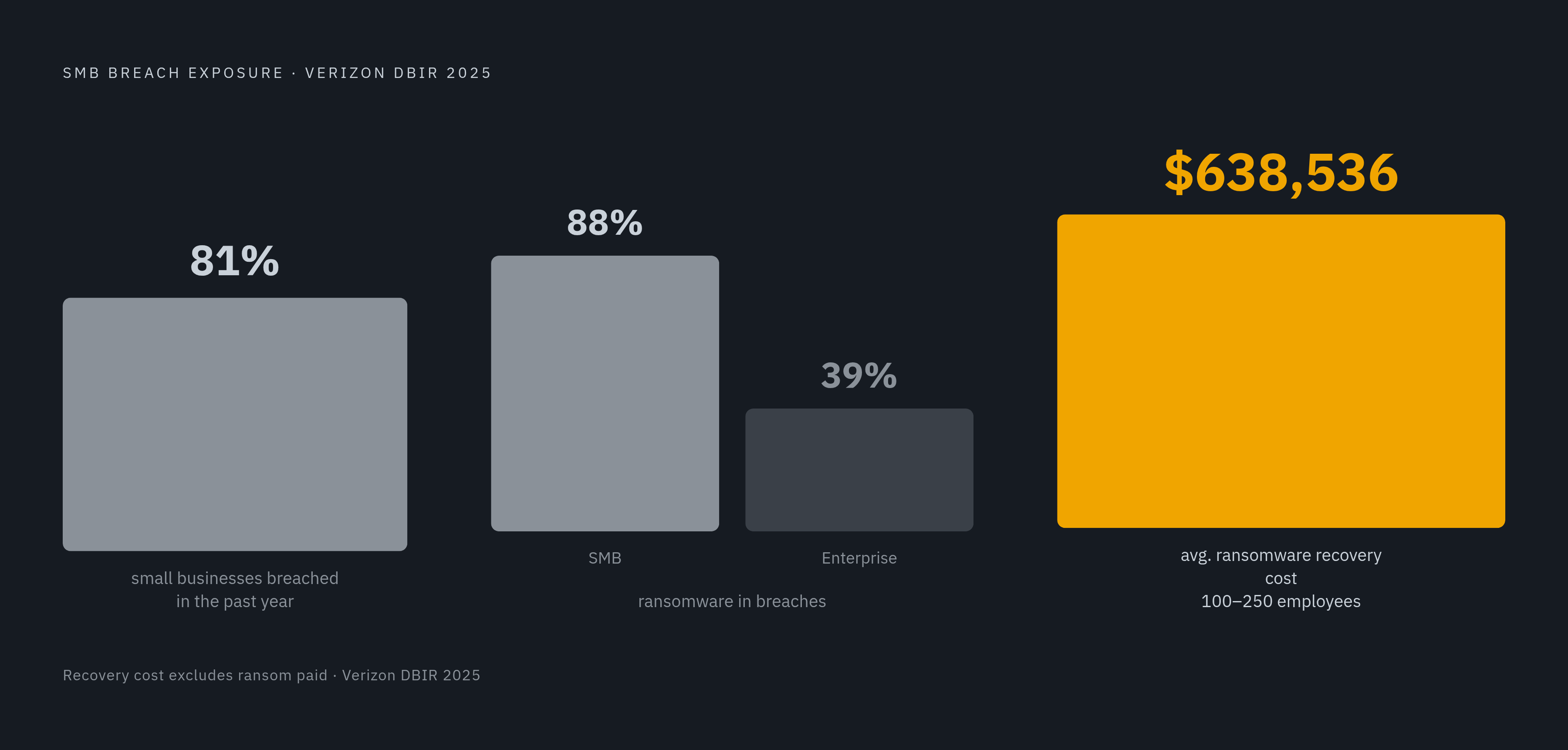
That gap isn't theoretical. Verizon's 2025 DBIR, drawing on more than 22,000 security incidents and 12,195 confirmed breaches, found ransomware present in 88% of breaches affecting small and mid-sized businesses, compared with 39% at large enterprises. The financial exposure lines up with that gap: the Identity Theft Resource Center's 2025 Business Impact Report found 81% of small businesses suffered a security or data breach in the past year, and 62.5% reported total financial impact above $250,000. Sophos put the average ransomware recovery cost, excluding any ransom paid, at $638,536 for businesses with 100 to 250 employees. Downtime and recovery costs routinely dwarf the ransom demand itself for small businesses.
None of that traces back to SMB teams being less capable. The volume, the complexity, the lack of dedicated staff watching for drift: those conditions are just most concentrated at that size of company, and no amount of individual competence changes the math.
What consistent, enforced configuration looks like in practice
Automation should carry the parts of configuration a human shouldn't be trusted to remember, and people should stay in charge of the decisions that actually need judgment. Get that split wrong, and the space where a mistake can sit unnoticed for months or years just keeps growing.
Consistent configuration starts with a baseline applied the same way on every device, not interpreted individually by whoever happens to be setting it up that day. From there, actual device state needs checking against that baseline continuously, not once a quarter. When a device drifts out of policy, that needs to get flagged or fixed automatically, instead of waiting for the next scheduled review. And the defaults on day one need to already be secure, so the starting point of a deployment isn't a liability before anyone's even touched it.
A fragmented toolset can't deliver any of that for a small team, and pretending otherwise is the mistake worth naming directly. When device management, identity, endpoint security, and compliance enforcement all live in five different dashboards, someone still has to mentally stitch together the full configuration picture across all of them by hand. That recreates the exact synthesis problem that produces the error in the first place. Fixing one setting across five separate vendor tools is itself a manual, error-prone step, no matter how good any single tool is on its own.
A platform that brings device management, endpoint security, identity protection, and compliance automation into one enforced policy layer closes the seams where drift and inconsistency usually build up. For a founder, an IT generalist, or an operations lead running security without a dedicated security team, the real payoff is that the failure patterns covered here stop being something a person has to catch by hand. Security awareness training can substantially reduce human error incidents, and that matters. But training changes behavior. It doesn't touch the environment those behaviors play out in. Closing both gaps at once, the human one and the environmental one, is what actually holds.