Compliance Evidence Automation for Endpoint Programs
Automated evidence collection proves controls ran continuously, not just today.
A team preparing for an audit usually discovers the real problem a few days before the auditor arrives: the controls exist, but the proof that those controls ran continuously does not. Endpoint compliance programs fail audits far more often because of missing or reconstructed evidence than because of missing controls. The traditional model relies on administrators periodically reviewing configurations, running scripts, inspecting logs, and applying corrective fixes by hand. That process is slow, and it delays detection of configuration drift or security misconfigurations by design, because nobody is watching between reviews. Peer-reviewed research looked at 60 Linux endpoints over two equivalent eight-week periods, and it found that manual verification methods are hard to scale and become inconsistent once a hybrid IT infrastructure enters the picture. A non-compliant endpoint can sit undetected for weeks under this model, which widens the security exposure window and complicates incident response when something eventually goes wrong. Auditors are not looking for a clean snapshot of today. They check for proof that a control operated continuously across the period under review, and they do this against six pillars: complete visibility and inventory, granular access control, policy enforcement, continuous monitoring and logging, structured incident response, and comprehensive compliance documentation. A single screenshot taken the morning of the audit satisfies none of those six on its own. Compliance documentation gets treated as a task to complete right before an audit instead of an output a program produces every day it runs. When that happens, the evidence trail gets rebuilt under deadline pressure instead of accumulating on its own, and that reconstruction is where most audit findings originate.
What automated evidence collection retrieves at the endpoint layer
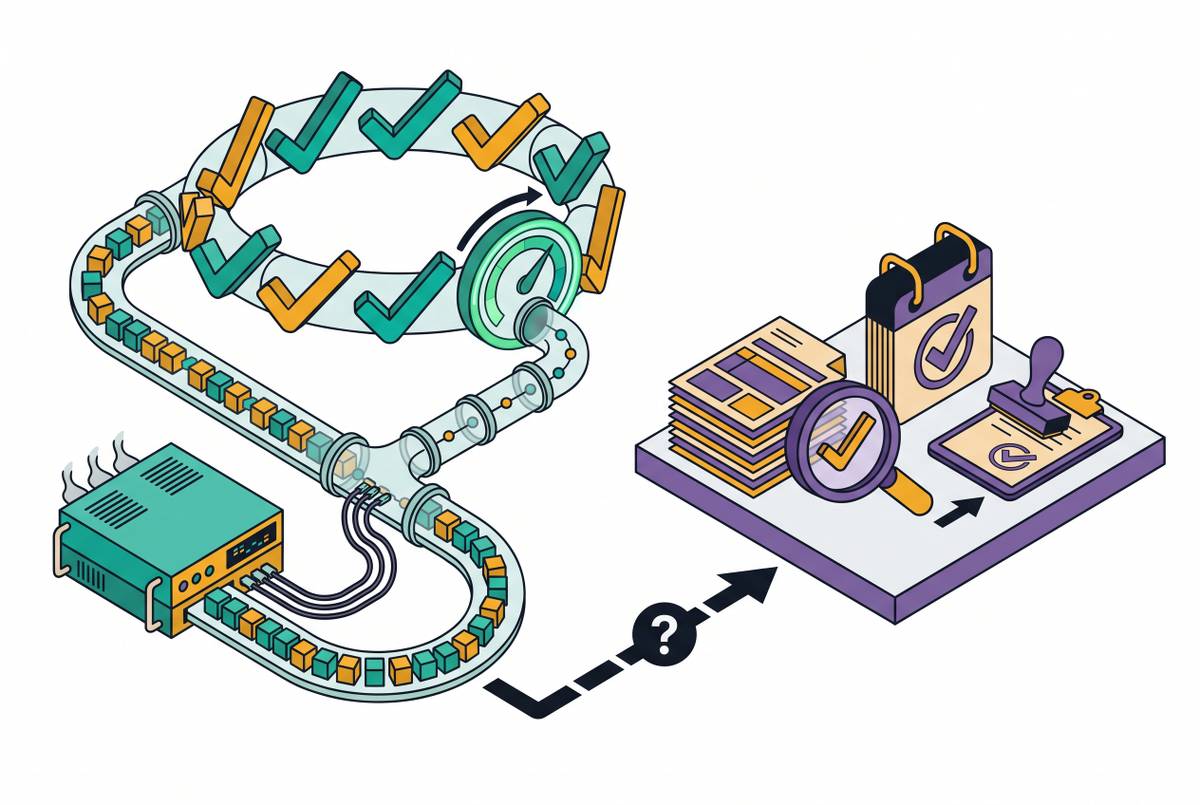
Automated evidence collection does not manufacture compliance out of nothing. It pulls machine-readable facts about system state from tools already running in the environment, attaches a timestamp and a source to each fact, and maps that fact to the control it is meant to prove. At the endpoint layer, this means pulling patch level per device, disk encryption status, and whether the EDR or antivirus agent is actually running, all current at the exact moment the system read them. Provenance is the detail auditors care about most: a machine-collected artifact that carries where it came from, when it was pulled, and by what tool answers most of an auditor's questions before anyone opens a file. A screenshot, by contrast, answers none of that on its own. Repetition is the second property that gives this kind of evidence its value. The same check runs again next week without a person remembering to schedule it, and that repetition is what turns a point-in-time fact into a continuous record.
An integrated endpoint program can supply many more categories than just patch levels and agent status. On the identity and access side, the same approach can show whether MFA is enforced per user, whether an offboarded employee's account is still active, and when a privileged role was granted and by whom. On infrastructure, it can confirm encryption-at-rest status per storage resource, flag public-facing assets and open ports, and check that logging is enabled on critical systems. Change management evidence includes merge approvals on pull requests, who reviewed them, and whether tests passed before deployment. Vulnerability scanning contributes open findings sorted by severity and age, whether a corrective action exists, and whether a fix was actually deployed or only scheduled. Personnel and HR records round this out with training completion certificates, policy acceptance records, and onboarding documentation tied to a start date. Auditors ask for access control records, encryption evidence, patch management logs, and incident response procedures aligned to whatever framework applies, and these categories map directly onto what a well-integrated set of tools can return automatically. SOC 2 Type II requires demonstrating that controls operated effectively over a minimum six-month period. A point-in-time check cannot satisfy that requirement under any circumstance. Only a continuous evidence trail, built from repeated automated pulls, can.
Why automation's limits matter for audit readiness
Automation hits a hard ceiling at the line between machine-readable system state and human judgment, and auditors in mature programs scrutinize the evidence living above that ceiling most closely. The moment a piece of evidence stops describing a fact about a system and starts describing a decision a person made, no integration has anything left to read. Board minutes, risk-acceptance rationale, the narrative context behind a control decision, vendor risk assessment reasoning, and exception approvals all require a human to write them down and sign off. Auditors also look closely at incident response procedures: evidence that tabletop exercises actually happened, forensic capability for investigating an incident, containment and remediation steps, and post-incident review documentation. None of that is a machine-readable system state, so no integration pulls it automatically.
A compliance tool that cannot pull meaningful telemetry from the security systems a team actually relies on ends up functioning merely as a reporting layer sitting atop the control system. It adds a dashboard on top of a gap. The ceiling also shifts depending on the framework in question: frameworks built around process controls, like documented review cycles and training acknowledgments, have a larger share of evidence sitting above the automation ceiling than frameworks built around technical configuration state. None of this is a reason to pull back from automation. Knowing where the ceiling sits is what tells a program exactly which pieces still need a dedicated human process wrapped around them, and that clarity is what makes the rest of the program trustworthy.
Why the quality of endpoint telemetry determines how much the automation can prove
A compliance automation layer can only be as complete as the telemetry the underlying endpoint, identity, and security tools actually produce. That single fact sets the ceiling for what any compliance tool, however well built, can prove about a program. Compliance automation connects to the systems the work already depends on: cloud infrastructure, the identity provider, endpoint management, code repositories, ticketing systems, and it captures the current state of each one on a repeating schedule. The effect appears when those systems are fragmented. If endpoint management, the identity provider, EDR, and the patch tool are four separate products with no shared data model, the compliance tool has to reach four different APIs returning four different data formats and reconcile all of it by hand. Gaps open at exactly the seams between those systems.
Configuration drift is the clearest version of this failure. When endpoint management, identity, and EDR are not integrated, a device can fall out of policy in one system while still showing as compliant in another, and the compliance tool has no way to resolve that contradiction without a person stepping in. Continuous monitoring and logging, the kind auditors actually check for, depend on centralized log aggregation, real-time security event monitoring, behavioral analytics, automated alerting for policy violations, and tamper-proof log storage that meets retention requirements. Every one of those is a property of the endpoint program's architecture, not something a compliance tool can supply on its own. Most compliance programs are not served by a single tool anyway. The infrastructure evidence layer, the certification automation layer, and the GRC layer each do different work, but all three need to draw on the same underlying telemetry, or they turn into three disconnected silos producing three different pictures of the same environment. The peer-reviewed study of 60 Linux endpoints found its operational gains came from centralized, orchestrated enforcement across the fleet, not from a compliance tool bolted onto a fragmented stack after the fact. The architecture comes first. The proof follows from it.
How Continuous Enforcement Changes the Endpoint Program
Continuous enforcement does more than generate cleaner audit artifacts. It changes the security posture of the endpoint fleet in real time, turning what looks like compliance paperwork into an active detection mechanism running every day. The automated framework reduces risk by cutting down configuration drift, catching security misconfigurations earlier, and pushing policy violations toward remediation faster, which shortens the window any given endpoint spends out of compliance compared to a program that only checks in periodically. The same integration that reports patch level per device to satisfy an auditor is the one that flags an unpatched endpoint before an attacker finds it first. Control evidence built for an audit doubles as an early warning system for security operations, and that overlap is the strongest argument for building the telemetry layer well.
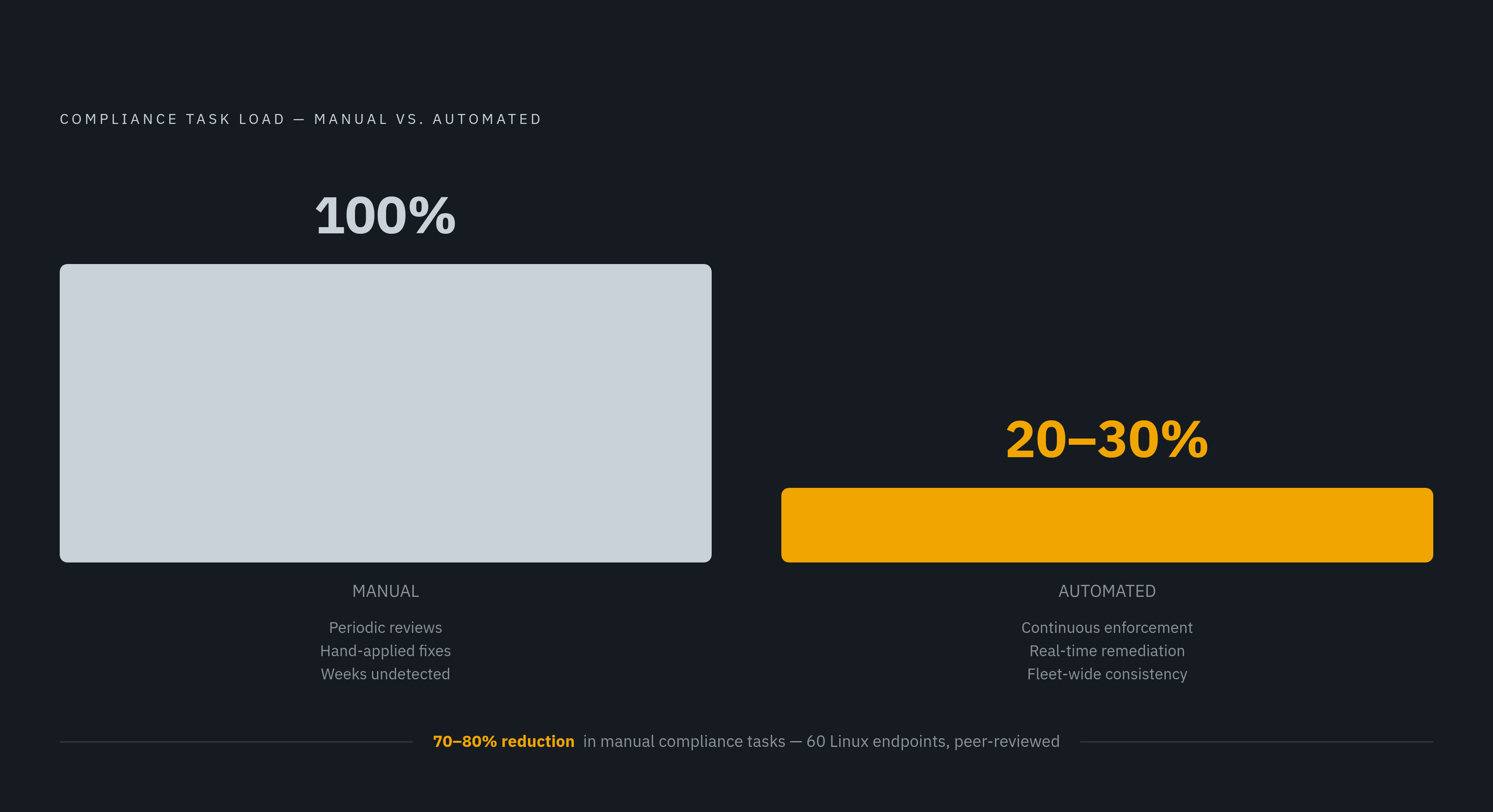
Continuous monitoring catches a departure from policy the moment it happens rather than waiting for a quarterly review to surface what already drifted weeks earlier. With policy-based enforcement, you set a rule once and it applies across every device automatically, so configuration stays consistent without an administrator touching each machine one at a time. The scale of the gain is measurable: the peer-reviewed study found automation cut manual compliance-related tasks by roughly 70 to 80 percent while improving configuration consistency across the fleet through continuous enforcement. That reduction in administrative load frees staff for security work that actually requires a person's judgment, instead of tying them up re-checking settings that a well-integrated system already checks on its own.
What auditors evaluate at the endpoint layer
Passing an endpoint compliance audit is a documentation problem as much as it is a security problem. Auditors need to verify that controls are real and that they ran continuously, so the structure of the evidence trail matters as much as whether the underlying controls exist. The six pillars auditors evaluate systematically are complete visibility and inventory, granular access control, security policy enforcement, continuous monitoring and logging, structured incident response, and comprehensive compliance documentation.
For complete visibility, auditors check that the device inventory matches reality, usually through sampling and network scanning, so an unmanaged device or a piece of shadow IT is flagged as a compliance finding well before it causes a security incident. Access control documentation requires proof of who accessed which resource, when, and from which device, and that kind of proof only holds up if it comes from continuous logging rather than a periodic export pulled together after the fact. Policy enforcement gets tested by one thing: whether a non-compliant device is actually blocked or quarantined automatically, not simply flagged for someone to review later. Monitoring and logging need tamper-proof log storage that meets retention requirements and is aggregated centrally, instead of logs scattered across systems that have to be reassembled by hand every time an auditor asks for them. Incident response gets checked through documented procedures, evidence that tabletop exercises took place, and post-incident review records, and this is a category automation already runs into limits above its ceiling. Compliance documentation itself covers current security policies that leadership has reviewed and approved, evidence that employees completed training and acknowledged policies, change management records, and vendor risk assessments.
What separates a tool that genuinely automates meaningful portions of audit prep from one that just moves the same manual work into a new interface comes down to three things: prebuilt mappings to the framework in question instead of generic log exports a person has to translate by hand, change tracking that captures before-and-after values for configuration and permission changes, and reports built for auditors that cut down on follow-up questions. Passing or failing an audit usually comes down to documentation quality in the end. Having the right controls in place does not help if the proof that those controls ran continuously cannot be retrieved in a form an auditor recognizes.
Integrating device management, identity, and security into a single program for standing audit readiness
If a team has no dedicated security function, audit readiness cannot work as a recurring project scheduled a few weeks before each audit cycle. It holds up only as a standing state, built on device management, identity, and endpoint security tooling integrated closely enough that evidence collection becomes a byproduct of normal operations. The fragmented-stack failure mode explains why so many teams end up scrambling anyway: when device management, the identity provider, EDR, and the patch tool are separate products from separate vendors, evidence collection demands manual reconciliation across all of them. The pre-audit scramble that results is the structural consequence of building the program on disconnected pieces.
Manual compliance work was tolerable when a company ran one framework, faced one audit a year, and operated on infrastructure that barely changed month to month. That environment does not describe most organizations anymore. Cloud infrastructure changes faster than audit cycles can track, frameworks multiply as companies take on new customers and new regulatory obligations, and endpoint fleets grow more distributed by the year. An integrated program, where device management, identity, and security tooling share a common data model, turns the evidence an auditor needs into something the system produces continuously as a matter of course. The architecture of the endpoint program, not the compliance tool sitting on top of it, decides whether an organization walks into its next audit with proof already in hand or spends the two weeks beforehand trying to build it from scratch.