Delegated Endpoint Administration Models for Distributed Organizations
Scoped roles and least-privilege boundaries enable safe delegation without multiplying risk.
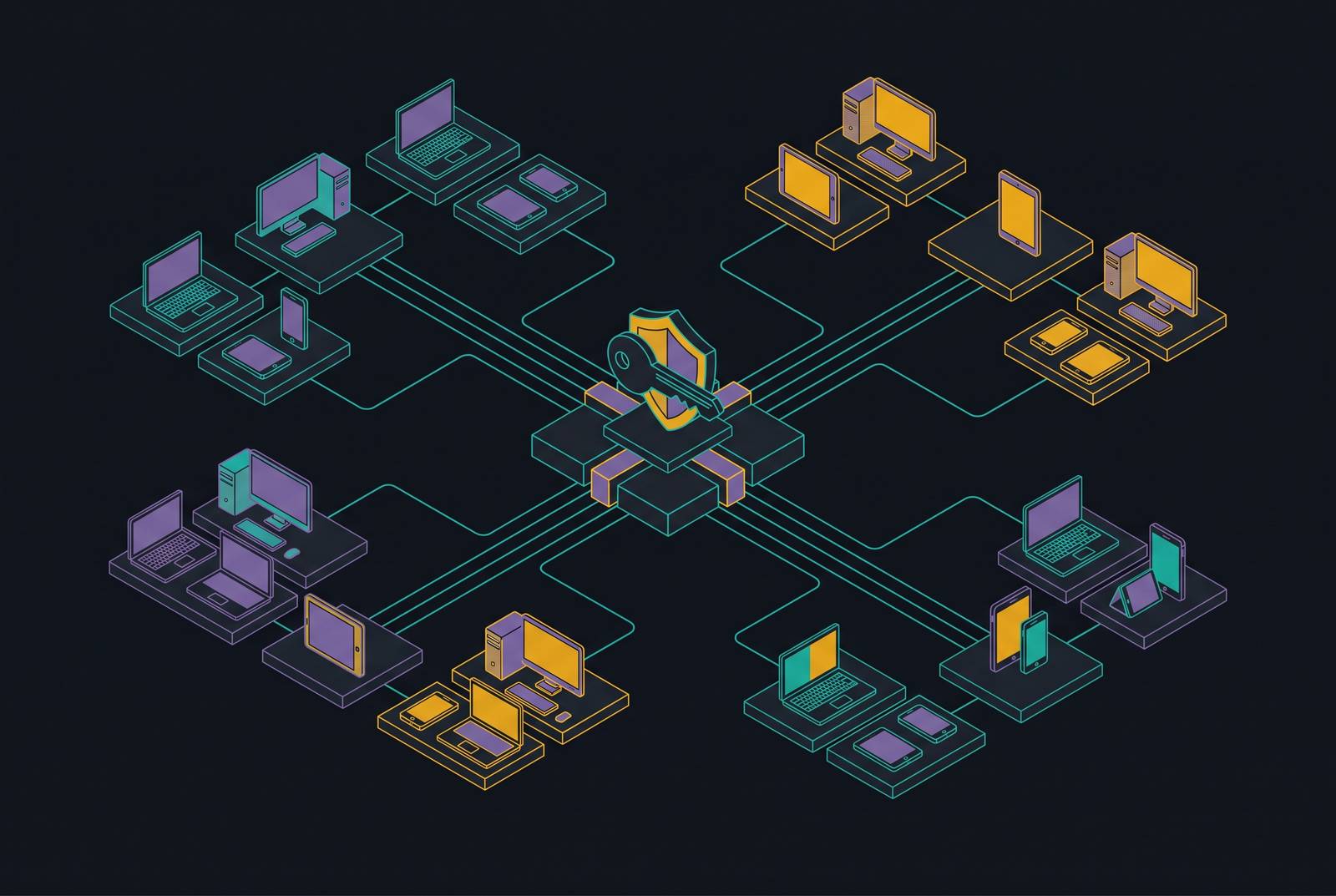
Delegated endpoint administration solves a scaling problem that every distributed organization eventually runs into: how do you push administrative authority out to the regions, business units, and teams that actually touch the devices, without handing every one of them the keys to the whole kingdom? The answer, and the thread running through this whole piece, is scoped roles, least-privilege boundaries, and a governance structure built so that delegation is safe from the start, not safe because everyone happens to behave.
Ordinary role-based access control governs what end users can touch. Delegated administration is a different animal: it's least privilege applied to the administrators themselves, the people who manage the end users. That distinction produces years of hardened user permissions alongside loose, undifferentiated admin permissions, because most organizations invest in the former while neglecting the latter.
Central IT cannot be the only place a password reset gets approved, a new laptop gets provisioned, or a configuration change gets pushed, once an organization spans more than one office, one country, or one time zone. Every ticket that has to travel back to a head office queue is friction, and friction compounds. So the instinct to delegate is correct. But delegation without a governance layer wrapped around it just relocates the risk instead of reducing it: distributing admin authority without boundaries doesn't solve the original problem, it multiplies it across more people and more places. Distributed authority, unmanaged, becomes distributed risk. That's the tension this entire model exists to resolve.
How scope and least-privilege boundaries turn broad admin rights into controlled delegation
Least privilege is the governing rule here, and it's a simple one to state: give a delegated administrator only the permissions needed to do the specific job in front of them, nothing more. The hard part is building a system where that's actually true in practice, not just true on paper.
CoreView frames this as two things working together, not one. First, delegate the function itself, hand the task of resetting a password or provisioning a mailbox to someone other than central IT. Second, constrain what that person can actually do through RBAC. Delegate the job without constraining the rights, and someone ends up with far more access than the task required. Constrain the rights without delegating the job, and nobody local can act at all, so the bottleneck never goes away. Both pieces have to be in place for delegation to function the way it's supposed to.
Visibility gets skipped most often. If a delegated administrator shouldn't be managing a resource, they shouldn't be able to see it exists either. Permission scoping without visibility scoping leaves a map of the whole environment sitting in front of someone who only needed a corner of it, and that map is itself a kind of exposure.
Regulators and vendors have both stated this directly. Microsoft's own guidance goes further: as organizations grow, keeping track of who holds which admin role turns into a security vulnerability on its own. Microsoft recommends keeping the Global Admin list small for this reason. A well-scoped delegation model, in practice, comes down to three things: roles drawn around tasks rather than titles, visibility limited to the relevant unit or region, and an audit trail that shows exactly who did what, inside their lane. CISA's Alert AA20-120A explicitly recommends protecting Global Admins from compromise and applying the principle of least privilege, particularly in cloud environments like M365.
Where native platform tools fall short of true granular delegation
Microsoft 365 was built around a centralized management model, and it shows. The native Admin Center offers limited ways to hand a local office or a regional business unit its own scoped management rights. Microsoft Entra ID's Administrative Units get closer, letting an organization carve delegation up by geography or department, but they bring limited role coverage, no nesting, and workload scope that doesn't stretch as far as most distributed organizations need.
The roles themselves are the other limitation. M365's built-in admin roles, password admin, Exchange admin, and the rest, are fixed. An organization can hand one of those roles to a regional technician, but it can't reshape the role to match what that technician actually needs to do day to day. It's an all-or-nothing menu when what most organizations want is a custom order.
A partner community post cited in CoreView's own whitepaper stated that permissions granted through native delegation are too broad, fine-grained access remains out of reach, and the ability to properly audit any of it is uncertain. That's not a minor complaint, given how much of this whole model depends on audit trails doing their job.
There's a real cost to getting this wrong, and CoreView describes two complementary concepts: delegating the IT function so it can be performed by someone else, and assigning limited rights via RBAC. Assume roughly 30% of the M365 tasks central IT currently handles could instead sit with local operators, power users embedded in regional departments who don't need a ticket to central IT to reset someone's mailbox permissions. At scale, across a large organization, that's a meaningful chunk of IT hours recovered every year, hours that would otherwise go to work that never needed a central admin in the first place.
AWS has its own version of this problem, and arguably a sharper one. Service Control Policies, the guardrails an organization sets up to constrain what accounts can do, simply don't apply to the management account. Any IAM principal sitting in that account operates completely outside the SCP fence. That makes the management account the single most dangerous piece of real estate in the whole environment, and it turns delegating work out to member accounts from a nice-to-have into something closer to a requirement.
The pattern across both platforms is the same: native tooling gets an organization partway there and stops. Anyone relying only on the defaults is accepting a gap, whether or not they've noticed it yet.
How cloud-native delegation models push administrative authority to where devices live
AWS built Delegated Administrator for this purpose. It registers a member account to run administration for one particular AWS service, and that account then manages the service across the whole organization, without ever touching the management account itself. It's a clean design, in that it keeps the most sensitive account in the org walled off from day-to-day operational work.
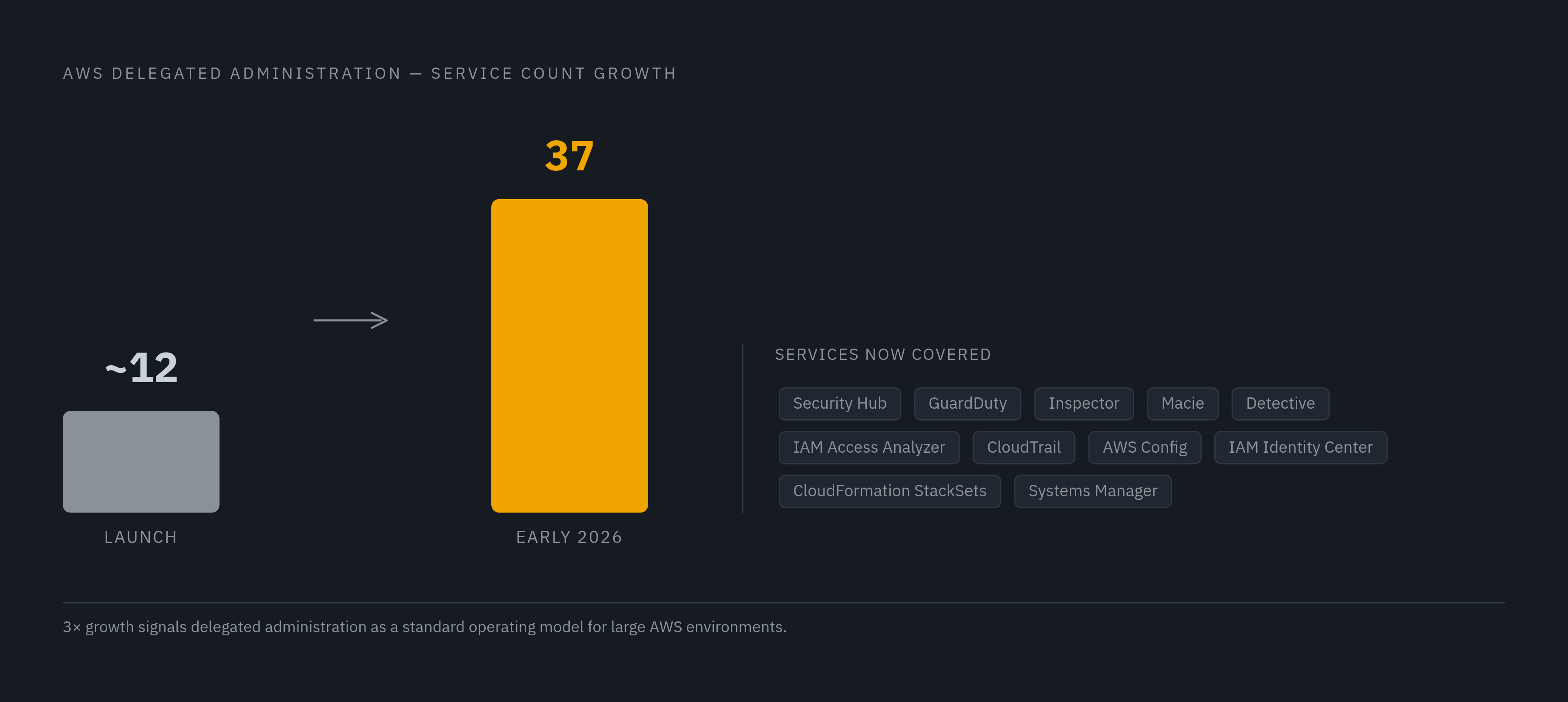
The service list driving this has grown fast. As of early 2026, 37 AWS services support delegated administration, up from roughly a dozen when the feature launched AWS Delegated Administrator: Setup Guide | CloudQuery Blog. Security Hub, GuardDuty, Inspector, Macie, Detective, IAM Access Analyzer, CloudTrail, AWS Config, IAM Identity Center, CloudFormation StackSets, and Systems Manager are all on the list AWS Delegated Administrator: Setup Guide | CloudQuery Blog. That's not a niche feature anymore, it's become one of the standard ways large AWS environments are run.
Three separate mechanisms make delegation happen, and none of them rules out the others. Most commonly, it's the Organizations RegisterDelegatedAdministrator API, called from the management account, naming the member account and the service in question. Resource-based policies handle a third path, delegating different capabilities depending on how the account structure is set up.
AWS also puts hard limits on how many delegated administrators a service can have at once, and the limits vary by service. IAM Identity Center allows exactly one AWS Delegated Administrator: Setup Guide | CloudQuery Blog. CloudTrail allows up to three, but hitting that ceiling means an existing delegated administrator has to be deregistered before a new one can be added. It's a small detail, but it forces organizations to actually think about who holds delegation rights rather than just adding people indefinitely.
If a delegated administrator account is also running application workloads, and that workload gets compromised, the attacker may inherit organization-wide service management along with it. The fix is straightforward, keep delegation accounts dedicated, separate from anything running production workloads.
Microsoft 365 has landed on a version of the same idea through a different route. CoreView's architecture segments users by geography, department, or any other Entra ID attribute, country, city, business unit, group, domain, and then grants administrators rights scoped only to that slice. It's the same principle as AWS Delegated Administrator, just applied to a SaaS management layer instead of cloud infrastructure. Across both platforms, the design goal is identical: shrink the blast radius of any one compromised account, while still getting operational authority out to the people standing closest to the devices and users they actually manage. Some services have their own delegation APIs that call the Organizations API internally, reflecting service-specific APIs as a distinct model.
Unified Endpoint Management platforms implement role-based delegation across device fleets
UEM platforms handle this at the device layer using organization groups, structures that localize policy and access by business unit or geography, giving each region or department its own scoped slice of the fleet. That's the mechanism that makes device-level delegation work in practice, not in theory.
What actually falls under a sub-administrator's control, once scoped, is a fairly long list: device provisioning, policy enforcement, application deployment, patch management, remote access and troubleshooting, compliance reporting. None of it requires handing that administrator control of the entire fleet. Remote access is a particularly good example of least privilege in action at this layer: fine-grained rules decide who can access a given device and what they're allowed to do once connected, and every session gets logged in detail for audit. That's the model working exactly as intended, operational access granted, but bounded and watched.
Microsoft Intune is the platform most organizations reach for first here, and for good reason. It brings device management, application deployment, and policy enforcement into one environment, and it ties into Entra conditional access so a device has to prove it's compliant before it's let onto the network. Its most recent stable release for Windows, as of August 2026, keeps that integration current with Microsoft's broader identity stack.
Omnissa Workspace ONE UEM is cloud-native, with automation, conditional access, and per-app VPN, and it's noted for broad cross-OS enterprise UEM. ManageEngine Endpoint Central bundles patching and remote control with EDR and DLP available through its Security edition or add-ons, putting unified management and built-in security in one console. IBM MaaS360 leans on AI-driven management across mobile, desktop, and rugged devices from a single pane. Hexnode UEM is built around zero-touch enrollment and a single policy model across a wide range of operating systems, which suits multi-platform fleets and kiosk-style lockdown. BlackBerry UEM is built for sovereign-grade device management, at the high-assurance end. Citrix Endpoint Management handles MDM and MAM inside the Citrix Workspace ecosystem, with MDX app containerization and a micro VPN layered in.
Evaluating any of these for a distributed organization comes down to one question that's easy to overlook, and it's not just what policies the platform can enforce; it's how finely it can scope which administrators see and touch which device groups. Delegation granularity is the differentiator, more than any single feature checklist. The market backs up how central this layer has become, endpoint management software is growing at a 12.2% CAGR through 2025 to 2033, which tracks with how much weight organizations are now putting on getting this right I Evaluated 7 Greatest Endpoint Administration Software program for 2….
The governance structures that make delegation safe by design rather than safe by assumption
Four requirements hold across every delegation model worth building, once the platform specifics are stripped away Proton 2026 SMB Security Report. Roles need to map to tasks and resource boundaries, not to job titles or how senior someone is. Visibility scoping needs to run alongside permission scoping, since an administrator who can't see outside their lane can't wander outside it, whether by mistake or on purpose. Every administrative action, in every delegated scope, needs to land in an audit trail that exists independently of the administrator being watched. And delegation assignments need a regular review, who still has access, whether they still need it, and whether the scope has quietly drifted since it was last checked.
The dedicated-account principle from AWS applies well beyond AWS. Administrative accounts used for delegation shouldn't also be running workloads, because mixing roles in a single account or identity is how a compromise of one function turns into a compromise of both. It's a simple rule, and it's one of the cheapest to enforce, which makes it worth enforcing everywhere, not just in cloud infrastructure.
Policy interaction is the trap that catches people off guard. That sounds like a feature, and it is, but it also means a misconfigured policy can silently block a delegated administrator from doing their job, with no obvious error pointing back to the cause. Governance has to account for how policies interact with delegated rights, not just what rights get handed out.
None of this holds up if the people operating it can't actually follow it. Proton's SMB Security Report found that 39% of SMBs report a cyber incident traced back to human error, and a delegation model too complicated for its own operators to use correctly carries the same risk as having no model at all Proton 2026 SMB Cybersecurity Report. So the framework has to be simple enough for a regional IT generalist or a help desk lead to operate inside their scope without needing to understand the entire permission architecture that produces it. The goal was never to restrict what distributed administrators can do. It's to make the line between what they can do and what they can't a structural fact, enforced by the system, rather than something that depends on any one person's judgment holding up under pressure. Delegated administrator accounts remain subject to SCPs, unlike the management account, so a misconfigured policy can silently block the delegated admin from performing its duties, and governance design must account for policy interaction, not just permission assignment.
What a delegated administration model means for organizations without a dedicated security team
Thin IT staffing intensifies this tension, since fewer people must cover the same administrative surface. Proton's SMB Security Report found that 1 in 4 small businesses has been hacked despite having cybersecurity measures already in place Proton 2026 SMB Security Report. The attack surface is real and it isn't shrinking, and the team responsible for defending it is often one person, maybe two.
For organizations without a dedicated security function, delegation governance does two jobs at once. It spreads the operational load, so one generalist isn't the single approval point for every device action across the company. And it enforces policy boundaries that would otherwise sit entirely on that same person's judgment, exercised at the end of a long day, under pressure, without backup. Without scoped roles in a lean environment, that overstretched generalist becomes the single point of failure for both operational access and security policy at the same time.
The foundational controls at this layer aren't exotic: endpoint protection, patch management, identity-centric access, and MFA, all things a properly delegated UEM model enforces on its own, structurally, rather than requiring someone to check each device by hand. Safe by design, for a lean team, means the platform is opinionated enough that doing the right thing takes less effort than doing the wrong thing: scoped roles by default, compliance checks that run automatically, policy enforcement that doesn't need a security specialist standing by to interpret it.
For most organizations at this stage, the first move isn't building a more elaborate delegation architecture from scratch. It's picking a platform where the sensible delegation model is already the default, so that pushing authority out to the edge doesn't require pushing security expertise out along with it.
Sources
- AWS Delegated Administrator: Setup Guide | CloudQuery Blog
- The No-Nonsense Guide to Microsoft 365 Delegated Administration | CoreView
- Microsoft Intune
- I Evaluated 7 Greatest Endpoint Administration Software program for 2026 – blog.aimactgrow.com
- From vulnerability to resilience: SMB incident response | Proton
- Delegated administration in Microsoft Entra ID - Microsoft Entra ID | Microsoft Learn
- Omnissa Workspace ONE UEM | Unified endpoint management
- CISA Urges Endpoint Management System Hardening After Cyberattack Against US Organization | CISA