Onboarding Speed as an Endpoint Security Risk Factor
Unmanaged devices during onboarding create a window attackers exploit in minutes, not days.
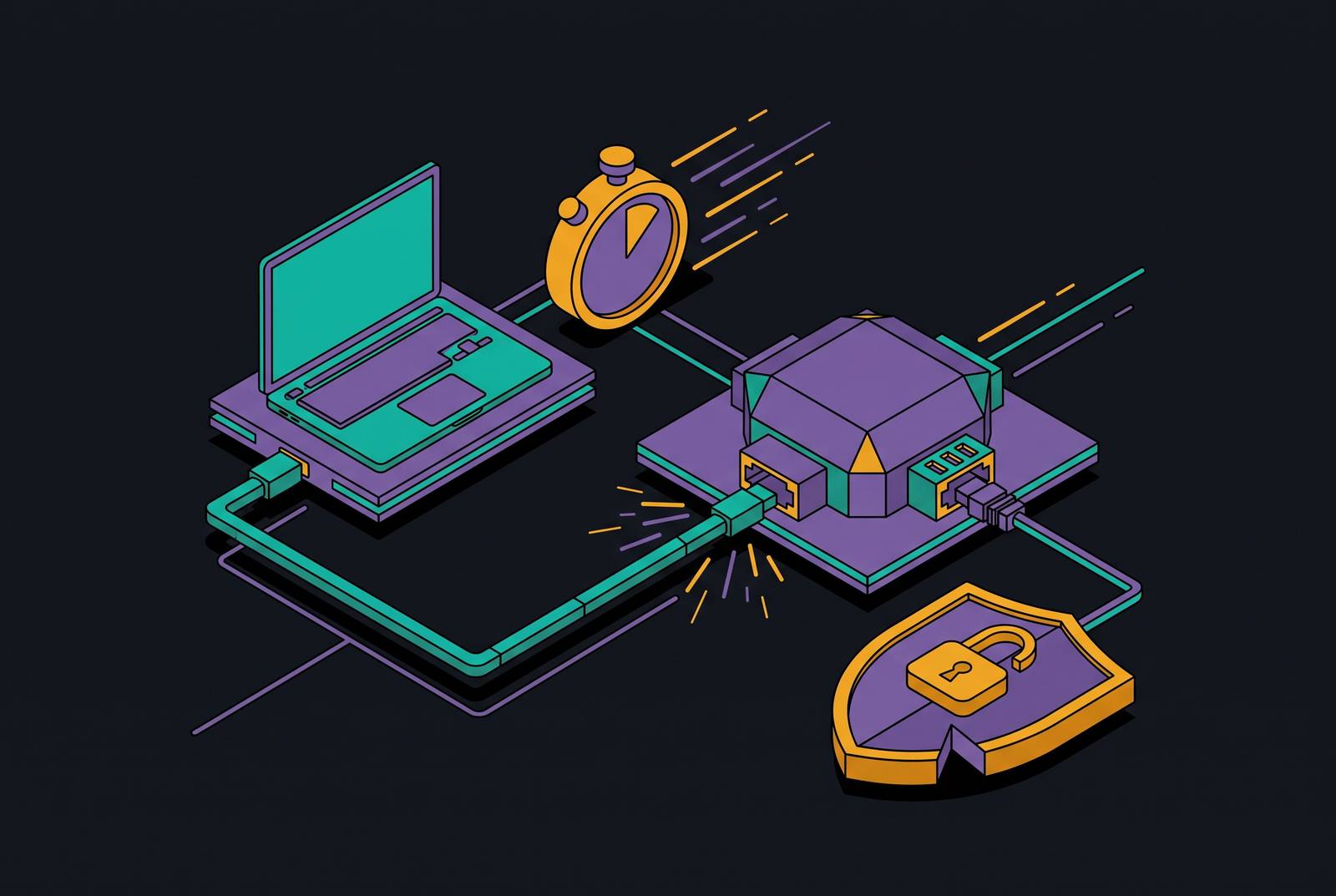
Onboarding speed is an endpoint security risk factor, plain and simple, and treating it as anything less costs money and sleep. The gap that matters is between a new hire's first day and the moment their laptop or phone actually enters device management, identity policy, and patch enforcement. This piece walks through how that gap opens up, what attackers do the second they find it, and what a lean IT team can actually do about it without slowing down hiring.
"Unmanaged" sounds abstract until you break down what it means on the ground. No MDM enrollment. No EDR agent running. No identity policy applied to the account. No patch baseline enforced. The device sits on the network, doing its job, completely invisible to every security control the company has built.
Barracuda's Managed XDR Threat Report found that every single security incident it responded to that year involved at least one unprotected or rogue endpoint. Merium Khalid, Director of AI and Automation in Barracuda's Office of the CTO, said it directly: "Attackers only need to find one to succeed".
A device doesn't need to be fully compromised to be a problem. An unpatched, unenrolled machine leaks credentials, hands an attacker a foothold for lateral movement, and creates a blind spot that security teams can't do anything about, because you can't act on what you can't see.
Remote and hybrid hiring turned this into a structural condition, not a one-off slip. According to Petri's onboarding security analysis, new employees, contractors, and third-party partners now get onboarded routinely without IT or HR ever meeting them in person. The whole process that hands out credentials and grants access happens at arm's length, under time pressure, with nobody in the room to catch something off.
And there's a business incentive baked into this that nobody talks about out loud. Lean IT teams juggle competing demands every day, and getting a new hire productive fast is the metric everyone sees and celebrates. Getting that same hire's device fully into security policy enforcement is not a metric anyone celebrates. That mismatch, visible speed versus invisible security, is exactly where the gap lives.
None of this is a process hiccup that works itself out over time. It's a quantifiable security risk with a measurable exploitation timeline, and that timeline is the subject of the next section.
How fast attackers move once a device is exposed
Start with the number that should reset everyone's sense of urgency: the average time from vulnerability disclosure to active exploitation fell from 756 days in 2018 to a matter of hours in 2025 hivesecurity.gitlab.io. That's the macro shift that changes what "a few days of onboarding lag" actually means in practice hivesecurity.gitlab.io.
Rapid7 data shows 28.3% of exploited vulnerabilities were weaponized within 24 hours of disclosure, 28% of exploits launched within one day, and 55% of zero-days were exploited within one week indusface.com hivesecurity.gitlab.io. These aren't rare, unlucky outliers. They're the median behavior attackers show now indusface.com hivesecurity.gitlab.io.
Once inside, attackers don't wait around. The CrowdStrike 2026 Global Threat Report clocks lateral movement at as fast as 27 seconds after a breakout, with an average eCrime breakout time, meaning initial compromise to lateral movement, of 29 minutes CrowdStrike 2026 Global Threat Report.
Here's what that means for an unenrolled device specifically. It isn't just unpatched, it's unmonitored, so even a 29-minute breakout produces no alert and no containment trigger CrowdStrike 2026 Global Threat Report. There's nothing for an IT generalist to act on, because there's nothing telling them anything happened at all CrowdStrike 2026 Global Threat Report.
Microsoft research cited in Guardz's endpoint security statistics found that the overwhelming majority of successful ransomware attacks trace back to unmanaged devices getastra.com. Compare that against what enrolled endpoints get in return: best-in-class EDR and XDR tools auto-contain within 2 to 4 minutes of detection, but only on devices that are actually enrolled acsmi.org. An unenrolled device has no containment mechanism at all, full stop acsmi.org.
A new hire's device sitting unmanaged for two or three days is operating inside a threat environment where adversaries move in minutes, and it is invisible to every single control the organization has spent money building.
The structural reasons onboarding enrollment drags
The credential handoff is often the first place things break down. According to Petri's analysis, plenty of organizations still send first-day credentials by email, SMS, or some other manual process. Those channels are easy to intercept and easy to socially engineer, and they're exposed before the employee has even logged in for the first time.
Service desks carry a lot of this weight, and the pressure they're under cuts against security rather than for it. They're measured on getting new users up and running fast, and per the same Petri source, the failure usually starts small: "I'm locked out before an urgent meeting," or "my account should already be active". Once the process depends on an agent deciding whether a story sounds plausible, identity verification has already failed.
Petri's analysis frames this as three trust gaps every organization has to close before access can be considered safe. Delivering first-day credentials without letting them get intercepted along the way. Protecting the service desk itself from AI-assisted vishing, cloned voices, and synthetic identity documents.
That third gap is getting harder to close by the month. AI is making social engineering faster and more convincing, and the same remote-first conditions that slow enrollment down also make verifying identity harder. Per Petri, phishing, vishing, and synthetic identity attacks are getting tougher to catch, not easier.
Deployment mechanics add their own drag on top of all this. CrowdStrike's Falcon Next-Gen SIEM onboarding analysis found that rolling out log collectors and agents at scale means coordinating across multiple teams, handling external software distribution, running packaging workflows, and clearing change-control approvals. Every one of those steps is a delay, and delays compound.
Even when a device does get enrolled, enrollment can be a mirage. Tiagoscarvalho's analysis of Intune and Defender for Endpoint onboarding found that a device can show a green checkmark in the admin portal while EDR block mode sits disabled, attack surface reduction rules go untouched, and tamper protection stays at its default setting. Nominal enrollment and enforced protection are not the same thing, and the gap between them is invisible unless someone checks.
Patching drags things further behind. The State of Patch Management Report, cited in Adaptiva's cyber resilience analysis, found that 77% of organizations take a week or more to deploy patches across their environment 2025 State of Patch Management Report. So even an enrolled device might not get patched inside the window an attacker needs to exploit it 2025 State of Patch Management Report.
Stack all of it together and the picture gets grim fast: slow credential handoff, slow enrollment, delayed patching, and no alert firing on an unenrolled device add up to an attacker who compromises a new hire's machine on day two facing zero detection and zero containment.
What dwell time data reveals about the cost of a slow enrollment process
Dwell time is where the cost of the onboarding gap becomes visible as a single number. Average dwell time across breached enterprises is 19 days, a 4-day jump from the year before, per 2025 endpoint security data cited in the acsmi.org analysis. Top-performing platforms bring that down under 6 hours using real-time behavioral analytics, but that's the ceiling of what's possible, not the floor most companies are living with acsmi.org.
Sit with that 19-day figure for a second acsmi.org. If an attacker compromises a new hire's unmanaged device on day one and the device doesn't get enrolled until day five, the organization has already handed over five days of invisible dwell time before detection is even possible acsmi.org. The enrollment lag sets a minimum on how long an attacker gets to operate undetected acsmi.org.
Nineteen days is plenty of runway for real damage acsmi.org. According to the optrics.com managed endpoint analysis, attackers use exactly this kind of delay between compromise and detection to move from initial access to domain-level control before anyone starts investigating anomalous behavior acsmi.org. Credential theft goes unnoticed. Lateral movement proceeds unbothered. Privilege escalation completes on schedule acsmi.org.
The payloads don't wait for the dwell window to close, either. According to stationx's small business cybersecurity statistics, 54% of ransomware incidents deploy their payload within 7 days of initial access app.stationx.net. An unmanaged device that's still sitting outside enrollment inside that window may already be the launch point for a ransomware payload before IT even knows the device exists app.stationx.net.
The dollar figures driving all this are not small. IBM's Cost of a Data Breach Report puts small business breach response costs somewhere between $120,000 and $1.24 million, and recovering from ransomware runs $1.53 million on average, not counting any ransom paid IBM 2025 Cost of a Data Breach Report programs.com. Those costs are downstream of dwell time that starts during the onboarding gap, not just from whatever the eventual attack looks like IBM 2025 Cost of a Data Breach Report programs.com.
There's a quieter cost too. Vendors that ran consultative onboarding saw 41% fewer false positives in 2025 than those using out-of-the-box configurations, the acsmi.org endpoint security analysis found. Poor enrollment quality doesn't just leave holes open, it drags down detection accuracy across the entire environment acsmi.org.
Why SMBs face a disproportionate version of this risk
Small and midsize businesses take a version of this risk that's out of proportion with their size. Ransomware showed up in 88% of all breaches affecting SMBs in 2025, against 39% for larger organizations, entremt's ransomware analysis found entremt.com. That gap isn't because SMBs are doing something uniquely careless, it's because attackers have learned smaller companies offer less friction entremt.com.
The numbers back that up from a different angle.
The preparedness gap makes an already bad situation worse. Only 14% of small businesses rate their own cybersecurity posture as highly effective cnicsolutions.com.
Hiring bursts make the exposure worse in a way that's easy to overlook. A small company bringing on three people in one week can triple its unmanaged device exposure overnight, and the onboarding gap scales directly with hiring pace. Lean IT teams have no surge capacity built in to absorb that spike.
For a lot of SMBs, one bad breach isn't just expensive, it's the end of the company; the stakes here aren't measured in cost alone, they're existential entremt.com indusface.com totalassure.com StrongDM 2025.
The same gap runs in reverse on the way out the door, too. Among HR workers who offboarded employees in the past year, 71% say at least one employee never returned company-owned equipment, per Capterra research cited in Guardz's 2026 endpoint statistics. Wing Security research puts the number even higher on the access side: 63% of businesses may have former employees still holding access to organizational data. Unmanaged devices cut both directions, new hires coming in and employees heading out are the same underlying gap.
Most SMBs simply don't have a security team standing by to manually chase down enrollment status device by device. The gap doesn't close on its own, and without some form of automation, it gets wider with every single hire. SMBs experienced approximately 4× more confirmed breaches than large organizations in 2025, according to the Verizon DBIR 2025 as cited in cnicsolutions' 2026 statistics. 47% of businesses with fewer than 50 employees allocate zero cybersecurity budget cnicsolutions.com. 83% say they are not financially prepared to recover from a cyberattack, cnicsolutions SMB statistics show cnicsolutions.com.
The specific attack patterns that target the onboarding window
Social engineering aimed at the service desk is the leading vector during onboarding, and the incidents behind that claim aren't hypothetical. According to Petri's analysis, the M&S ransomware attack, which cost the retailer roughly £300 million ($397 million) in operating profit, and the MGM Resorts attack, with losses topping $100 million, both traced back to social engineering the service desk rather than any technical exploit uprite.com. The onboarding window is where this works best, because a new hire hasn't built up a trusted identity that anyone at the company can recognize yet uprite.com.
Three service desk patterns are especially hard to catch during onboarding. An attacker impersonating a new hire before the real person ever logs in, with no behavioral baseline in place to flag anything unusual. A claim of "I changed phones and need MFA reset," a completely standard onboarding request that looks identical whether it's the real hire or an attacker who's already got their hands on stolen credentials. AI-assisted vishing and cloned voice attacks, where synthetic identity documents and cloned voices are making remote identity checks less reliable by the day, and the remote-first onboarding model has already removed the face-to-face check that used to catch this.
Personal devices widen the exposure further. A new hire using a personal device before corporate enrollment finishes is a credential exposure point with zero visibility attached to it.
Shadow IT compounds the day-one risk. New hires who haven't been enrolled yet tend to reach for whatever tools feel familiar to get work done, quietly adding unauthorized apps and new data pathways before any policy has touched their device.
Fileless malware and living-off-the-land techniques thrive in exactly this kind of blind spot. According to Fidelis Security's endpoint threat trends report, attackers increasingly lean on methods that slip past traditional security defenses entirely. Those methods work especially well against unenrolled devices, because there's no behavioral baseline to compare anything against, so nothing looks anomalous even when it is.
AI has scaled all of this up fast. TotalAssure's SMB statistics cite a 340% surge in AI-powered cyberattacks in 2025, and the attacks aimed at the onboarding window are faster, more convincing, and more scalable than they were even two years back Cobalt totalassure.com. The kind of attack that once needed a genuinely skilled operator now just needs a well-prompted AI tool Cobalt totalassure.com.
What closing the onboarding gap requires
Closing this gap has nothing to do with buying more tools. It's about removing the manual steps that let enrollment drift in the first place, because every handoff that needs a human to start, coordinate, or approve it is a delay an attacker can walk through.
Credential delivery has to change before day one even starts. According to Petri's analysis, that means dropping email and SMS as channels for first-day credentials, since both are interceptable and easy to socially engineer before the employee ever logs in. Identity verification needs to happen before credentials go out, not after, flipping the usual order to "verify first, grant access second". Temporary Access Passes or passwordless authentication cut down the window where a stolen credential is even worth stealing.
MDM enrollment needs to happen automatically, before the new hire ever touches the device. Zero-touch provisioning means the laptop shows up already policy-enforced, so there's never a moment where the device sits in an unmanaged state waiting on someone to configure it.
And nominal enrollment that shows a green tick without enforced protection needs solving directly. Tiagoscarvalho's Intune analysis shows that nominal enrollment appearing on a dashboard isn't enough on its own. EDR block mode, attack surface reduction rules, and tamper protection all need to be checked as genuinely active, not assumed just because a portal shows a checkmark. Onboarding speed and security enforcement aren't actually in tension. Getting both right at the same time is what separates the organizations still standing after their first close call from the ones that end up as a statistic in next year's breach report. SOURCE PAGES (what the pages behind the outline's links say).
Sources
- How Can Organizations Secure the Onboarding Process in 2026? - Petri IT Knowledgebase
- Top Endpoint Threat Trends Enterprises Face in 2026: Report
- 36 Endpoint Security Statistics MSPs Should Know in 2026
- acsmi.org
- app.stationx.net
- hivesecurity.gitlab.io
- Microsoft Defender for Endpoint Onboarding with Intune 2026: Practical Field Guide