Automation Coverage Gaps in Endpoint Security Programs
Most enterprises protect only 79 percent of endpoints on any given day.
How "partial automation" became the industry's comfortable middle ground
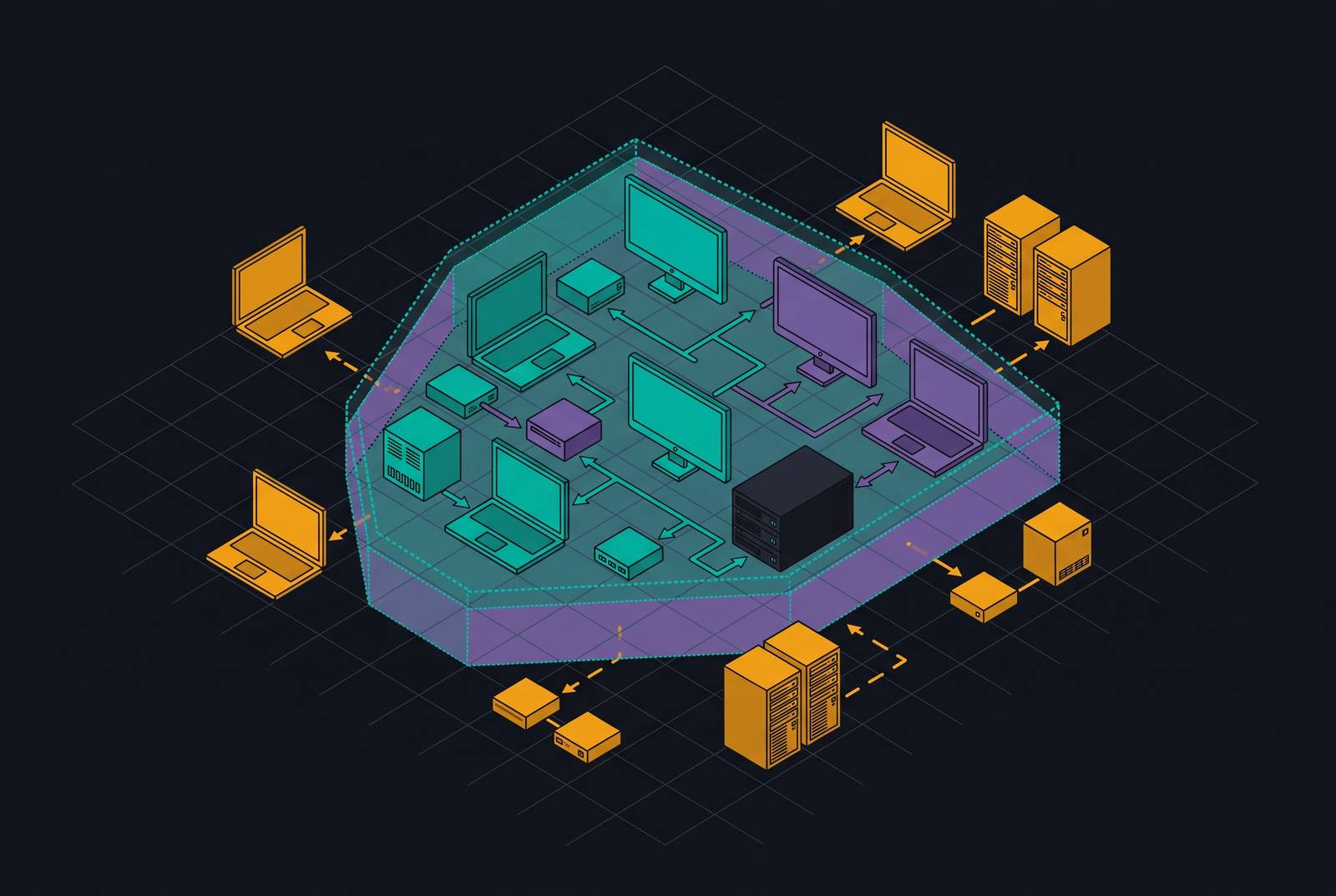
Absolute Security's Resilience Risk Index found that one in five enterprise endpoints sits outside a protected, enforceable state on any given day. That's the average across organizations that keep adding tools and spending more money every year. Dashboards say coverage is climbing. The devices say otherwise, and the devices are the ones that get breached.
A dashboard counts how many endpoints have an agent installed. It doesn't tell you that the agent is enforcing policy right now, that it can even reach the device, or that the patch it claims to have pushed actually landed. Deployment and enforcement are two different measurements, and most programs only track the first one. Most teams don't realize they're solving for the wrong number until something breaks.
The protected-state figure moved from 78% in 2025 to 79% in 2026 among devices lacking active resilience enforcement. A one-point gain. At that pace, the average enterprise device still spends something like 76 days a year outside a reliably enforceable security posture. Tool counts go up, spend goes up, and the gap between what's reported and what's real doesn't close. It widens, because every new tool adds another seam where enforcement can fail quietly, without tripping a single alert.
For a lean IT team, that seam is the dangerous part. Nobody's job is to watch the space between tools. Someone owns the patch console, someone else owns the endpoint agent, and the gap between the two belongs to nobody until an incident forces the question. What follows maps where those gaps form, why they look worse up close than they do in a quarterly report, and what closing them actually takes for a team with no dedicated security function.
The State of Endpoint Management Report, sponsored by Automox and covered by InformationWeek, found that only 6% of surveyed organizations have reached full endpoint management automation. Everyone else sits somewhere in the middle, and that middle has a name: partial automation. Most of the industry has decided to treat it as good enough, and that's the wrong call.
OS patching runs on a schedule, scripted and mostly hands-off. Exceptions get handled by hand. Approvals route through email or a ticket someone has to remember to check. Third-party applications, the browsers and PDF readers and productivity tools that live outside the OS patch cycle, fall to whoever has time that week. The automation investment didn't free anyone up so much as relocate the manual work: 43% of endpoint management teams still spend 10 or more hours a week on manual endpoint tasks.
Visibility is just as thin. Only 17% of teams have one dashboard showing end-to-end patch status. Everyone else stitches together spreadsheets and point-tool exports, and that data goes stale before anyone reads it. More than half of teams take five or more days to patch, or they genuinely don't know their mean time to patch. Not knowing is an absent number where a real one belongs. It's an absent number where a real one belongs.
There's a human reason partial automation sticks around. A team that got burned once, a bad patch that took down a fleet of laptops, a script that pushed the wrong config, starts demanding rollback controls and override authority before expanding automation any further. That instinct makes sense: nobody wants to hand a script unchecked control over production machines. But it also locks the team into partial coverage indefinitely, because every expansion gets vetoed until trust rebuilds, and trust rarely rebuilds fast enough to matter.
Partial automation is the destination, dressed up to look like progress. It's the destination, dressed up to look like progress. Patching happens, dashboards show green, and the same enforcement gaps sit open quarter after quarter, because the distribution architecture never got fixed.
The specific places where enforcement gaps predictably form
These four spots appear in almost every environment.
Patching seams between tools cause the first one. Only 54% of perimeter-device vulnerabilities got fully remediated during 2024 and 2025. One system deploys a patch, a separate monitoring tool fires an alert about that same vulnerability, and neither system knows the other already handled it, all because of the distribution architecture rather than the patching tool itself. Nobody closes the loop, so the vulnerability sits flagged as open even after it's fixed, or worse, sits genuinely unpatched because the deployment failed silently and nothing caught it. Third-party applications regularly appear in CISA's Known Exploited Vulnerabilities catalogue, yet many partial-automation programs focus patching effort at the operating system level, leaving other application categories less consistently covered.
Devices outside the update cycle entirely cause a quieter version of the same failure. Roughly 10% of enterprise endpoints are still running Windows 10, which lost free general security updates on October 14, 2025. A paid Extended Security Updates program keeps a lifeline open through October 2027, but not all organizations have taken advantage of it. Absolute Security's data put average patch age on those Windows 10 devices at around 150 days, measured from that final update. These machines show up in the asset inventory, and might even report a status into the dashboard. But no automation platform can push a patch that doesn't exist anymore.
Tool sprawl builds blind spots right at the seams where tools are supposed to talk to each other. A 2025 survey of more than 1,000 IT and security professionals found 49% struggling with too many overlapping tools, and 41% facing direct security risk from poor integration between them. Compliance evidence ends up scattered across separate exports that take hours to reconcile by hand, turning audit prep into a multi-week scramble instead of a quick pull. A useful line worth drawing here: endpoint management (device health, compliance) and endpoint security (threat detection, response) are different disciplines. Treating them as the same thing opens gaps in both at once.
Governance gaps tie the first three together, and the causal link is the hardest part to spot from a distance. Cyber Defense Magazine's SMB cybersecurity analysis found that many organizations already own good technology. What's missing is the policy, process, and oversight to run it well: no clear asset inventory, no defined owner for a given alert type, and the tool just sits there generating findings nobody acts on. Vendors can sell better software. They can't sell you the governance to run it, and that's what's missing in most 2026 environments.
The speed of exploitation makes these gaps more dangerous than they appear in a quarterly review
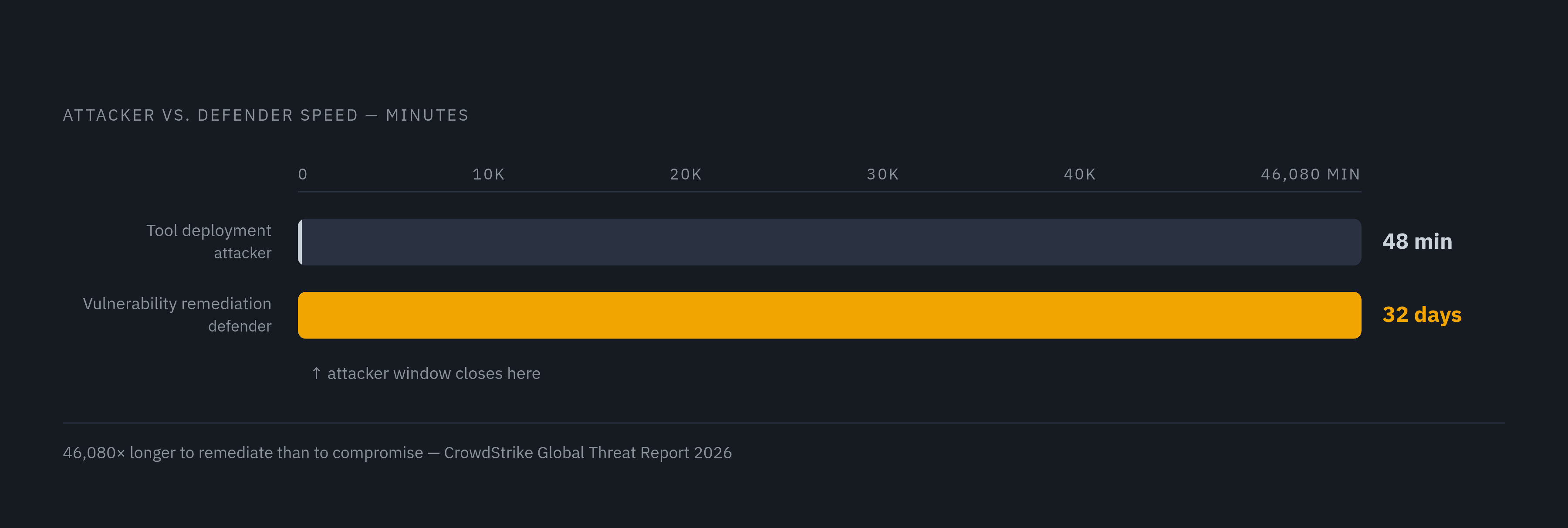
CrowdStrike's Global Threat Report 2026 puts average time from initial access to deployment of malicious tools at 48 minutes. Most manual review cycles require a person to eyeball an alert before deciding whether to act, and haven't even started by the time that window closes.
Exploited vulnerabilities ranked as a leading root cause of ransomware in 2025, with a median time to remediate of 32 days. Some of those vulnerabilities got exploited on day zero, before a patch even existed. The 48-minute attacker window makes the math stop looking like a gap. It looks like an open door with the address posted online.
Palo Alto Networks' Unit 42 Global Incident Response Report found identity-related factors present in 89% of incidents and endpoints in 61%. These are the predictable attack paths, the ones partial automation leaves unguarded because its coverage stops at OS patching and misses everything else.
Picture the actual moment inside a lean team: an alert fires, someone wants a second look before acting, and nobody's entirely sure who has authority to isolate the affected machine. That hesitation is completely human, and it's exactly the delay the 48-minute window is built to exploit. Tool sprawl makes it worse. Teams running 16 or more disconnected tools report 50% high burnout, compared to 17% for teams running five tools or fewer. Burned-out responders move slower, and slower responders are the ones who lose the 48-minute race.
Genuine enforcement coverage versus dashboard reporting
"Unified" gets thrown around loosely. In an actual unified platform, it means one data layer, not one login screen bolted onto five separate backends. Patch compliance, monitoring alerts, device inventory, and help desk records all draw from the same source, so a compliance report takes minutes to generate instead of days of manual reconciliation.
Real enforcement coverage needs three things true at once, not just one. Every device in the asset inventory has to be actually reachable by the enforcement mechanism first. Cloud-native agents that talk over HTTPS without needing a VPN connection matter here, because a patch workflow built around VPN reachability can't touch every device in a hybrid workforce. The laptop that never connects to the office network doesn't get patched, no matter how good the tool is.
Policy also has to apply the same way across platforms. A tool that manages Windows down to the registry key but only offers a thin policy set for macOS creates a blind spot, and that blind spot becomes visible in an audit the moment an auditor goes looking for it.
And alerts have to resolve into action instead of sitting in a queue. Enforcement means the control actually changes the state of the device. Logging a finding isn't fixing it, even though plenty of dashboards report the two as if they're interchangeable.
None of this replaces governance. Knowing what assets exist, applying protections the same way across the fleet, defining who triages a suspicious alert and how fast: these are process questions, and no product answers them on its own. A useful gut check for any lean team: if a new laptop joined the fleet yesterday, how long before it shows up in the dashboard with the right policy applied and patch status confirmed? Whatever that answer is, it is the real coverage latency sitting apart from the number on the dashboard.
Prioritizing gap closure without a dedicated security team
Close the gaps attackers actually use before spending time hardening against rare, sophisticated scenarios. Unit 42's 2025 incident data shows phishing accounted for 22% of initial access, making it one of the leading entry points alongside vulnerability exploitation. Identity and patching deserve the first dollar spent, not the tenth.
Start with identity, because more incidents begin with a stolen or misused valid credential than with some exotic zero-day. That means phishing-resistant MFA across every user, conditional access policies that check device health and user risk before granting access, and lifecycle automation that pulls access promptly when someone leaves the company. That last one is a policy failure as much as a tooling one, and it's cheap to fix once someone actually owns it.
Then patch what's already known to be dangerous. CISA's Known Exploited Vulnerabilities catalogue is a prioritized to-do list, already ranked by real-world exploitation. Third-party applications on that list get patched before anyone goes hunting for something more exotic.
A practical approach sequences the work across three phases. First: inventory every identity, disable dormant accounts, enforce MFA everywhere, block legacy authentication protocols that skip MFA. Next: build conditional access baselines and require a compliant device before anyone touches sensitive resources. Finally: classify data, restrict external sharing, start monitoring for policy violations and adjust as issues come up. Governance stops being a slogan at that point, because it's now something you can measure and check.
None of this holds without the safeguards that make teams trust automation enough to extend it. The 2026 State of Endpoint Management Report lists the top requirements teams demand before expanding automated processes: automated rollback, pause and override controls, role-based access control with audit logging. Building those in first tends to fade the resistance to automating further on its own.
Consolidating the stack as the lever that makes the other fixes stick
Disconnected tools produce disconnected enforcement. The seams between monitoring, patching, and ticketing are a structural fact. The seams between monitoring, patching, and ticketing don't close because someone configures each tool more carefully. They persist because the tools were never built to share one source of truth.
The 41% of IT and security professionals reporting direct security risk from poor tool integration reflects a widespread experience for teams running more than a handful of point products stitched together over the years.
Consolidation fixes this at the root. A single data layer keeps patch status, alert history, and device inventory in sync on its own, so compliance evidence is live data sitting in one place, ahead of any reconciliation project that starts three weeks before every audit. Cloud-native architecture also reaches full fleet coverage in days instead of the weeks it takes to stand up on-premises distribution infrastructure, and speed of deployment translates directly into speed of enforcement. Fewer tools means fewer seams where a vulnerability can sit unnoticed for months. The burnout numbers say the same thing from a different angle: 17% high burnout among teams running five tools or fewer, against 50% among teams managing 16 or more.
For an organization without a dedicated security team, that difference isn't a nice-to-have. The reconciliation overhead of a fragmented stack is exactly the kind of ongoing labor a small IT staff can't absorb indefinitely, month after month, without something else slipping. A platform that folds device management, identity, and compliance enforcement into one enforced state is the structural fix for the coverage gap this whole piece keeps circling back to.
Consolidation doesn't replace governance, either. It creates the conditions where governance can actually get enforced the same way, on every device, every time, instead of existing as a document nobody checks against reality. That consistency is what the dashboard was claiming to show all along. Closing the gap means making the claim true.
Sources
- 12 Best Unified Endpoint Management Tools for IT Teams (2026) | Syncro
- The State Of SMB Cybersecurity In 2026: Key Trends And Predictions - Cyber Defense Magazine
- Your security stack looks fine from the dashboard and that's the problem - Help Net Security
- Endpoint Security Australia: 7 Critical SMB Gaps in 2026 - Adept IT Solutions | IT Service and Support Newcastle, Hunter and Central Coast
- Half-Automated, Fully Exposed: Endpoint Management Hits a Wall in 2026